Justine

Some two hundred years before Lawrence Durrell offered readers a blank page to represent silence – perhaps inviting us to interpret that of Clea – Lawrence Sterne, in “The Life and Opinions of Tristram Shandy, Gentleman”, invited us to paint on his a likeness of a chosen beautiful mistress.

Durrell’s page is followed by a list of Workpoints as perhaps for a notebook, which may explain my ambivalence about “Justine”, the first of his acclaimed Alexandria Quartet, to which I have returned after perhaps 40 years of forgetfulness.

The writer’s cornucopia of abundantly luscious prose exploring the nature of love and lust in the context of a portrait of a suffocating city is indeed engaging. The mistresses described by the anonymous narrator are as beautiful as those suggested by Sterne. His descriptions of the nature of Alexandria shortly before World War II are packed in verbally delightful, yet economical, sentences.

My problem is that for me the work itself reads like a notebook in which I seek to follow a narrative of the interwoven lives of a variety of very passionate protagonists unable ultimately to commit, over periods of time to those they truly love, and consequently seem doomed to remain unsatisfied. Durrell has maybe captured the experience of many of us.

I am pleased that I was prompted to revisit this work by https://shoreacres.wordpress.com/2023/01/30/the-threshold-of-imagination/

Linda is an intelligent, resourceful, respected blogger. She has put much more layers of thought into her review highlighted above than I have managed in mine, no doubt the result of her repeated returns to it. In the interests of reasonable balance I would recommend reading what she has to say.

The Betrothed

This paragraph from https://viewfromtheback.com/2023/01/20/fridays-tall-tales-3/ by Sheree:

“Manzoni’s masterpiece, I promessi sposi, 3 vol. (1825–27), is a novel set in early 17th century Lombardy during the period of the Milanese insurrection, the Thirty Years’ War, and the plague. It is a sympathetic portrayal of the struggle of two peasant lovers whose wish to marry is thwarted by a vicious local tyrant and the cowardice of their parish priest. A courageous friar takes up the lovers’ cause and helps them through many adventures to safety and marriage. Manzoni’s resigned tolerance of the evils of life and his concept of religion as the ultimate comfort and inspiration of humanity give the novel its moral dimension.The novel brought Manzoni immediate fame and praise from all quarters, in Italy and elsewhere.”

took me back to my copy of this work, last read in 1969.

Enough time had passed for me to have entirely forgotten the book’s story, so I am grateful to have been prompted to revisit this work which is so much more than the echoes it bears of Scott, Thackeray and Dickens. The text contains by quotation an acknowledgement of his debt to Shakespeare whom he judges to be a master of feelings and the human heart.

Just as we, often too early, are expected to read and learn quotations from the Swan of Avon, so Italian children do the same with this novel. Just as gems from Shakespeare have entered our language and are often quoted without knowing the source, so it is with what we have translated as “The Betrothed”.

Considered as a linguistic influence on the Risorgimento, Manzoni died just before the reunification of the various states of the Italian peninsular.

As he set out on this project which was to occupy the central years of his life, the author expressed his aims and his reason for choosing the Counter Reformation period as his major focus, in a letter to a friend: “The memoirs we have from that period show a very extraordinary state of society; the most arbitrary government combined with feudal and popular anarchy; legislation that is amazing in the way it exposes a profound, ferocious, pretentious ignorance; classes with opposed interests and maxims; some little-known anecdotes, preserved in trustworthy documents; finally a plague which gave full rein to the most consummate and shameful excesses, to the most absurd prejudices, and to the most touching virtues.” This gives an example of his flowing prose, reflecting his passion, reason, and humanity.

He certainly resembles Shakespeare in his mastery of characterisation; his understanding of a wide range of human nature, its conflicts, its strengths, its weaknesses, and its capacity for tenderness, loyalty, and overcoming obstacles. His insight into the minds and emotional life of his persona is more complex than that of Dickens, whose grasp of history he matches.

In fact his research into the events of the period are so thorough as to make this central section somewhat tedious. He explains his purpose for its inclusion as offering essential insight into the life situations of his protagonists.

His subtle humour pervades the book. Either Manzoni himself or our translator favours simile over metaphor, as evidenced by plentiful examples in much excellent, at times poetic, detailed description of urban and rural life and contrasting environments; in particular the distressing effects of living and dying through famine, war, strikes, and plague. We are given insight into mob psychology, which the author gained from personal experience. This was a time of social disruption, violence, and turmoil.

The resilience of the betrothed pair is admirable in their circumstances, affected as they are by the conflict between church and state, and by blind faith, as well as staunch belief in each other.

Manzoni’s own struggle with Catholicism, to which he returned in later life, perhaps influenced the sudden change of heart and behaviour of the Unnamed, who forges a beneficial relationship with a revered Cardinal.

I hope I have not given away too much of the story to spoil it for any readers who may wish to follow my recommendation and pick up the book for themselves.

My 1969 edition is that of The Folio Society. The translator, who has provided a valuable and informative preface, is Archibald Colquhoun. I would be unable to read the original but this does seem to be a faithful rendition.

Here is the frontispiece and Title Page.

The sharply lined and detailed drawings by Eric Fraser have the incised quality of such as scraper board.

Droll Tales 30

By returning to the “Beautiful Imperia” whose tale introduces these stories, Honoré de Balzac has travelled full circle in the last, “The Married Life of Fair Imperia”, which tracks our heroine’s transformation from haughty beauty making the most from her charms, certainly not freely given, yet widely distributed among the rich, into a faithful wife in love for the very first time.

From continuous festivities she turns to staunch constancy with her equally devoted, much younger, husband who she does not wish to see her grow old, despite his conviction that, as Shakespeare puts into the mouth of Mark Antony’s friend Enobarbus, “age cannot wither her, nor custom stale her infinite variety”.

I will say no more for fear of spoiling the author’s swansong.

Mervyn Peake has produced one drawing for the Folio Society edition;

and Gustave Doré provides his own veritable swansong for The Bibliophilist Society.

Further details of the publications are given in https://derrickjknight.com/2023/01/06/droll-tales-1/except that there are no pictures here by Jean de Bosschère as I do not have any of the third Decade by him.

Droll Tales 29

This, the shortest tale in the collection, occupying not much more than two pages of text, has no illustration in The Folio Society edition and just one small one in The Bibliophilist Society’s production.

It is, to my mind, the neatest gem with a play on two kinds of “Innocence”.

Here are the drawings of Gustave Doré for the second society above.

Further details of the publications are given in https://derrickjknight.com/2023/01/06/droll-tales-1/except that there are no pictures here by Jean de Bosschère as I do not have any of the third Decade by him.

Droll Tales 28

The Folio Society’s “The Unwise Chatter of Three Pilgrims” seems the title that best matches this story of Balzac’s. The Bibliophilist Society gives “Odd Sayings…..”

The sayings’ oddness stems from the fact that on their way to Rome to pay in kind for their sinful lives they “let their tongues wag freely” in the hearing of a serving girl in the inn where they stopped for rest and refreshment, thus each revealing their hidden treasures about their person with which they hoped to redeem their mortal misbehaviours. In revealing the inevitable outcome the author employs a wealth of double entendres exemplified by his last sentence: “This goes to show that in public inns we should keep our tongues between our cheeks.”

Here is the illustration of Mervyn Peake for Folio;

and those of Gustave Doré, who must have been running out of inspiration, for Bibliophilist.

Further details of the publications are given in https://derrickjknight.com/2023/01/06/droll-tales-1/except that there are no pictures here by Jean de Bosschère as I do not have any of the third Decade by him.

Published
Categorised as Books

Droll Tales 27

The Folio Society entitle story number 27 in this series “About a Beggar known as Old Parchemins”. The Bibliophilist Society adds a hyphen to their version, in Par-Chemins thus clarifying the origin of the nickname which could be translated as “about the roads”, because that is where this homeless vagrant was always to be found.

I find this a story of two halves, in that, after squandering an inherited fortune this man wandered the roads studying “philosophy in a bird school” where we are treated to the author’s straightforward delightful descriptions of the lanes and their avian residents. We are then shocked, as was his sleeping victim by this aged gent’s sudden rape of a young woman, and the familiar prose of double entendre takes over.

We have learned about Parchemins’s success in gambling with dice; was he to succeed in gambling with his sexual prowess to save him from the gallows?

Here is Mervyn Peake’s illustration for The Folio Society:

and those of Gustave Doré in the other publication.

Further details of the publications are given in https://derrickjknight.com/2023/01/06/droll-tales-1/except that there are no pictures here by Jean de Bosschère as I do not have any of the third Decade by him.

Droll Tales 26

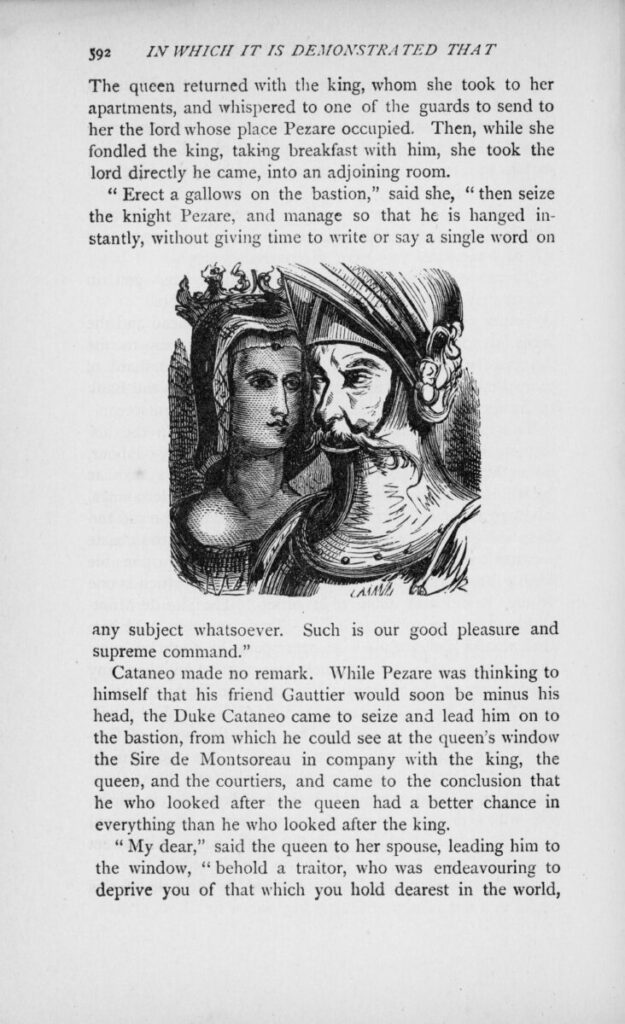
In this sixth story of the third Decade of Honoré de Balzac’s humorous tales, entitled by The Bibliophilist Society “In which it is demonstrated that Fortune is always Feminine”, the writer seems to have drawn the general from the particular.

False friendship, deception, and trickery are the tools of rivals for Royal pleasure – that of the King and of the Queen. It seems to me that no-one really comes off best anyway, certainly not the fair lady.

The Folio Society did not include any drawings from Mervyn Peake, so, given that I don’t have any from Jean de Bosschère

we have only Gustave Doré’s interpretation, in The Bibliophilist Society’s publication, dated 1874, just 37 years after first publication by Gosselin of Paris, and the first in English. At some point the volume has been skilfully rebound, but the pages are clear and undamaged.

Droll Tales 25

A short tale with the author’s customary salacious double entendres this story describes how the young lady, with the help of the maid, outwits the magistrate attempting to wriggle out of a finding of rape because of the perpetrator’s wealth and standing at Court. The Folio Society entitles the tale “How the Portillon Beauty Scored over the Magistrate”; for The Bibliophilist Society it is “How The Pretty Maid of Portillon convinced her Judge”.

Here is Mervyn Peake’s illustration for the first of these;

and Gustave Doré’s for the second.

Further details of the publications are given in https://derrickjknight.com/2023/01/06/droll-tales-1/except that there are no pictures here by Jean de Bosschère as I do not have any of the third Decade by him.

Droll Tales 24

“Bertha the Penitent” according to The Bibliophilist Society is the 24th story in Balzac’s set; The Folio Society entitle it “Magdalene Bertha”.

Bertha’s first conception, within marriage to a much older man, was not technically immaculate, but it might as well have been as she had no real idea of how it had happened, and was certainly ignorant of any sexual delights. With less suggestive wordplay than is his wont, the author relates how the very young woman was tricked into learning the joy of sex, and the inevitable consequence. Shocked to learn the truth of her behaviour, she forces herself and her lover into celibacy over the next dozen years. I will not report the eventual outcome.

Here is Mervyn Peake’s drawing for the Folio Society:

and those of Gustave Doré for the Bibliophilists

Further details of the publications are given in https://derrickjknight.com/2023/01/06/droll-tales-1/except that there are no pictures here by Jean de Bosschère as I do not have any of the third Decade by him.