which was undergoing work on the roof as we arrived.
I first featured their ancient farm cart in https://derrickjknight.com/2020/09/11/do-not-climb/
Here are some more details from this visit. With its injunction warning customers against climbing on this vehicle of a past age, it lies alongside the car park, its wooden boards slowly degenerating; self-seeded plants seeking nourishment from a build-up of soil and other materials; its powerful iron fittings protected from the ravages of time by the patina of rust or of red paint.
These garden obelisks are some of the many artefacts on sale in the yard.
As we turned into Ringwood Road on our journey home a grinning cyclist passed us from ahead.
The reason became apparent around the next bend where donkeys blocked the road;
pannage pigs foraging a little further on kept to the verge.
This evening, begging porcine forgiveness, we dined on Mediterranean style pork chops (with paprika, garlic, and a little chilli); crisp roast potatoes, some sweet and softer; crunchy carrots; tangy red cabbage; and tender green beans with which Jackie drank Hoegaarden and I finished the Malbec.
The overnight gales offered us a brief respite this morning, during which the
sun was permitted an appearance and the rain lessened. This was not to last, but we were fortunate for a time during which we ventured into the forest.
A dip in the landscape as we head towards Burley from Holmsley Passage, dry until recently has filled with water the surface of which ripples with reflections while fat, pendulous, raindrops slip from the branches above, sending ever increasing circular patterns into play.
Clay Hill is closed to traffic when small birds are nesting among the undergrowth. Today its own pond was fuller than it has been so far this year.
It, too, reflected the surrounding woodland,
containing dripping rose hips.
On the moorland to our left as we drove back down Holmsley Passage, several damp ponies enjoyed a small spot of sunshine, while
a fire on the opposite side of the lane seemed to be a bout of controlled burning of gorse.
This evening we dined on more of Jackie’s pasta Bolognese, this time with stir fried vegetables al dente. I drank more of the Malbec while the Culinary Queen, Flo, and Ellie, all abstained.
Regular readers will know that Martin, our skilled and knowledgeable garden helper works in all kinds of weather. Current renewed gales were, however, enough to keep him away today.
When Flo and Ellie returned from two weeks with Becky and Ian we were struck by how animated and engaged she had become in that short space of time.
Here she utters sounds akin to speech of sorts, and waves her hands and feet about, tracking her elephant with her eyes as Jackie moves it backwards and forwards across her line of vision.
Parents of a certain age will recognise the introduction of the repetitive earworm “Stick”, associated with Hey Duggie!’s stick insect character. Ellie’s response to him is an indication of how in tune with the needs of their audience of pre-verbal children are the creators of the TV programme.
This morning, as I rose to my feet to fetch my camera to photograph her playing in her recliner,
she turned to give me a smile. Despite all her mother’s best efforts to keep her nails short she has managed to scratch her face for the first time – always distressing for a parent.
At the foot of Ellie’s recliner is fixed a panel which relays various sound effects.
When she triggered these with her own kicking feet
she looked bemused, as if she wondered where that had come from.
This evening we dined on Jackie’s penne pasta Bolognese with grated Parmesan cheese, green beans and broccoli. The Culinary Queen drank Hoegaarden and I drank Mendoza Malbec 2020.
Early this morning we transported an old office chair, an old radiator, some rusty artefacts and some CDs to the Efford recycling centre. They took the chair into the reuse shop but not the large collection of CD films which went straight into a container bin because “no-one wants those any more”.
We then drove on to the moorland section of Hatchet Pond around which I walked with my camera.
Someone had taken a bite out of a large mushroom beside a freshly budding gorse bush;
further golden fungus consorted with lime coloured lichen scaling the fractured stump of a dead tree.
Pearly dewdrops twinkled on the grasses.
We wondered whether the burgeoning blackberry blossom was early or late.
Autumn leaves floated above reflections of branches which had shed them;
mallards paddled over others.
A child had probably limped home on one boot.
Dogs accompanied their people on either side of the main stretch,
and an image-conscious coot checked over its appearance from the bank.
Thinking that it must be of a similar quality to MacDonalds, I have always been prejudiced against KFC. For tonight’s dinner I was persuaded that this fast food was more tasty than the former. We therefore dined on it and I was converted. Jackie and Flo both drank Diet Pepsi, while I finished the Cabernet Sauvignon.
further along which, fenced woodland to our left had suffered more fallen branches;
to our right stretched fields on which distant domesticated horses grazed;
forest ponies with one growing foal enjoyed the freedom of the road and its verges,
beyond which a variety of cattle basked in the balmy weather as I stood without the need of a jacket.
As we neared Burley a pair of Oxford Sandy and Black pigs snuffling for mast brought intrigued drivers to a watching standstill.
Even as we neared midday the Holmsley Passage landscape
bore twinkling, lingering, dewdrops.
A trio of the many cyclists enjoying the weather crossed the junction with the disused train track, its path one of the consequences of the Beeching era.
Those commemorated at the Remembrance Day parades mentioned above would never enjoy such post-war autumnal days.
This evening we dined on succulent roast chicken; flavoursome sage and onion stuffing; crisp Yorkshire pudding and roast potatoes; crunchy carrots; firm cauliflower and broccoli; tender runner and green beans; and meaty gravy, with which I drank more of the Cabernet Sauvignon, Jackie drank diet cola, and Flo drank water.
This morning I watched the Women’s rugby World Cup final between England and New Zealand.
This afternoon we took a forest drive on which I focussed on some poppy displays.
This one is at Everton;
this one at Boldre Memorial Hall at Pilley;
and this one against the wall of the Parish Church of St John the Baptist at Church Lane, Boldre,
where can be found several gravestones bearing
inset Death Pennies. My speculation is that the parents of the two young men featured kept these tribute plaques in a treasured place until they followed them in death and joined them in their burial plots.
‘The Memorial Plaque [so named] was issued after the First World War to the next-of-kin of all British Empire service personnel who were killed as a result of the war.
The plaques (which could be described as large plaquettes) about 4.72 inches (120 mm) in diameter, were cast in bronze, and came to be known as the “Dead Man’s Penny”, because of the similarity in appearance to the much smaller penny coin which itself had a diameter of only 1.215 inches (30.9 mm). 1,355,000 plaques were issued, which used a total of 450 tons of bronze,[1] and continued to be issued into the 1930s to commemorate people who died as a consequence of the war.[2]‘ (Wikipedia).
‘It was decided that the design of the plaque, was to be chosen from submissions made in a public competition. Over 800 designs were submitted [1] and the competition was won by the sculptor and medallistEdward Carter Preston using the pseudonym Pyramus, receiving two first place prizes of £250 for his winning and also an alternative design. The name Pyramus comes from the story of Pyramus and Thisbē which is part of Ovid‘s Metamorphoses, a Roman tragedynarrative poem.[3]
Carter Preston’s winning design includes an image of Britannia holding a trident and standing with a lion. The designer’s initials, E.CR.P., appear above the front paw. In her outstretched left hand Britannia holds an olive wreath above the ansate tablet bearing the deceased’s name cast in raised letters. Below the name tablet, to the right of the lion, is an oak spray with acorns. The name does not include the rank since there was to be no distinction between sacrifices made by different individuals.[1] Two dolphins swim around Britannia, symbolizing Britain’s sea power, and at the bottom a second lion is tearing apart the German eagle. The reverse is blank, making it a plaquette rather than a table medal. Around the picture the legend reads (in capitals) “He died for freedom and honour”, or for the approximately 600 plaques issued to commemorate women, “She died for freedom and honour”.[1]
They were initially made at the Memorial Plaque Factory, 54/56 Church Road, Acton, W3, London[2] from 1919. Early Acton-made plaques did not have a number stamped on them but later ones have a number stamped behind the lion’s back leg.[2][4]
In December 1920 manufacture was shifted to the Royal Arsenal, Woolwich. Plaques manufactured here can be identified by a circle containing the initials “WA” on the back[1] (the “A” being formed by a bar between the two upward strokes of the “W”[5]) and by a number stamped between the tail and leg (in place of the number stamped behind the lion’s back leg).[2][4]
The design was altered slightly during manufacture at Woolwich by Carter Preston since there was insufficient space in the original design between the lion’s back paw and the H in “HE” to allow an “S” to be inserted to read “SHE” for the female plaques. The modification was to make the H slightly narrower to allow the S to be inserted. After around 1500 female plaques had been manufactured the moulds were modified to produce the male version by removing the S.[2]
The plaques were issued in a pack with a commemorative scroll from King George V.[6] Sometimes the letter and scroll were sent first.’ (Wikipedia).
Had these people from earlier generations not made the ultimate sacrifice it is possible that
neither I nor the friendly young couple I photographed conversing with an alpaca in Rodlease Lane would have existed to remember them,
as do the parishioners of Pennington Parish Church.
The knitters of the postbox on Wootton Road have made their own visual tribute.
Late this afternoon Becky returned to her home in Southbourne.
We dined with Flo on second helpings of last night’s Red Chilli takeaway with which Jackie drank Hoegaarden and I drank Coonawarra Cabernet Sauvignon.
The Modus was ready for collection early this morning and we celebrated with a forest drive.
Just after I had photographed mushrooms and autumn leaves on a roadside at Arden Tyrell a truck driver stopped to ask if we needed any help. There followed a pleasant discussion and a scroll through the pictures of mushrooms I his camera. He sad people said he was mad for doing this. I replied that he was as mad as me.
I pointed across the road, telling him that I also photographed woodland scenes.
I pictured more from around the Smugglers Road car park
including a bay pony blending with the autumn colour.
While looking down from Beechwood Lane onto Lester Square
I admired the thick, twisted, roots of a large lichen covered eponymous tree.
This evening we all dined on Red Chilli’s excellent takeaway fare. My main course was Tandoori King Prawn Naga with Special Fried Rice; we shared peshwari naan. Jackie drank Hoegaarden and I finished the Bordeaux.
I spent much of a dull but dry day finishing my second reading of
prompted by the ‘Richardson’s Novels’ essay in Leslie Stephen’s ‘Hours in a Library’, in which he praises this as the best of the author’s works.
Originally published in serial form during 1747-48, then in eight bound volumes, The Folio Society edition has been packed into two volumes comprising
1,500 tightly compressed pages containing well over a million words, of which this is an example.
If you are able to cast your mind back almost 300 years to a time without television soaps, with no internet, devoid of printers or photocopiers; when reading was done by candlelight and sedan chairs served as taxis; if you are satisfied with the leisurely journey offered by the lengthy prose which entertained those of that era you may well be entranced by this novel.
If you enjoy a fast pace of economical language leading to a quick conclusion; if you prefer watching your serials on streamed television freeing you from deferred gratification before you race ahead to the next, you probably wouldn’t last the course.
Yes, this is a long haul, and perhaps you would need to be an ex-marathon runner forced to slow down to take it on. The first time I read it I was commuting for an hour and a half each way on an intercity train.
Nevertheless this tragic tale presented in the form of exchanges of letters of varying lengths relaying differing perspectives on the same events is in fact compelling reading, if you don’t nod off. It is difficult to write without spoilers – as regular followers will know I try not to reveal the story, but perhaps I can point out that Richardson begins and ends with a duel, an example of his neatly tying up all the strands.
Each of the main protagonists details events and their inner thoughts to a trusted friend with whom they are not necessarily in agreement. Thus morals, honour, deception and devious devices are explored. The language, grammar, and sentence construction is not so different from today, but it is necessary to understand how the writers express themselves. Several copies of the correspondence were sometimes made and passed backwards and forwards to recipients. All this without modern reproductive devices.
A woman, once married, had no rights to property – any she owned became that of her husband, whom she was bound to obey. Although there is now no uniform marriage service in UK it is only 100 years since the female partner was no longer expected to “obey”. Jackie and I can’t quite remember, but we believe that when we first married in 1968, she vowed to obey me; not so in 2017.
It can be seen then, that one motive for marriage was the acquisition of assets and thus the potential enrichment of a family. This is one of Richardson’s themes, as is the domination of the husband.
Angus Wilson’s introduction to this edition is knowledgable and informative.
I am still limited in the number of illustrations I am able to include in posts, so I cannot feature every one of Simon Brett’s drawings.
This one ‘Meeting at Dusk’, appears opposite the sample page 166 above, which conveys the lady’s sensible mistrust.
‘Mr Solmes at Breakfast’ accurately conveys the oppressive atmosphere;
while ‘Miss Howe Writes a Letter’
has, on the reverse, an indication of the deception being employed.
Skilled as these illustrations are, they are rather too evocative of the text for me to include some of the more upsetting ones.
Late this afternoon Becky brought Flo and Ellie home and stayed the night.
We dined on another of Jackie’s shepherd’s pies with similar vegetables as yesterday with which she finished the Sauvignon Blanc, I drank more of the Douro, and the others abstained.
Looking out of the French windows showed me that Jessie’s moon butterfly solar light, deprived of the sun for three days of gales, can be expected to glow once more after dark, this evening, and
our pair of bird cruets on the kitchen shelf display beneath shadows on the wall led me to wander around the garden on the first of two days while the car is in hospital following an M.O.T. test.
Speaking of hospital I received a message from Boots Opticians saying I was not eligible for cataract surgery. Upon my enquiry this translated as my vision is not yet bad enough. I hadn’t thought it was.
The front fence provided a canvas for the shadow of a chair back,
as did the wooden poppy for those of roses.
Stronger sun than we have seen of late tipped the edges of fluffy clouds and
silhouetted some trees and shrubs, while
a few golden leaves still clung to the Weeping Birch.
The winter Clematis Cirrhosa also caught the sun,
which burnished one of the dead stumps flanking the Back Drive.
This evening we dined on Jackie’s wholesome shepherd’s pie with onion, tomato, and onion additions to the creamy mashed potato topping; crunchy carrots; firm cauliflower, and tender runner beans, with which she drank more of the Sauvignon Blanc and I drank Azinhaga de Ouro reserva 2019
Jackie and I spent most of the morning in Boots Opticians in New Milton where we bought new specs for her and I was advised that a cataract operation would be in order.
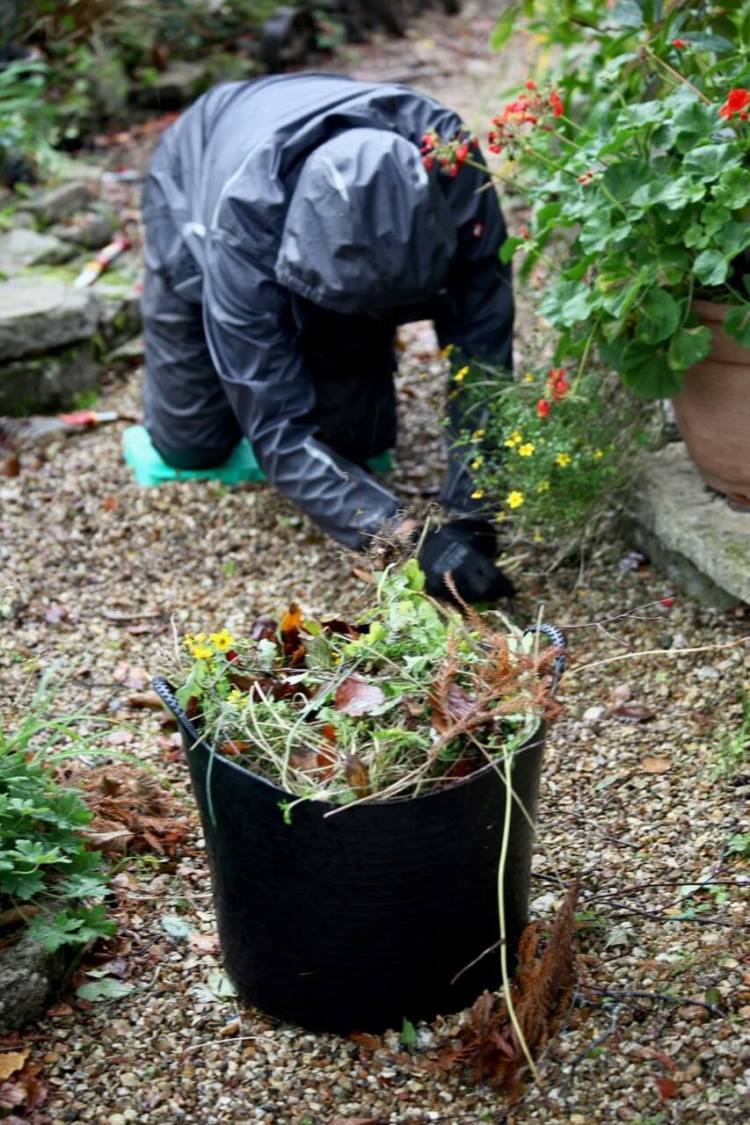
Martin, in the meantime, battled the gales to make far more progress on tidying the garden, and in particular
weeding the Gazebo Path.
Where’s Martin? (3).
Wind swept
the Cordyline Australis
and the Weeping Birch, stripping the latter of the last of its leaves.
In the afternoon the washing machine we bought last week was swiftly and efficiently fitted and the old one taken away.
Later Elizabeth and Jacqueline dropped in for a chat in which we sorted out international and national politics. They didn’t stay for dinner because they had enjoyed a substantial late lunch at Rosie Lea Tea Rooms.
Jackie and I dined on Chicken Kiev, chips, peas, and sweetcorn with which she drank Hoegaarden and I finished the Bordeaux.