Literature And Western Man

“J. B. Priestley, (born Sept. 13, 1894, Bradford, Yorkshire, Eng.—died Aug. 14, 1984, Alveston, near Stratford-upon-Avon, Warwickshire), British novelist, playwright, and essayist, noted for his varied output and his ability for shrewd characterization.” I begin with this extract from https://www.britannica.com/biography/J-B-Priestley which gives details of the author’s life and more than 120 books across these varied genres. I concluded my reading of this today.

For the purposes of this study literature may be defined as written work of influential artistic merit, embracing poetry, drama, and novels.

In his brief introduction to this lengthy, yet remarkably readable book the author states “The term ‘Western’ in my title……is used in the old geographical and cultural senses, to show that Russia is included as well as America, and that all Asia is excluded…….”our story begins in the second half of the fifteenth century”. 1939 is the year he chooses to close.

“This is not a work of scholarship”, he continues, and “strictly speaking, this is not a literary history, although at a pinch it could be used as one.” He is writing for the reasonably intelligent and sensitive  ordinary people “who enjoy most good literature, but, for one reason or another, are rather wary of it.”

Each of the five parts begins with Priestley’s take on the age. Having regard to the cultural, political, religious, and technical developments he then identifies those artists he considers to have exercised the most significance on the writers of that period. William Caxton’s printing press, for example, made books more plentiful during the start of the first section; Machiavelli influenced the Italian political scene; Rabelais and Montaigne, in their different ways, led French writing; Shakespeare, in English, left his dramatic mark on the world.

Priestley speaks of how each influential writer of his choice interrelates with his contemporaries across the Western nations. He describes how the changes wrought by prevailing religious beliefs affect or control literary thought and execution; how political constraints, for example those in post revolutionary Russia, can severely restrict the freedom of writers; the First World War’s cutting off the supply of young talented writers who would never reach their maturity. George Sand of France and England’s George Eliot had to write as men because of prevailing views about women writing; my favourite Mrs (Elizabeth) Gaskell wrote as a married woman, just as Mrs Beaton wrote her Book of Household Management – neither of which does Priestley mention, but we’ll forgive him that, especially as the latter is not a recognised work of art.

We see the movement in fashions from the dominance of poetry and drama to the rise and decline of the novel.

Expressed at publication in 1960, the writer’s concerns about the condition of humanity, could almost be applied – magnified – to our current age.

Priestley has a largely balanced and insightful view on a wide range of writers whom he features at varying lengths according to their impact on their periods and acknowledged statuses. He distinguishes between talent and genius, maintaining that they are best combined. Although not condemning her work, “for even in her least successful novels there are wonderful passages”, he describes Virginia Woolf as “perhaps with more innate genius than solid talent”. For obvious reasons, William Shakespeare gains the most coverage; William Butler Yeats, also blessed with longevity, is a 20th century Irish poet of considerable standing; Dostoevsky, Tolstoy, and other Russian giants take their positions; Scott Fitzgerald of America loses his early promise, while Mark Twain fares somewhat better.

The scope of our author’s wide international range of reading and skill of his analyses are breathtakingly impressive. That he presents them in such a fluid and insightful style that certainly reaches this ordinary, non-academic, general reader, is most enjoyable. Naturally I cannot test all his opinions, but on those works or writers that I do know I mostly agree. For example I really find the American Henry James, with whom I felt I might have an affinity because of his focus on the internal lives of his subjects, dull and boring, so I would happily concur with Priestley; on the other hand his opinion of Jane Austen, my dislike of whom is based on my youthful reading, might prompt me to revisit her. He has given such eloquent descriptions of writers, such as the Danish dramatist, Strindberg, whom I have never met, that I feel I know them.

There is a useful and informative appendix of Brief Biographies of selected writers.

Well, that has taken care of another day of constant rain.

This evening we all dined on pork spare ribs in barbecue sauce on a bed of Jackie’s colourful savoury rice, with which she drank Hoegaarden and I finished the shiraz.

Always Remembered

On this sun-bright morning we stopped driving for two minutes at 11 a.m. and gave a thought to the fallen.

This is how children passing through Hordle Primary School will remember.

On our survey of likely locations for the displays we drove down Vicarage Lane, but not the made up lane crossing Sky End Lane.

It was along Kings Farm Road that we stopped to arouse the curiosity of several inquisitive sheep.

St. Mark’s Church in Pennington had not forgotten.

Almost directly opposite this message lies a most dangerous pothole. Hopefully someone will remember to fix it before long.

The blue flowers on the Bodre War Memorial Hall, situated at Pilley celebrate the memory of the many animals sacrificed in conflict.

Donkeys, including a thirsty foal, basked in the midday warmth beside

woodland harbouring a squirrel photographed by Jackie who also pictured the last of the donkeys above.

The backlit autumn leaves and the holly close up are mine; the next two images of holly berries and autumn oaks are Jackie’s.

The Commonwealth War Graves society combined forces with St Mary the Virgin church at South Baddesley.

The signpost at Everton Road displayed poppies around its base.

Before dinner I came to the brink of completing my reading of “Literature and Western Man”.

We then all enjoyed another of Jackie’s beef and onion pies with the same range of vegetables and even meatier gravy than yesterday. The Culinary Queen drank Hoegaarden and I drank more of the Malbec.

The Rain Kept Off

Today was forecast to be another of sunshine and showers, so we drove out early for a brunch at Hockey’s Farm Shop. In the event, although rain threatened on the way out

through Walkford,

along Ringwood Road,

along flooded and reflecting Gorley Road where skies were blue, and maple leaves sunlit;

and on our post prandial return along Roger Penny Way,

Lyndhurst Road,

and from sun-tipped clouds above Lyndhurst we felt none, although leaves swirled about like golden showers and acorns and other mast clattered upon the car roof.

The clear water at Ibsley Ford sped under and over the bridge,

offering vehicle drivers the opportunity for a free car wash, while

a sunny interval dappled the nearby woodland.

Gleeful Gloucester Old Spots at North Gorley, joined on the road by a friendly equestrienne, rejoiced in collecting much of the earlier mentioned mast in the continuing pannage season.

After enjoying her Laura’s favourite meal Jackie satisfied herself with photographing the cakes and hollyhocks at Hockeys, before visiting the aviary and focussing on some of the residents, namely

a zebra finch, a cockatiel, several diamond doves, and three cuddly budgerigars.

Needless to say, I didn’t manage to finish reading Priestley, but I did cover a lot more.

This evening we all dined on Jackie’s succulent, well filled beef and onion pie beneath firm short crust pastry; crisp roast potatoes; carrots, cauliflower, broccoli and Brussels sprouts, well timed to arrive al dente together, and meaty gravy with which the Culinary Queen drank Peroni and I drank Chilean Reserva Privada Malbec 2022.

To Be Read

Picking up Priestley’s lengthy yet immensely readable “Literature & Western Man”, for a short spell after lunch I found myself still engrossed at dinnertime. One useful benefit is that it is pointing me towards a To Be Read list of unread or forgotten works in my own library. At this rate I may be in a position to review it tomorrow.

Said dinner consisted of Jackie’s piquant lemon chicken, colourful vegetable rice, and tender green beans, with which Jackie drank Peroni and I abstained.

Published
Categorised as Books

Braving The Elements

With the wild winds whooshing among the quavering trees and trembling shrubs as rowdy raindrops pattered on fallen leaves, a determined

Martin persisted in his task of weeding muddied gravel paths and cutting back plants thriving on our warm, wet, weather, clearly succeeding in replacing the next car load of bags of garden refuse that Jackie and I, driving through an even more waterlogged Christchurch Road, took to the dump after she had enjoyed Ellie playtime during which our great granddaughter

led Granny on a walk,

then read a book and practiced pointing to facial features contained therein.

When not keeping Martin fuelled with teas and coffees, I read more of Priestley.

This evening we all dined on oven fish and chips, mushy peas, pickled onions and gherkins, with which Jackie drank Peroni and I finished the Australian Shiraz.

Peepo! On The Way To Bed

With the day beginning as had yesterday I planned to visit a different sunset location later this afternoon, and therefore settled back into my Priestley literature analysis.

A dark-browed shower descended at the time we were due to set off, so I carried on reading with half an eye trained on

the skies while the sun deliberated on whether or not to put in a appearance.

The first shot in the above gallery was reflected in the casement gable window through which I need to poke my lens for any images from above.

Finally, from the car park of The Royal Oak I was able to photograph the red-gold orb playing peepo! on its way to bed.

The bangers and mash which we all enjoyed for dinner this evening consisted of a mix of pork and garlic and pork and chives sausages, mashed potatoes as creamy as usual, crunchy carrots, tender runner beans, and toothsome sweetcorn, with which Jackie drank Peroni and I drank more of the Australian Shiraz.

Walking Into The Sun

Today we experienced warm blue-sky-sunshine with just enough cloud for what was to come. We began with a trip to the dump with another batch of garden refuse in spent compost bags.

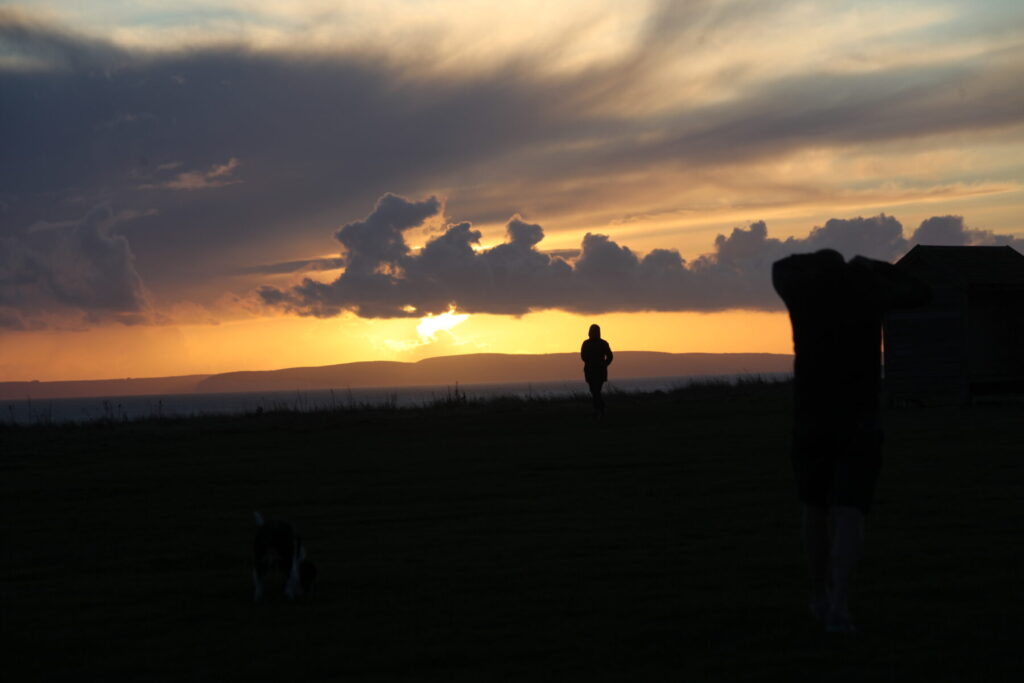
After lunch I read more of J. B. Priestley’s “Literature and Western Man”, until it was time to dash down to Barton on Sea to catch the

coastal sunset. The last three of these gentler images were produced by Jackie who was looking away from the direct dazzle.

This evening our grandfamily finished the leftovers from the recent Red Chilli takeaway while Jackie and I dined at Lal Quilla. My main course was tender lamb naga; Jackie’s tasty chicken sallee; we shared exquisite mushroom rice, egg paratha, and seb loo Jalfrezi, and both drank Kingfisher. Service, ambience, and cooking were as excellent as always.

Lingering Or Precocious

The weather was kind to us today, with no rain and the sun shining most of the shirt-sleeves warm day.

I hadn’t slept well so was feeling rather tired. I therefore spent several hours in the company of J.B.Priestley’s “Literature and Western Man”, before wandering round the garden with my camera.

Having battened down the hatches in our normal manner over the last week, I was pleased to note that most of our pots and garden furniture were not blown over and the weeping birch still stands.

Nasturtiums are a good temperature barometer. The first frost renders the tendrils limp and the blooms and leaves jelly-like. We have had no sign of that this year.

The hebes and roses like yellow Laura Ford seem to have emerged very early for next spring;

hot lips remain sun-kissed, as do various clematises; roses such as Peach Abundance and Gloriana continue to flourish, while Hawkshead is just one of our thriving fuchsias, and the starlike gaura is the only one that has ever survived for us.

Clerodendrum and iris foetidissima seeds promise a good crop next summer.

This evening we all dined on tender roast lamb; crisp roast potatoes and Yorkshire pudding; firm sage and onion stuffing; crunchy carrots; soft broccoli stems; and meaty gravy, with which I drank Mighty Murray Shiraz.

Reflections On Floodwater

Our forest drive this morning was taken through very heavy fusillades of rain alternating with bright bouts of sunshine.

Surfaces of roads, lanes, fields, waterways, all glistened with the excess liquid dropped continuously by heavy clouds throughout the night.

The No BBQs sign on waterlogged Balmer Lawn beside the swollen Highland Water seemed a little unnecessary at the moment.

It was difficult for the naked eye to discern the difference between lawn and water,

or to distinguish between the yellow lines of the road markings at the verges beneath the surface reflections from above and the grassy islets bearing autumn leaves.

Beneath a bridge crossing Balmer Lawn Road, we sat weighing up whether to follow the warning posted beside the dicey looking road. So did another vehicle behind us, until this oncoming larger vehicle snowploughed its way over. We and our followers did the sensible thing, as did a number of others while we were amusing ourselves

with the Water Recycling Centre sign,

beside which I photographed wet leaves and Jackie photographed a tree trunk regularly bitten by a wire fence.

Tilery Road is a stretch of deeply potholed gravel along which the only smooth journey could be made by joggers and dog walkers who could simply slalom round the water-filled cavities the depth of which could not be gauged by car drivers. The waterlogged woodland flanking this should give readers an idea of how joint-ricking was this trip.

Many roads, like this one at North Weirs on the outskirts of Brockenhurst, had become shallow lakes, along which we all followed each other somewhat gingerly.

It was not surprising that Jackie was able to photograph a briefly lasting rainbow along Meerut Road.

This evening we all dined on more of Jackie’s penne Bolognese with which which she drank Zesty and I drank more of the Italian red wine.

We Had Been Conned

Anticipating more showers after a short spell of sunshine this much clearer morning we took an early trip down a very wet Lower Pennington Lane and back.

Vehicles en route along Christchurch Road continued to splash sprays of standing pools over themselves and others.

The occasional dog walker waded among the overflow from the

rippling reflective rivulets running down the gutters joining runnels across the pock-marked tarmac.

Overhead branches relinquished onto ruffled runlets ripped leaves that sank beneath or imprinted themselves on the mirror of accumulated rainwater.

Vehicular lights, front and back, gleamed on the fluid surface.

Skeletal trees were silhouetted against the constantly changing skies.

Further down the lane waterlogged open fields were a more natural element for honking Canada geese, cawing crows, more silent waterfowl, and squelching cattle.

I was forced to wait in the car before photographing these fauna because the only shower – a heavy one blurring the windows – that we experienced during the rest of a sun-filled day hit me head on as I ventured out. Clearly we had been conned by the meteorologists.

This evening we all dined on Jackie’s herby penne Bolognese with which she drank Hoegaarden and I drank more of the Italian red wine.