This evening we dined on baked gammon; macaroni cheese; boiled potatoes, carrots, broccoli stems and green beans, with which Jackie drank more Weissbier and I finished the merlot.
George Macaulay Trevelyan is a truly literary historian. This is why my
review of ‘England under The Stuarts’ varies from my normal style with this series in that it contains more examples of his prose and quotations from the book.
We are immediately treated to his descriptive skills in the section covering the overall “State of England”: “After the mansion itself, the chief object of pride was the park, where the deer were shut in by high palings, cut from the old oaks of the glades in which they browsed. Sometimes they were hunted slowly round the inside of this enclosure; the ladies and their cavaliers caught glimpses of the sport from some point of vantage, and listened critically to the cry of the hounds, whose notes of different pitch were meant to harmonise like a peal of bells. [ a reference to A Midsummer Night’s Dream ] But a nobler form of the chase was to hunt ‘at force’ over the whole countryside. Although deer-hunting and deer-poaching were at this time the ambition of all English sportsmen, some of the smaller gentry had to be content with forms of the chase more within their means. The otter was speared, the badger trapped, the hare coursed, and the fox hunted by squires who each led our his own little pack…..”
“The bulk of the acreage of England was not a garden but an open country; one part wilderness of heath, turf, or marsh; the other part unenclosed plough-fields…. But the bleakness of this open land was broken by great tracts of brushwood and tall trees, wrecks of the old English forest that the hand of man had never planted….. When James I ascended the throne, the little population of England (somewhere on its rise from two and a half to five millions) was scattered throughout the cultivated country in fairly even distribution.” “Manor House and cottage varied pleasantly in every district. Some were of oak-beam and plaster, others of stone or red brick; some were roof with thatch, others with stone-slab, according to the natural products and the immemorial tradition of each countryside.”
Metaphor is instanced by “… the numerous cadets of the family were sent to swell the river of national life with a stream of high-spirited adventurers”; and subtle alliteration by “…..unprosecuted, spared by the charity of his poor neighbours….”
Humour tends to be dry and suggested, such as “The would-be courtier and gallant, trying to pass himself off as the Sidney of his day, misquoted Romeo and Juliet to his mistress, slept with ‘Venus and Adonis’ under his pillow, and hung up Sweet Mr Shakespeare’s picture in his study at the Court.”
Upon the death of Elizabeth I in 1603, James VI of Scotland was created James I of England. “For a month of spring weather James rode south. The land seemed bursting into bud to welcome him, growing greener each day as the ever-increasing train of courtiers wound slowly down out of the north country into the midland valleys; through shouting market-places where the masque of welcome and the corporation with its address were lost in the press of men…..” This paragraph continues in similar vein.
As Parliament wrested more powers from the crown, continuing conflicts between Puritans and Catholics led to the Gunpowder Plot in 1605. “…..Its more important consequences were that for a dozen years the King allowed some of the Penal Laws to be partially enforced, that Popery became at last unfashionable in the hall and more than ever unpopular in the street; that for a hundred years to come the religion of Guy Fawkes and the Jesuits was regarded as a creed so dark and murderous that any man who made political alliance with the Catholics imperilled the adhesion of his supporters, or even the loyalty of his subjects.”
“In the reign of James I the House of Commons again became the focus of local opinions, which otherwise would never have united into a national policy. The isolated communities of England, divided from each other by days of riding on steep and muddy roads, uninformed by newspapers and perplexed by strange tales about poisoners and Papists at the Court could only rely, for creditable information and sober opinion, on the men whom they sent up to Parliament to enquire into these matters on the spot.”
“From February 1611 to January 1621, no Parliament met, except during the two months of 1614, when the Addled Parliament expressed the anger, but demonstrated the impotence, of the electoral classes.” Trevelyan eloquently describes the licentious state of James’s despotic Court.
The disastrous influence that Charles I allowed the Duke of Buckingham on control of the country’s management at home and abroad led to the Forced Loan, commissioners for which “were appointed in each county, with power to summon their neighbours, assess them man by man……[many] paid with their hearts; but others preferred to suffer [rather than pay up]. Some eighty gentlemen were imprisoned; poor men, to whom the laws of England were no less dear, were pressed into the army, that their families might beg in the streets, while French and Austrian did execution on their bodies.”
Parliament’s Petition of Right put an end to martial law and Buckingham was murdered by Felton who had followed him to Portsmouth.
Archbishop Laud’s persecution of the Puritans in the 1630s, led to “many thousand religious refugees of all classes abandon[ing] good prospects and loved homes in England, to camp out between the shore of a lonely ocean and forests swarming with savage tribes.” “in 1620 a few score of emigrants in the Mayflower had shown the way [for the colonisation of New England].”
The division between the Parliamentary Puritan Party and those of the Royalists slowly, inexorably, led to Civil War from 1642-6 and a resurgence, which our author calls the Second Civil War.
“The great issue was decided in a war waged by two small minorites. When Edgehill was fought, not half the nation, not even half of the gentry, had been induced to support the war whether for King or Parliament…..There was indeed no middle party: every man was a little for the King or a little for the Parliament…..the hired labourer in the field remained neutral to the end….”
Following the Parliamentarian victory at Naseby, although the King was subsequently held at York, divisions within the Parliament factions; Parliament’s refusal to pay the soldiers who had fought for them; and the failure of Cromwell’s peaceful process led to the Second Civil War. The Scots joined the Cavaliers who were ultimately defeated in 1748.
During the Protectorate of Oliver Cromwell there was no real agreement on the government of the country.
“More than a year and a half passed between the death of Oliver September 1658) and the Restoration of Charles II (May 1660). In that period England fell into the power of the generals…. It did not take them long to dispose of the new Protector, Oliver’s eldest surviving son, ‘Tumbledown Dick’ as he was called.
The Republican Party [Illegally] tried and executed King Charles I. The perpetrators eventually met their own similar fate.
The assembly freely elected under [General Monk’s] protection called back Charles II.
in 1665/6 the Great Fire of London and the Great Plague were devastating disasters.
A detailed article on the plague of 1665/6 is featured in
During the years 1678-85 Charles II wrestled with Protestants over the government of the country. Catholics and Protestants alternately lived in fear of retribution and their lives. The struggle over the next in line once Charles should die pitted the supporters of the illegitimate Monmouth against the king’s brother James who became James II.
False witness against the king was led by Titus Oates and his co-conspirators.
King James’s revenge for Monmouth’s rebellion in The West Country was executed by Lord Chancellor Jeffreys in the Bloody Assizes of 1685.
The Huguenots, cruelly persecuted in France under Louis XIV, fled to England in their thousands and gave us the benefit of their nature and their industry.
“So great was the power of the Crown that the mere fact of Anne’s succession had caused, not only a change of ministry, but the acceptance of that change by the votes of the nation. Between the years of 1702 and 1715 there were six general elections; three were won by the [more peaceable] Tories and three by the [more warlike] Whigs; but in every case the decision was in favour of the existing ministry and in influence of the Crown.”
The Duke of Monmouth led the English armies in the war of the Spanish Succession, especially the decisive battle of Blenheim. “Great Britain was the power that gained most by the war and by the peace. In William’s time, she had done little more than stand on her defence against Louis and the Jacobites; William, rather than England, had been head of the League of Augsburg. But in the Marlborough wars, Britain held the Grand Alliance together; she financed the other nations; her fleet had almost a monopoly of the ocean; her soldiers, for the first time since Agincourt, decided the fate of Europe on famous fields; the great general of the Alliance was an Englishman; and British ministers dictated the terms of peace.”
I spent much of the day completing my reading of ‘England under the Stuarts’; making a start on my review; and scanning all the pictures that will illustrate it.
For a break, as evening descended, we took a brief forest drive where
we followed a few pheasants along the verges of Monument Lane.
Now we are about to sit down to a dinner of tasty baked gammon; piquant cauliflower cheese; boiled new potatoes and carrots; and tender purple sprouting broccoli, with which Jackie will drink Patronus Weissbier while I imbibe Watarra Ridge Merlot 2023.
On the morning of an apparently lifeless overcast day I took
advantage of the diffused light to display some of the garden life, in and out of season. The cluster of mushrooms has risen from the roots of a heavily pruned viburnum. All items in the gallery carry their titles.
In a vain attempt to restore some balance with my iPhotos file I deleted all the photos featuring in
This evening we dined on smoked haddock fish cakes, piquant cauliflower cheese, sautéed leeks and green beans, boiled new potatoes, and carrots with which Jackie drank Weissbier and I finished the merlot.
This morning I approached the end of my reading of ‘England under the Stuarts’, and began to reflect on reviewing it.
After lunch we took a forest drive.
Ponies gathered in the sunshine along Broadlands Road on the outskirts of Brockenhurst.
We continued to Puttles Bridge where bracken and fallen oak leaves provided hints of autumn reflected in the rippling surface and the gravelled bed of this stretch of Highland Water.
This gentleman told me he had visited the bridge to reflect on the scene of his boyhood paddles.
From the Weak Bridge on Rhinefield Road could be seen the reflections of the flanking woodland.
This Highland bull stood guard over his cows on Holmsley Road.
In a small amount of culling of my iPhotos file I retained just one picture featured in
Jackie’s jalfrezi meals mature well from day to day. This evening’s chicken version was the third generation, served with mushroom rice containing onions, cardomans, cinnamon and garlic. Delicious, as was the packed vegetable samosa. The Culinary Queen drank Erdinger Weissbier and I drank more of the merlot.
Sandwiched between two sessions of reading ‘England under the Stuarts’ was a trip to Efford Recycling Centre to which we transported another car load of green refuse and returned with a very well built
mirror to be stood against the fence behind the gingko tree in Elizabeth’s Bed.
Some of the refuse had come from Jackie’s further substantial work
of clearing the third compost bin and bagging the sifted soil replenishment.
Today’s efforts at culling my iPhotos collection involved removing three images appearing in
This evening we enjoyed a repeat of last night’s curry with substitutions of vegetable pakoras, onion bahjis, and a plain paratha for the samosas; we drank the same beverages.
Apart from transporting to the pile for tomorrow’s dump trip two bags of garden refuge removed from the compost bin that Jackie has continued sieving today, I spent most of my time reading more of ‘England Under The Stuarts’.
Before dinner in undertook some more culling of my iPhotos file by removing three of the images featuring in
We are now about to enjoy Jackie’s spicy chicken jalfrezi; basmati rice with cardomans and turmeric; and vegetable samosas, followed by apple crumble and custard, with which she will drink Weissbier and I will drink Kingfisher.
Over the last few days Jackie has finished clearing the second
compost bin and added bags to the sieved collection. This afternoon I
helped cut out and bag up the more recent top layer of the third bin,
transported the bags of waste to the pile awaiting the next dump trip, and left the Head Gardener preparing the sifted soil. The bags to the left of the last picture are the latest nutriment for the beds.
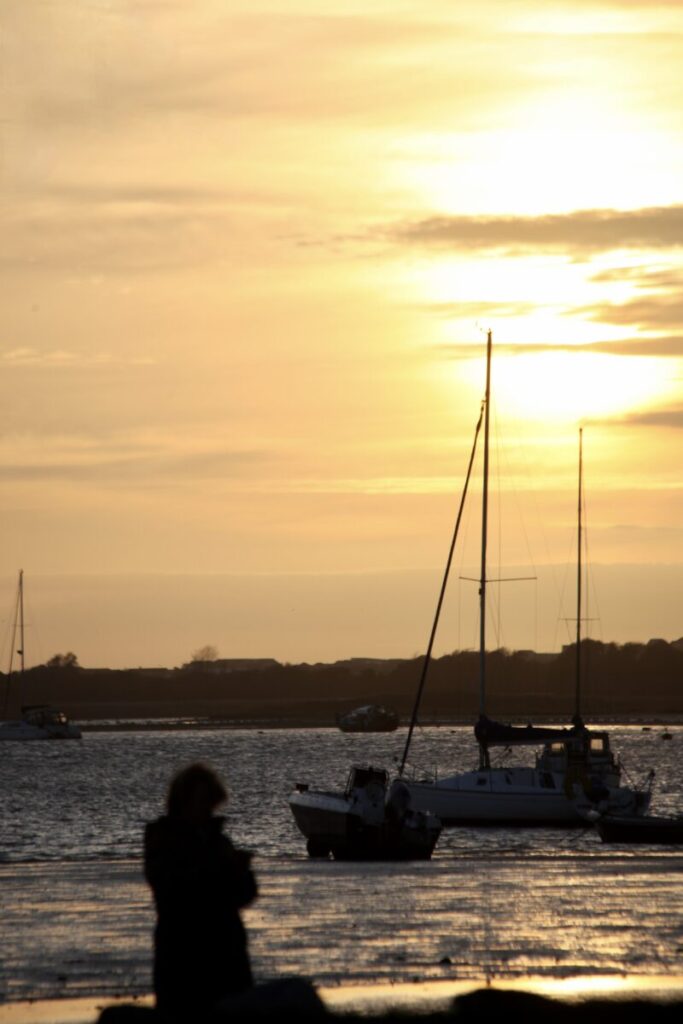
Early this evening we drove to Mudeford in search of sunset.
Gulls were silhouetted against the early sky;
Sunset watchers settled in to wait while a fisherman flung his line;
Boats, bicycles, and other people added their own forms to the scene.
Later, we dined on Jackie’s chilli con carne and her flavoursome savoury rice with green beans; she drank Juicy rosé and I finished the merlot.
Although the winds of hurricane Amy have largely desisted I wasn’t yet ready to tackle the garden, so I made considerable headway with ‘England under the Stuarts’.
Taking a break to tackle the culling of my iPhoto’s collection, I retained just one of the images featuring in
This evening we dined at Rokali’s where we both enjoyed the fine food and friendly, efficient, service. My main course was prawn dhansak, Jackie’s was ponir mokani; we shared mushroom rice, poppadoms, and garlic naan, and both drank Kingfisher.
As the winds of hurricane Amy tear around the garden threatening to take me with them I spent much of the day reading more of ‘England Under The Stuarts’.
Intermittently I carried out culling of my iPhotos file by deleting all those featured in
I also removed a few more that don’t appear in a blog post.
Late this afternoon we took a forest drive just as heavy rain joined the fierce winds.
Some of the rain can be seen driving down the misty background to the first of these sparkling scenes.
This evening we dined on a repeat of last night’s roast pork meal with moistened meat, crisped up crackling and fresh vegetables, including the last of the roadside purchased carrots, with which Jackie drank Juicy rosé and I drank more of the merlot.