A Freak Of Fate

This morning I carried out more dead-heading of roses.

My post ‘https://derrickjknight.com/2018/06/04/auntie-ivy-and-sir-edmund-hillary/explains that I inherited my aunt’s book collection.

Another of her volumes, from The Book Club, published by Michael Joseph in 1958, is the first of a series of five novellas by British writer H.E. Bates which was adapted for a hugely popular television series from 1991-1993.

Bates, and his readers, revel enviously in the somewhat sybaritic lifestyle of the Larkin family. I found it very difficult to put down the book which must have taken no more than three hours, completed after lunch, to enjoy. The prose romps along following the Larkins’s “perfick”ly carefree escapades. Just three spring weeks transform the life of a would-be tax inspector who is hopelessly enamoured by the eldest daughter in what must be the most blatant efforts at an arranged marriage imaginable.

Pop Larkin is the archetypical happy-go-lucky wide boy miraculously conjuring up wildly extravagant provisions for the voluptuously maternal Ma and their vibrant brood. The initially hapless Mr Charlton is defenceless against parental schemes and the seductive allure of Mariette.

The jacket designer has captured the chaotic contentment of the author’s work so well that it is a time that he or she remains anonymous.

I hope I have not divulged too much for those who have not seen

this series of extracts from the TV series. Apart from the wedding scene these clips are most faithful to the first book.

Pam Ferris and David Jason, straight from his role as dubious trader DelBoy in ‘Only Fools and Horses’. are ‘perfick’ as the pleasure loving parents; Philip Franks as the bashful young man; and Catherine Zeta Jones as the delectable daughter.

My copy of the book bears an inscription of significant coincidence for me. An address on the first page had me doing a double take. This is ‘W.V.S. Paddington, 313 Harrow Rd.’

https://www.royalvoluntaryservice.org.uk/about-us/our-history?gclid=EAIaIQobChMI-uno9aqW4wIVDp3tCh3caQHBEAAYASAAEgIqb_D_BwE

gives details of what was then called the Women’s Voluntary Service.

I don’t know how Ivy acquired the book, but I certainly knew 313 Harrow Road. Some twenty years after the novel came into my possession I was, as Manager of Westminster Social Services, Area 1, in charge of that building, a former Victorian town hall. When my department moved in we had a number of tenants, being charitable organisations. W.V.S. was no longer one of those – that would surely have been an even more fortuitous freak of fate.

Later this afternoon I carried out further irrigation.

Jackie having returned this evening we dined on more of her delicious chicken jalfrezi and pilau rice with which she drank Hoegaarden and I drank Concha Y Toro Casillero del Diablo reserve 2107.

The Evolution Of A Room

Today was hot enough for us to open doors and windows.

One of these was the stable door. It is my fond imagining that a horse was once kept in what became the garage, which we converted to

a utility room leading to a library, fronted by

a boarded trellis bearing clematises, solanum, nasturtiums, petunias, geraniums, etc.

I do hope this accurately describes the evolution of a room.

A few days ago I had taken my copy of J.L. Carr’s short novel, ‘A Month in the Country’ from my library, and I finished reading it this afternoon. Winner of the Guardian Fiction Prize for 1980, the book is a many faceted gem. Two men are linked by the fact of having survived Passchendaele and each having accepted commissions to uncover secrets of a medieval church. I will try not to reveal too much, but can say that in economical, well-placed, prose encompassing just 121 pages of my Folio Society copy of 1999 the author speaks of heaven and hell; of judgement, redemption, and damnation; of joy and pain; of culture and spirituality; of time and eternity; all with a slowly seething undercurrent of suppressed sexuality. It wasn’t heterosexual love to which Lord Alfred Douglas referred as ‘the love that dare not speak its name’, yet there are other reasons for fear of revealing feelings.

Ronald Blythe’s perceptive and informative introduction reflects the author’s style.

Ian Stephen’s detailed illustrations are true to the text.

The front and back boards are each printed with a copy of the artist’s engraving for the frontispiece.

Here are the rest.

Early this evening we took a brief trip into the forest.

From Pound Lane near Thorney Hill we watched ponies paddling in Whitten Pond, alongside which a young woman played ball with a pair of dogs.

On our return we dined on a second helping of Mr Chan’s excellent Chinese Take Away with which we both drank Tsing Tao beer.

I Held One Back

Last night I finished reading:

One of Trollope’s shorter works, this deals with familiar themes concerning the status of women; socio-economic inequalities; intrigue and romantic entanglements. It is a tragic love story breaching differences in fortune, in social class, in geography, and in religion. As usual the prose flows along smoothly to the tale’s surprising, if inevitable, conclusion.

Given that the action takes place alternately in England and Ireland, the choice of the sensitive, and insightful Irish novelist and poet, Maeve Binchy to write the excellent introduction was most apt.

The generous quantity of Elisa Trimby’s drawings are faithful to the text. In particular she manages effectively to convey the emotions of her subjects. I was impressed with the appropriate flattening of perspective enabling her to depict a good depth of field.

In order not to give away the dénouement I have held back the last of the illustrations.

Much of this morning was devoid of Internet connection, which rather delayed my drafting of this review; and my listening to the England v. Sri Lanka men’s World Cup Cricket match.

In order to calm my nerves took a stroll round the garden.

The first two images of these day lilies are of those purchased from https://www.polliesdaylilies.co.uk which, containing our national collection, is situated very near to us.

These penstemons adorn Margery’s Bed.

This evening we dined on Jackie’s superb sausages in red wine; crisp new potatoes, carrots, and broccoli, with which she drank Hoegaarden and I finished the Pinot Noir.

The Road To Spiritual Redemption

The book I finished reading yesterday once, according to the bookplate it bears, graced the shelves of Geoffrey P. Shakerley. Was this Colonel Sir Geoffrey Peter Shakerley (1906–1982), Chairman of Gloucestershire County Council (1956–1967) ? I wonder. And was he the first owner?

Here is the gold-embossed front board of another beautiful volume in the Bodley Head collection of the works of this author and illustrator.

I rarely read a book twice, but the tell-tale train ticket slipped inside suggests that I first read this one in June 1996, and was not deterred from enjoying it again. First published in 1890, this is the first illustrated edition of 1926.

Undoubtedly rich in satire from M. France, this is nevertheless a treatise on the trials and tribulations on the road to spiritual redemption. St Thais of Egypt, a libertine said to have lived in the 4th century A.D. and converted to early Christianity by a monk wracked with thoughts of lust for her. The writer, within this story, weaves struggles with conscience and much philosophical debate. His effortless prose has been well translated by Robert B. Douglas.

As usual, Papé’s superb draftsmanship is represented by endpapers;

by twelve full page plates;

by introductory section headings;

and by end pieces, from each of which I offer a selection.

Jules Massanet’s eponymous opera was based on Anatole France’s book.

Here is the final scene including the Renée Fleming duet with Thomas Hampson (10.29 minutes)

This evening we dined on Hordle Chinese Take Away’s excellent fare.

The Crime Of Sylvestre Bonnard

Unfortunately my copy of the title work of fiction is not one of the Bodley Head collection of the works of Anatole France, illustrated by Frank C. Papé. It is, however, an early Folio Society volume of 1948, complete with dust jacket.

This charming little tale, first published in 1891, was the author’s first novel. In his usual flowing, poetic, prose he gives us a story of relationships spanning generations. With a delightful delicacy he describes the beauty of human emotions, not omitting scoundrels. As usual, I will not reveal the details. The work has always been in print for anyone who wishes to read it.

Lafcadio Hearn’s translation has been used by permission of The Bodley Head. The translator has provided a useful introduction.

Book illustration, by 1948, had moved on from the Golden Age of elegant draftsmanship exemplified by Mr Papé. The more impressionistic lithographs of Harold Hope-Read are quite a contrast to the careful lines of the earlier illustrator.

Once the reader peers through the murk of the artist’s well balanced designs and deciphers the suggested expressions of the people in the images it is possible to recognise his fidelity to the charming text.

This evening we dined on Lidl ready-made curries. Mine was chicken jalfrezi; Jackie’s was chicken korma. These acceptable meals were followed by Belgian buns.

The Revolt Of The Angels

This morning I finished reading ‘The Revolt of the Angels, Anatole France’s satirical novel based on a potential re-run of the Christian idea of the war in Heaven between the evil angels of Satan and those of St Michael on the side of good.

Fallen angels are brought to life in cities ancient and modern, and consort with human beings.

We begin with a mysterious chaos in an historic library and follow the tale through the next two hundred years. I will reveal no more of the story, save to say that it is written in the author’s usual flowing prose as ably translated by Mrs Wilfrid Jackson. Mine is the first illustrated edition, produced by The Bodley Head in 1924.

As regular readers will expect, the illustrations are by the estimable Frank C. Papé.

Here are the front board, and

the end papers.

There are the usual 12 plates worthy of close perusal,

and the vignettes at the ends of chapters. I have included a sample of these.

This afternoon I watched the BBC transmission of the Six Nations rugby match between Scotland and Wales.

I settled down to a recording of the England/Italy game after we dined on pizza and salad.

The Well Of St Clare

28th February 2019.

This morning I finished reading the next of my works of Anatole France illustrated by Frank C, Pape. This Bodley Head edition was published in 1928.

The book was translated by Alfred Allinson, who has clearly reproduced the author’s beautifully, simply, flowing poetic prose. The title tale is one of a selection of short stories, mostly set in Mediaeval times, being satirical commentary on the religion of that period; with a lacing of philosophy..

The intact jacket reproduces the gold embossed design on the front board.

The endpapers don’t quite fit my scanner.

As usual there are a dozen full page plates,

and a number of chapter end pieces, of which I present a brief selection.

Feeling pretty rough, I went to bed early and forgot to publish this until the morning.

The Epic Of Gilgamesh

Prompted by this post https://johnknifton.com/2019/02/02/the-world-of-the-mysterious-2/ from John Knifton I decided that I must read my own copy of

It has waited for 45 years after all. I finished it last week.

John’s excellent research tells the story. I concentrated on the coloured illustrations. The are also smaller black and white woodcuts.

The very large 8vo format makes scanning the double spread of the flood impossible.

As the evening descended, I gradually fell to collapsing myself. I didn’t eat anything, and went up to bed soon after Elizabeth paid a visit.

The Plague

This afternoon I watched the BBC broadcast of the Six Nations rugby match between Scotland and Ireland.

The following three paragraphs have been taken from http://www.beautifulbritain.co.uk/htm/outandabout/eyam.htm

The site contains more information and relevant details.

‘It’s hard to imagine that the quiet village of Eyam, off the A623 in Derbyshire, could have such a fascinating, yet tragic story to tell. But …. at the end of August 1665 bubonic plague arrived at the house of the village tailor George Viccars, via a parcel of cloth from London. The cloth was damp and was hung out in front of the fire to dry, thus releasing the plague infested fleas. On 7th September 1665, George Viccars, the first plague victim, died of a raging fever. As the plague took hold and decimated the villagers it was decided to hold the church services outdoors at nearby Cucklett Delf and, on the advice of rector William Mompesson and the previous incumbent Thomas Stanley, villagers stayed within the confines of the village to minimize the spread of the disease. Cucklett Delf was also the secret meeting place of sweethearts Emmott Sydall, from Eyam, and Rowland Torre, who was from a neighbouring village. They would call to each other across the rocks, until Emmott Sydall herself became a victim of the plague. Six of the eight Sydall family died, and their neighbours lost nine family members.

To minimize cross infection, food and other supplies were left outside the village, at either the Boundary Stones, or at Mompesson’s Well, high above the village. The Earl of Devonshire, who lived at Chatsworth House, freely donated food and medical supplies. For all other goods, money, as payment, was either purified by the running water in the well or was left in vinegar soaked holes. The Riley graves, close to Riley House Farm and approximately 1/2 mile from the village house the bodies of the husband and six children of farmer Elizabeth Hancock. All died within a week of each other. Because of the high risk of infecting her neighbours she had the traumatic task of burying them all herself. Even more tragic is that the infection probably came to her family when she helped bury another villager’s body. Twelve months after the death of George Vicars, the plague was still claiming its victims, and on 25th August 1666 Catherine Mompesson, wife of the recently appointed rector William Mompesson (aged 28) , died of the plague. She had loyally stayed with her husband and tended the sick, only to become a victim herself.

The Plague in Eyam raged for 14 months and claimed the lives of at least 260 villagers. By 1st November 1666 it had run its course and claimed its last victim. Eyam’s selfless villagers, with their strong Christian convictions, had shown immense personal courage and self sacrifice. They had prevented the plague from spreading to other parishes, but many paid the ultimate price for their commitment.’

It would be fascinating to know whether, when he wrote ‘The Plague’, Albert Camus, Algerian winner of the Nobel Prize for Literature, had known of the story of Eyam during the 17th Century bubonic plague. He has certainly written a convincing account of life during an enclosed confinement at the mercy of such a pestilence.

Camus stated of his work, first published in 1947 that ‘I wish to express through the plague the suffocation which we have all suffered, and the atmosphere of threat and exile in which we have lived.’ This is an undoubted reference to the German occupation of France. On a broader scale the book could be seen as a metaphor for any oppressive invasion.

As usual I will not reveal details of the tale. There is in fact very little plot, but the writer has evoked the initial disbelief, subsequent reluctant acceptance, psychological isolation, resignation, and despair of most, along with exhausting resistance of a few.

I have not read the original French of ‘La Peste’, but I believe Stuart Gilbert’s translation reflects the author’s flowing, insightful, prose.

My Folio Society edition of 1987, which I finished reading today contains an informative introduction by Derek Parker, and is illustrated with

Linda Kitson’s muscular drawings.

The essential difference between the English village and the town depicted by Camus is that of voluntary sacrifice and imposed isolation.

This evening we dined on Mr Chan’s excellent Hordle Chinese Take Away fare, on trays on our laps while we watched a recording of the earlier match between Wales and Italy.

Empress Of The Senses

Winds had subsided overnight and sunshine has returned. Another very strong storm is predicted for tomorrow. In the meantime

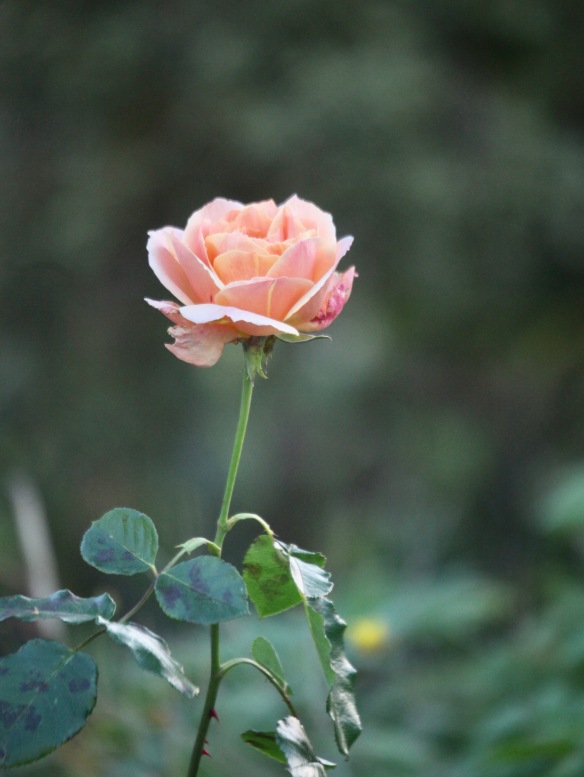
the pink rose stays erect

and the Japanese maple leaves cling to their moorings.

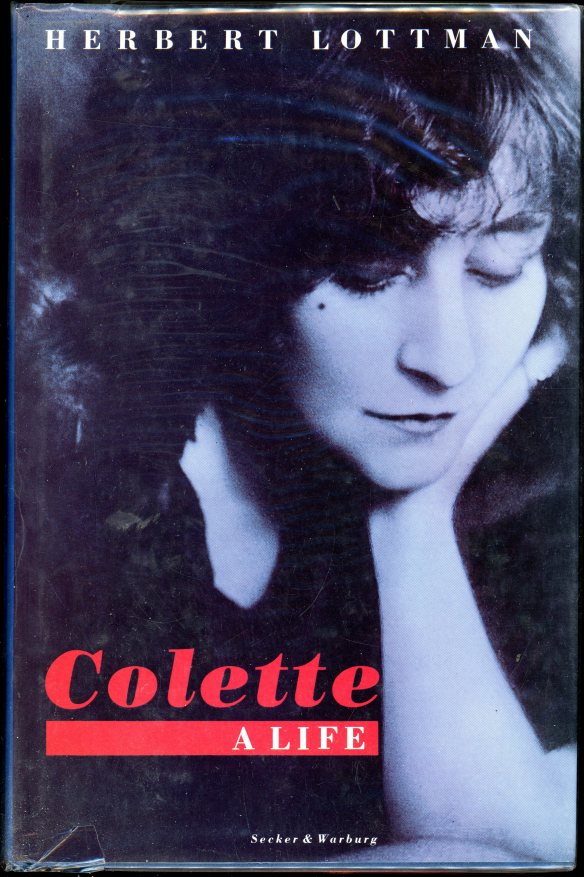
This morning I finished reading:

The front jacket shows the French icon of the demi-monde as a young woman.

On the back she appears in her later years, by which time she had become a celebrity recognised by the literary establishment. The ISBN number of this 1991 publication can be seen beneath the photographs.

Herbert Lottman has written an engaging account. Unlike John Carey whose review was published in The Times Books of 17th March, 1991, I will not précis the life in case my readers will wish to read it for themselves. All I will mention is that Colette’s painful last years is one more reminder of how fortunate I am to live in an era where hip and knee replacements under anaesthetic are commonplace, at least in my culture.

Richard Willson’s excellent newspaper illustration probably reveals enough.

A brief obituary of this prolific caricaturist and political cartoonist appears in https://www.independent.co.uk/news/obituaries/richard-willson-political-cartoonist-and-environmentalist-6281503.html on 26th December 2011

One of my methods of selecting books to read is the review. This one I had slipped inside the book where I will leave it as a marker.
My mother’s frailty has steadily worsened since she was discharged from hospital a fortnight ago. It is clear that she needs 24 hour care, either at home or in a residential establishment. This afternoon we are travelling to her home in the village of West End where we will join in Elizabeth’s discussions on the options with Mum. A Waking Carer will be on hand when we take my sister out for a meal. I doubt whether I will have time to follow this up until tomorrow.