A Knight’s Tale (42: I Find My Direction)

When my grief at my loss of Vivien had subsided somewhat, my brother Chris and his great friend Mike Ozga took me in hand and out with them to various venues.  We rode around in a little mini.  I don’t remember whose it was.  As we were all six feet two or three we caused great amusement when we unfolded ourselves from this tiny, yet surprisingly roomy, vehicle.  One evening they drove me ‘creeping like snail unwillingly to’ Helen’s twenty first birthday party. 

Never, at the best of times, a party animal, I stood in the Amerland Road flat not knowing where to put myself.  There were a couple of girls in a corner and I thought I might put myself there.  One of them said to her companion: ‘You’re in luck, he’s coming over.’  Unfortunately I only had eyes for the disinterested party. 

Jackie.

Although she was, in spirit, rather like Shakespeare’s schoolboy, she was definitely female.  Claiming to be eighteen, Jackie, I learned later, was awaiting that birthday before taking up her post as a housemother at Shirley Oaks.  Near Croydon, this was a laid out estate of forty two large houses, called cottages, each accommodating twelve children.  At that time the project also included a swimming pool, an infirmary, a laundry, a general store, a junior school, and even an unused mortuary.  The individual houses were staffed by ‘housemothers’, many of whom offered ‘families’ of children long term consistent care.  Jackie was one of these carers, in ‘Laurel cottage’, and the person who introduced me to the world of Social Work that was to provide me with a new direction.  Long since out of fashion as a method of child care, these buildings were sold off to form an exclusive, expensive enclave.  The seclusion that had been considered too institutional, isolating and ghetto-like for troubled children, had become an attraction for those wealthy enough to buy their homes.  Shirley Oaks children were given no experience of life outside the institution until they were thrust into secondary school.  They didn’t go to the public baths and pay their entrance fee.  They knew no launderettes.  A daily truck provided an enuretic service for the wet sheets which were left outside the back door.  Their shop issued the housemothers with weekly order forms on which they ticked what they needed and collected it once a week.  No money was handed over.  No ‘outsiders’ attended their school.  When a group of boys from outside began to visit a girl in Jackie’s care, a bunch of Oaks boys attacked them with such violence that there was blood on her doorstep.  

This was one of the old style self-contained residential villages that existed in those days for children in local authority care.  Visiting Jackie there, I got to know the young people and their stories.  How did they get there?  Who was responsible?  What could be done to prevent it?  These were the questions which exercised me and gave me my direction.  I soon left my insurance desk and began working as an Assistant Child Care Officer in Tolworth Tower in the Royal Borough of  Kingston Upon Thames.  That was December, 1966.

I was inspired to attempt to do my bit in changing all this.  Perhaps I made a difference to some young lives.

The Wind And The Rain

After overnight rain on a morning of winds still over 50 m.p.h. I was blown around the garden while investigating the damage. The sunlight was very strong, but birds remained silent.

The pictures display a range of the comparatively minor disturbance requiring attention when the wind subsides. As usual, individual images are titled in the gallery.

All is not hopeless as shown by these further photographs.

The wind subsided somewhat but the rain returned this afternoon; petrol needs preserving, so I read some more of ‘Our Mutual Friend’ and scanned the next four of Charles Keeping’s skilful illustrations.

‘Mr Dolls collapsed in his chair’

‘Bradley went with him into an early public house’

‘She gave him her hand’

‘The old man looked distressfully at Fledgeby’

This evening we dined on hot and spicy, and tempura, prawns; served with Angela’s authentic sticky rice (supplemented with egg by Jackie) and spring rolls. Mrs Knight drank more of the Rosé and I drank more of the Cotes du Rhone.

A Knight’s Tale (41: My Awful Night)

Vivien and I were married at St Lawrence’s Church, Sidcup on 8th June 1963.

We began our married life in my parents’ house at 18 Bernard Gardens, Wimbledon.  

This was where she proudly brought Michael home and we lived for a few more months until we bought 49 Ashcombe Road, Wimbledon for £2,500 (no noughts missing). 

In Ashcombe Road we did our own decorating and I transformed a rubble heap into a reasonable back garden mostly laid to lawn for our little boy to play in. 

As a recent toddler he helped me push a roller over the turfs we had laid. 

This was not to be our home for long.  In September 1965 I went out one evening  window shopping for a present for Vivien’s 23rd. birthday which was to be in a couple of weeks time.  Forty five minutes later I returned home to find her dead on the floor of the sitting room.  In less than an hour I had become a single parent.

Years later I was queueing for soap in Floris in Jermyn  Street when the young man ahead of me was offered products from Duchy Originals.  “I don’t want any of that stuff.  It goes to charities like unmarried mothers doesn’t it”, was his response.  I leaned forward and said: “I’ve been a single parent as it happens.” “I’m bringing mine up on my own”, said the shop assistant.  He was gone.

Now I must return to my awful night.  Deep in shock I collected Michael from his bed, where, thankfully he had been sleeping; gathered him up in his blankets; and carried him up the road to Bernard Gardens.  My mother took us in and eventually put us both to bed.  In my case that was not to lead to sleep for another three days, when I had stopped crying.  Dad came home a little after our arrival.  I can still hear his teardrop hitting my bedding.  I will be forever grateful to the gentleman, doctor, official of some sort; I have no idea;I was past taking it in, who visited me the next morning to tell me that death had been instant and Vivien would have known nothing of it.  My wife had died in an epileptic fit.  I had always known that she could possibly have an accident, but never dreamt that the condition could produce a fatal collapse.  To this day I don’t know whether he said it was her heart or her lungs that had failed.

Returning from the funeral I was to find a Health Visitor on the doorstep.  She had not visited before but was making a check up call following Michael’s birth.  He was now fourteen months old.  She fled and never came again.

Michael and I were to stay at Bernard Gardens for the next three years.  Until he was three Mum cared for him alongside my brother Joseph, just three years older.  When Michael was considered old enough he attended a day nursery, where he met his lifelong friend Edward Blakely, and he and I moved to a studio flat at the top of the house which had just been vacated by the Egan family.  I could be sole carer with the advantage of family below who babysat when I went out.  I was able to continue working, collect him from nursery at the end of the day, and, I thought, cook us a meal. 

On the evening I began my new routine, never having cooked before, I decided we’d have spaghetti bolognese.  I cooked up some mince in a saucepan.  No herbs, no spices, no onions, no carrots, no tomatoes, just mince.  Hopefully I used some sort of cooking oil, but I wouldn’t be sure.  I boiled the spaghetti until it was soggy and served up.  I don’t remember whether either of us ate any of it, but I do remember thinking, after I’d tucked Michael up in bed and turned to face the washing up at 9.30 p.m.: “Blow this, he gets a meal at the nursery, I’m going to the caff at midday”, I told myself.

I had, by now, realised I could never stay in an office job. All I needed was a direction. How I found that direction is a further story.

Photographing Windsurfers

After lunch I posted https://derrickjknight.com/2021/09/26/a-knights-tale-40-not-a-book-illustrator/

Later, partly in order to preserve petrol, we took a short drive to Tanners Lane and back. The garage that had been the cause of severe hold-ups two days running as panic buyers queued for petrol, had only a couple of pumps working, so we were able to pass it unimpeded.

Within sight of the Isle of Wight windsurfers were out in force at the end of the lane.

Jackie photographed me photographing them, and also distant passing yachts.

This evening we dined on tasty baked gammon; crisp fried potatoes; moist ratatouille; firm carrots, cauliflower, and broccoli; and tender runner beans. Jackie drank Sud de France Rosé 2020 and I drank Prestige de Calvet Cotes du Rhone 2020.

A Knight’s Tale (40: Not A Book Illustrator)

My first choice of occupation on leaving school at eighteen would have been attending Wimbledon Art School. As the eldest of five, and recognising the family’s need for me to bring in an income, I chose, with no pressure, to do neither this nor apply to University for which my A levels in English Literature, French and History would have entitled me. Instead, there being no such thing as careers advice at Wimbledon College in 1960, I followed the advice of my Uncle Derrick who suggested I apply to the Committee of Lloyd’s, where, as perviously indicated, I soon took up employment in the Autumn of that year.

Had I had more confidence in my teenage abilities, and had my parents been able to send me to art school, I may well have taken up book illustration.  As it was, I needed, on leaving school, to go straight to work.  I also thought I’d never make a Charles Keeping, a John Bratby, or even a Beryl Cook, all of whom have illustrated Folio books.  My first annual salary was about £340, the bulk of which I handed over to my mother.  I kept enough back, however, to be able, upon seeing an advertisement for The Folio Society, to sublimate my desire to illustrate by joining this book club.  A lifetime later I have a large collection of beautifully illustrated, imaginatively bound hardback books, printed on good paper which doesn’t turn brown, with suitable typeface and font.  All these elements are carefully selected to be in keeping with the original writing.  Younger, budding, illustrators are encouraged by an annual competition.  I have the Society to thank for many works of which I may otherwise have no knowledge, and for pleasurable editions of numerous others.

I have some talent at drawing. During the late 1950s I used to sit and draw and paint alongside Kenneth Lovell, an artist who, among other works, illustrated Hulme Beaman’s Toytown series of children’s books.

Derrick & Kenneth

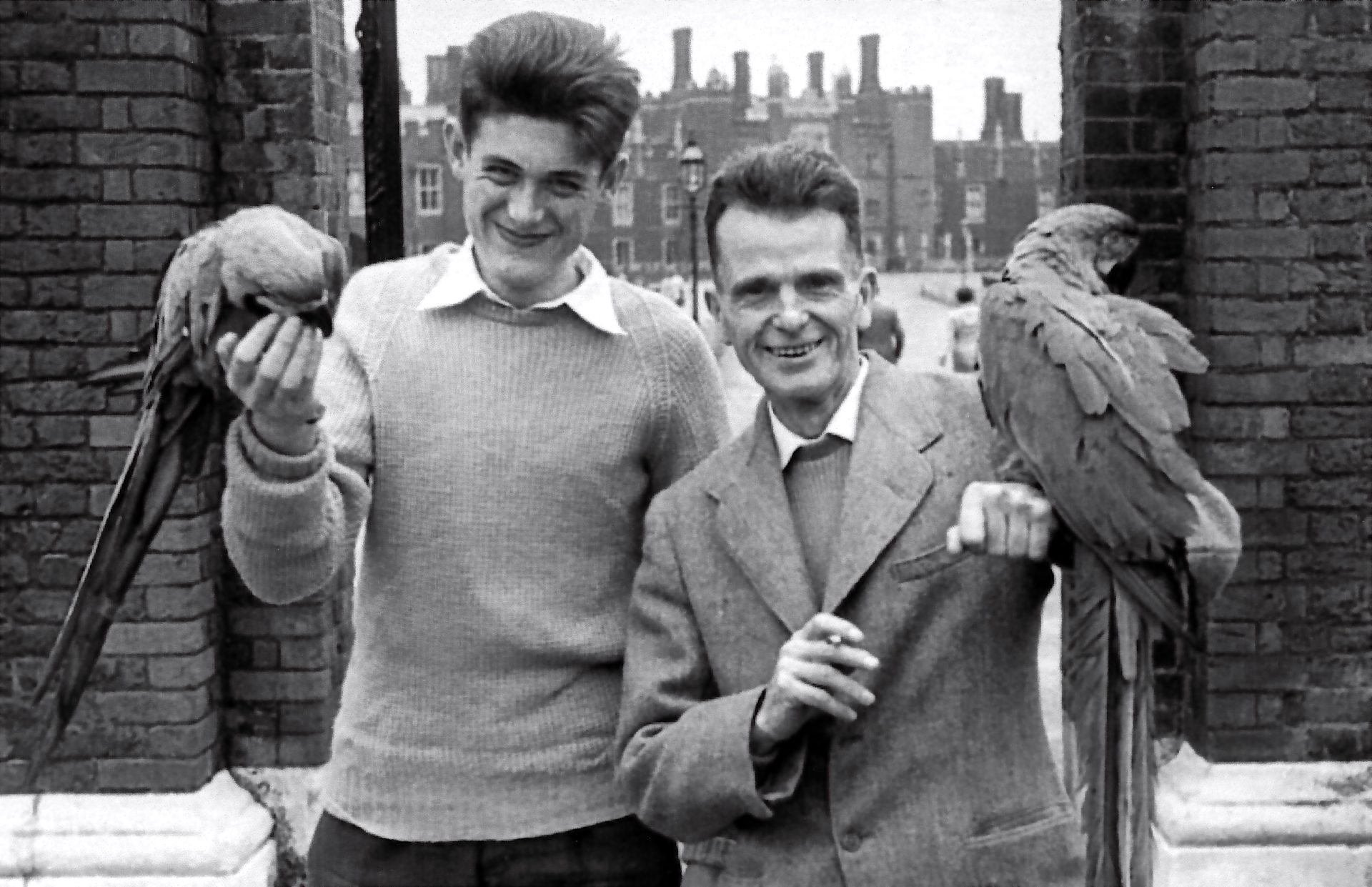
It is Ken who, having been perfectly happy to patronise a man with an impressive camera and two equally striking parrots, stands beside me outside Hampton Court in about 1958.  

My drawing with the artist was a weekly event that had come into being as a result of Mum, through a mutual friend, having been introduced to Ken and showing him my nascent cartoon work ‘Toad in the Wild West‘.  The original masterpiece is long gone, but here is a rough idea of the eponymous character:

I never did progress beyond my first display board of this tale, but I spent many happy and fruitful hours with my friend from whom I learned all I ever did directly from anyone about drawing.

For several years we would spend Sunday afternoons working and then have tea consisting of delicious sandwiches and a fruit salad.  We were occasionally joined for the meal by Ken’s live-in friend George Edwards, an opera singer.

The assistance I gave Ken on one of the Toytown books was a tracing exercise.  Nothing to do with ancestry, this was a method of transferring draft drawings onto display boards for the production of the finished work for publication.  Ken would illustrate the stories of Larry the Lamb, Mr Grouser, and many others in bold colour with firm outlines in pen.  The final drafts of those in which I had a hand were handed to me drawn on good quality fashion plate board.  I would trace these onto fresh tracing paper.  Taking a soft pencil, I would cover the backs of these sheets with graphite, then place the paper face up on the finishing board fixing it firmly in position with a tape something like Sellotape.  I then took a sharp, harder, pencil and traced over my  work, leaving a print on the board.  The artist would ink over the prints and then apply the colour.  I felt very proud to have been entrusted with this task.

When Helen and Bill unearthed my 1965 drawing of Jackie, the story of which will come later, I decided that the very small frame consisting of a piece of board fixed to glass by passe-partout could do with being replaced.  Imagine my surprise and delight when I found, on the ‘smooth surface’ of a George Rowney & Co. Ltd “Diana” Fashion Plate Board behind the drawing, 

some of my own efforts at reproducing Ken’s characters.  I had done these to satisfy us both that I was up to making adequate tracings.

When my bereaved sister-in-law Frances, was working her way through the unenviable task of sorting through Chris’s effects some real gems came my way. None more amazing than this postcard. The stamp on this missive I mailed to my family when we were still living at Stanton Road, shows that first class post in about 1958 cost 2 1/2 pence in old money. Today’s decimalised equivalent is fractionally more than 1p. On January 1st, 2021 the price was raised to 85p. A very early portrait of Queen Elizabeth II is featured. The postmark is illegible, but the content tells me that this was sent from Ockley, where I spent a summer holiday with Ken and George.

When Chris asked me to help him write up his family history, he praised my writing ability, but commented that I had ‘verbal diarrhoea’. What I managed to cram into an area of 63 square centimeters on this small card is surely evidence of this.

In case you can’t read it, here is the text: ‘Dear all. I hope you’re having as nice weather as I’m having. Well done Chris. Send Prof my congratulations. Thanks for the letter mum. I had no idea so much of interest would be crammed into two pages. The first day I ran 3 mls and walked 5. The second day I walked 1! The farm animals come so close to the garden that I can draw them. Last night the farmer, who brings his cattle down the main road twice a day, got into an awful jam on the main road in the dark with them – cars were tearing down at 80, and not seeing his notice. Also Jacqueline there’s a mare with a baby foal which gallops over when anyone comes to the gate. After painting the house yesterday Ken and I went blackberrying – we got loads of them in a very short time. Probably today I will go down ‘weird’ St and do a watercolour. Ken’s cooking is as wonderful as the rest of his housekeeping. P.S. Will catch early morning train home Monday morning so have some dinner for me. Love Derrick.’

I was not the only one writing during this week. Dad was not a letter writer. On my return home he presented me with an unfinished, pencilled, missive that he had not posted. It was a beautiful tribute to me as his son. I carried it in my wallet for years – until the wallet was stolen. He died on Christmas Day 1987. I still treasure the lost letter.

Angela’s Photoshoot

Beneath oppressively leaden skies on an unseasonably warm morning we carried out some tidying of the garden.

Enjoying the sounds of gentle birdsong in the trees; raucous geese honking overhead, and the

clinking and scraping of Jackie’s tools as she trimmed the grass and weeded brickwork, I concentrated on sweeping fallen beach leaves and dead heading in the rose garden and elsewhere.

The bonus of the weather conditions was the diffused light in which to photograph

Summer Wine (too high to reach with secateurs); crisp, pink, Just Joey; constantly blooming white Winchester Cathedral; and the seemingly everlasting Crown Princess Margareta.

Early this afternoon Joseph and Angela visited. Our sister-in-law, a superb Chinese cook, came laden with authentic cooking including some ingredients not available in this country. She brought paper plates so washing up would be negligible; non-alcoholic beers and rosé wine. By the evening she had finished the preparation and served starters of prawn crackers, spring rolls of flavours never experienced here, prawns in garlic, and runner beans with an intriguing taste. Later, came a complex curry and steamed rice to which more prawns could be added to taste. Lemon cheesecake and strawberries were to follow. I finished the Fleurie, while the others drank non-alcoholic beers or rosé wine.

Before settling down to the cooking, Jackie and I accompanied Angela on a

photo tour of the garden.

In addition to her favourites from this collection, I printed her copies of a number of my photographs including this one of

Joe and me from about 1963, and another of

Mum and her five children from 2011.

Elizabeth joined us later.

We have plenty of left overs for another day.

Planning A Garden

Richard from Kitchen Makers visited this morning to check measurements and discuss the work he will be doing for us in other rooms after mid-October. As always we spent quite a lot of time putting the world to rights.

Later, I posted https://derrickjknight.com/2021/09/24/a-knights-tale-39-down-the-drain-to-the-dome/

This afternoon we visited Elizabeth to discuss more of the arrangements for our mother’s funeral. We added to the information and opinions to be given to the vicar to help him with his address. Jackie summed up the changes Mum experienced from a childhood of taking a lighted candle upstairs to bed when there was no light on the stairs to six weeks ago conversing with her great granddaughter on a smart phone in our garden.

Later, the ladies walked around Elizabeth’s garden planning its development.

Naturally I hovered with a camera.

Afterwards Elizabeth produced a meal of well-filled and tasty chicken and leek pie with short crust pastry; creamy mashed potatoes; crunchy carrots; and tender runner beans from her own garden.

Our journey home was hindered by a chaotic traffic hold-up on the A337, forcing an emergency ambulance to cross a roundabout on the wrong side of the road, which was being caused by an extensive queue for petrol by drivers fearful of an impending shortage – despite being advised that this was not necessary.

A Knight’s Tale (39: Down The Drain To The Dome)

At weekends during my last years at school I worked with Dad on his removals van.

On August 29th 2012 I met Michael for a drink in the Hand in Hand on Wimbledon Common.  Fifty-plus years ago, when I drank there with my own father, this greatly extended Young’s pub was a small spit and sawdust independent establishment run by four sisters.  As I was a little early I wandered across the green to look at a grand house into which Dad and I had moved a family at that time.  In the garden was a man, probably in his fifties, having a cigarette.  I told him about the removal, in particular that we had, with a piano we were bringing in, damaged a skirting board at the bottom of the stairs.  I omitted to mention that we had prided ourselves in lifting the small upright upstairs unaided, and dropped it. This man told me his family had owned the house for about that length of time. He would have been one of two little boys excitedly running about their new home. The damage had been repaired.

The removals work with Dad was a pocket money earner beginning in my schooldays which continued on Saturday mornings during my first career, in Marine Insurance.

My first annual salary was earned in the old Lloyd’s (insurance) Building.  It had contained the ‘Room’ of 1928 where all the underwriters carried out their business.  By 1960, when I began, a second Lloyd’s building, which has itself been superseded, had been built, and my building was occupied by the back room boys, such as me.  I dealt with marine insurance claims under the management of Mr. Goodinge, who once gave me a collection of his excellent shirts; and alongside people like Ray Denier who took seven wickets on his first turn-out for my cricket club, and Ian Frederick Stevens, otherwise known as IFS, who was a soulmate for a while.  More importantly, my secretarial work was done by Vivien, who was to become my first wife.  This building, known as ‘The Dome’, had no natural light.  You could never tell what time of the day or year it was, or what the weather was like.  It was here that I knuckled down to what I was assured was a secure pensionable job.  This, then, was more important than strange concepts like job satisfaction.  By correspondence course I set about qualifying for the Chartered Insurance Institute and thought that would be my job for life.  It wasn’t until I became a twenty three year old widower with a baby son that I knew I could do this no more.

The insurance world held me for the first six years of my working life.  I commuted daily on the very route, but on very different trains, that I used today; first from Raynes Park, then after marriage and the purchase of a first house, from Wimbledon itself.  The trains in those days had carriages with which viewers of period dramas will be familiar.  During the rush hour those carrying commuters from Waterloo into Surrey would become packed.  One evening two of my classmates who made such a journey were the first to occupy one of the compartments. 

Each stationed at one of the windows, they pulled grotesque faces and leeringly beckoned to other would-be passengers to enter.  In that way they kept the seats to themselves.  One evening, travelling back to Raynes Park, the train became fogbound.  We remained stationary right outside my home for an hour and a half.

The first three years of my time at Lloyd’s were spent in Leadenhall Street.  From Waterloo mainline station it was necessary to travel on ‘The Drain’.  This was the name given to the Underground journey to Bank station.  I can’t quite remember how it worked, but, at one end or the other of this daily grind there was a long tunnel through which thousands just like me tramped to their destination.  You had to go at the pace of the slowest. 

It felt like a scene from a film about zombies or prisoners of war, silent enough to be “Battleship Potemkin”.  Looking back this seems an awful mole-like existence.  But security was all, and we made our own fun, pulling each other’s legs and taking some amusement from misprints in memos and the joys of the German language.  The Westmonster Insurance Company caused some glee and we became hopelessly incontinent whenever we came across the shipping company whose name sounded like ‘dampsheepfarts’.  There were side streets off Leadenhall Street with provisions stores. I remember a butcher’s which, at Christmastime had turkeys hanging up like a film set for ‘A Christmas Carol’, and, during the winter months, lamplighters climbed ladders to light the gas lamps early enough for me to see them before I set off back down The Drain.

My memory fails me in attempting to recollect the name of the kindly gentleman who was my boss during my brief employment at the Yorkshire Insurance company in Leadenhall Street in about 1963/4. I do, however remember that he bought all his staff ties or other similar birthday gifts from Austin Reed, the upmarket outfitters on Regent Street,

visible from this corner of Brewer Street. I took this practice to heart, and, when I became a Social Services manager myself, gave everyone a birthday card. Since the staff numbers ran closer to three figures, that’s all I could afford.

It was Mike Vaquer, a colleague in the Yorkshire Insurance Company, who introduced me to the pleasures of colour slides as a medium, and took me with him for a year or so to photograph the West End decorations.  The two of us eagerly awaited these annual trips, each descending on the capital from our respective suburban homes.

Mike was a little older than me, didn’t have a family, and could therefore invest in a top of the range Pentax. Mind you, he still needed a rangefinder attachment.  I photographed him on our 1964 expedition.

More than thirty years later, I met another of those colleagues on Victoria Station. He told me that all my contemporaries were still working there. The only difference in personnel was that he had replaced the manager mentioned above. 

I considered that I had escaped a life of boredom when I turned to Social Work in 1966. How this came about will follow in due course.

Woodland Ecology

After lunch today I posted https://derrickjknight.com/2021/09/23/a-knights-tale-38-girls/

The day remained largely overcast, but reasonably warm, so, after a trip to Ferndene Farm Shop we took a drive among the forest lanes.

I am not sure what these tractors were doing alongside Preston Lane, but they were sending up clouds of dust.

We can never normally stop on the A35 to Lyndhurst, but, as a consequence of extensive bridge widening works near Holmsley, there are long tailbacks enabling me to photograph the adjacent woodlands from my window.

We turned left into the road to Burley where

Jackie parked the Modus in order for me to wander into the woodland

with its green and golden bracken, its live, dead, fallen, and decaying trees, and its magical views.

Later, I scanned three more of Charles Keeping’s illustrations to ‘Our Mutual Friend’, each one bearing recognisable portraits of characters previously depicted.

‘Wegg held the will tight, while Venus searchingly and attentively read it’

‘The darkness gone, and a face bending down’

‘Bella kissed her on the cheek’

This evening we dined on second helpings of our Red Chilli takeaway, with which Jackie drank Hoegaarden and I drank more of the Fleurie.

A Knight’s Tale (38: Girls)

Although I was to make up for it later, I was rather late in waking up to girls. When I was about fifteen, and working in my school holidays in the Despatch Department of Cawdell’s, formerly Kennard’s store in Wimbledon Broadway, Dad cajoled me into my first foray into the unknown.

The Despatch Department, at the back of the building, was where suppliers made their deliveries. We would then carry the goods up to the various departments. Dad drove a van that took parcels out to buyers.

That summer, a young lady whose name I have conveniently forgotten, made frequent visits to my workplace from the perfume counter. “You know what she wants, don’t you?”, asked my father. “No”, said I, somewhat bemused. “She wants you to take her out”, was the frightening reply.

Plucking up courage, I made a date. On the appointed day I waited outside Wimbledon Town Hall for an hour. She didn’t turn up. I felt both chastened and relieved.

Her story the next day was that her grandmother was ill. I didn’t really buy that, and didn’t repeat the exercise.

It was two more years before my cricketing prowess was to earn me my first real encounter. Somewhere in North London I took seven wickets for twelve runs in a club match. Two child minders were watching on the boundary. I think they wore the suitable uniforms of the day as they guarded their charges’ prams. One of them in particular clapped and cheered each time I took a wicket.

As we left the field at the end of the game, John O’Rourke pointed to a stunning young lady all dolled up, standing silently on her own. “That’s your nurse”, said John. “No. It can’t be”, said I. Nevertheless, I did walk in her direction.

John was right. I borrowed the entrance money from Chris and took her to the cinema.

North London was a long way from Raynes Park, especially for a schoolboy. This was another exercise not repeated.

It had, however, given me a taste. Nearer to home, a little while later, came the excitement engendered by Angela Davies, the first girl who set my teenage pulses racing.  We had met at the school dance, the only occasion on which we were officially allowed contact with the pupils of the Ursuline Convent.  I had spent a very uncomfortable few days attempting to learn the waltz, at which Angela considered I still wasn’t much good.  Nevertheless she didn’t seem to mind the last one, and we were to share a delightful nine months in 1959.

Towards the end of my schooldays, I worked in the holidays. My first such employment was in Morden industrial estate. During my fifteenth summer, at the beginning of the school holidays I had tramped the burning streets between there and Raynes Park in search of a holiday job.  I landed one in a printing works where my task was to produce glossy brochures. 

(Wikipedia image)

It was there that a beautiful girl told me that I looked like Tony Curtis.  Not being sure whether that was a compliment or not, the gauche teenager I then was had no inkling of the opportunity I’d obviously missed out on.