I may have become slightly out of sequence in this next stage of the long walk, but who cares? I never had much idea of where I was, anyway.
The first few were images from the early stages of the row, as Sam, with James’s guidance, left Henley and enjoyed the width of the River Thames, as he approached Sandford Lock.
Once through, James took the oars,
and we soon passed a young lady in a punt considering modelling for Ophelia.
Cattle and horses, with their foal, drank from the river,
while a red-legged partridge took her chicks for an airing. Can you spot two in the second picture?
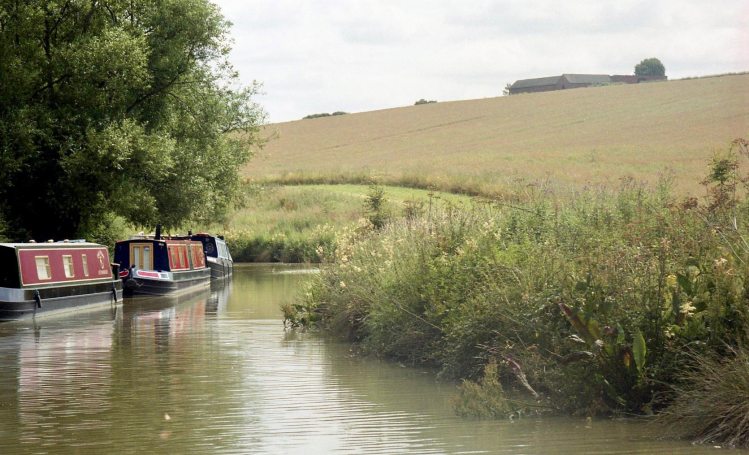
Fast forward to Napton where, with far less oar-space, the lads were making their way through the moored narrowboats.
It was quite likely The King’s Head where we enjoyed a meal and a drink with friends we had found. I was not to know it at the time, but, Don in the front of the image, had given Sam a bottle of rum with instructions not to open it until he had won the Atlantic race. Fortunately he was victorious, and, as a thank you for my support, was to start on it with me.
Just beyond that location is the 250 metres long Newbold Tunnel. As we didn’t have a horse, a couple with a narrowboat offered to tow Pacific Pete through it. Here are the preparations taking place.
This underside of a bridge may or may not be part of the tunnel, but it would be similar.
Goodness knows how I reached the other side, but the standard of towpath was all downhill from here. However, I did, and was able to photograph grasses, convolvulus, and burdock clogging up the potholed paths.
Today the ladies’ colds are subsiding while mine is rising. I wasn’t up to anything else today, but Jackie and I were guided by Becky in the process of producing kiosk strips of passport photos in order to prove that we live where we do for Florence’s benefit.
Jackie did not consider hers suitable for the blog.
Viewers of mine may question whether I was really up to it.
This afternoon I watched a recording of last week’s Women’s Six Nations Rugby match between Wales and Ireland. then today’s live contest between Wales and Scotland.
We dined this evening on Mr Chan’s excellent Hordle Chinese Take Away fare. No-one imbibed.
With all three ladies having streaming head colds, no-one was going anywhere today.
This afternoon I scanned and e-mailed to the cemetery officials a copy of Mum’s grant of probate. Apparently this is necessary to have our mother’s name added to our father’s gravestone. I then focussed on completing a form for recovery of Jean Knight’s Premium Bonds, until I realised that I cannot do this until the Bank Account has been freed.
Checking the renewal of our home insurance policy was straightforward enough.
Next, I read four more chapters of Charles Dickens’s ‘Bleak House’ and scanned the relevant illustrations.
‘Mr Tulkinghorn, standing in the darkness opposite’
‘Sir Leicester finds the cousins useful’
‘Pacing her rooms, her figure twisted as if by pain’
‘She flings the sovereigns on the floor’
This evening, while the others grazed, Jackie and I dined on her delicious chicken and vegetable stewp with which she drank Hoegaarden and I finished the Fleurie.
On the next leg of the Henley to Newark trip of July 2003
grasses and wild flowers still covered the footpaths, and I was treated to what I believe was my first sight of a damselfly.
Sheep and fields of grass occupied the landscape on the opposite bank of the Oxford Canal,
which seemed an unlikely resting place for an iconic red telephone box.
I caught up with Pacific Pete at the Braunston Turn Bridges. theoxfordcanal.co.uk website informs me that this section of the waterway, which shares its route with the Grand Union Canal Main Line as far as Napton Junction, is ‘one of the few places on the entire stretch of the Oxford Canal where there is narrow boat access to another river or canal. It is worth noting from the point of view of use by cyclists and walkers that the towpath really deteriorates very soon after Braunston Turn Bridges. In fact this section of the canal has hardly any towpath in some places and is a real mess suffering from collapse, potholes, mud, nettles and brambles. It can be all but impassable in places if there has been any sort of recent wet weather.’
Founded by Aaron Manby,[1] it is most famous for constructing the first iron steamer, The Aaron Manby, in 1821.[2][3] The boat was assembled at Rotherhithe. She was only the first of a number of steamboats built on the “knock-down” principle. The ironworks have also been responsible for the manufacture of numerous canal and railway bridges of the 19th century.
The ironworks were built near the Toll End Communication Canal[4] on the Horseley estate, which had been sold by their owner at the turn of the 19th century[5] due to demand from engineers wishing to profit on the construction of the BCN Main Line through the estate. The date when the ironworks were constructed is unknown but is believed to have been by 1815.[5] Industry in the area prospered and the location retained the name of the Horseley estate as shown in an 1822 survey of the area.[6]
With the increasing popularity of canals, the ironworks quickly became popular for manufacturing canal bridges, mainly in the local vicinity.[7]Canal bridges made by the ironworks include the Engine Arm Aqueduct(1825), two roving bridges at Smethwick Junction (1828),[8][9]Galton Bridge(1829), and Braunston Towpath Bridges (1830).[10][11] By the end of the canal construction era, Horseley Ironworks had emerged as one of the most prolific manufacturers of canal bridges in the West Midlands region,[5]especially in Birmingham.[12] This was a result of their signature bridge design which had become popular amongst canal constructors. The design has been replicated more recently, for example in Birmingham during the regeneration of Gas Street Basin where Worcester Bar is linked to Gas Street.[13]
Horseley Ironworks were also responsible for manufacturing in the railwayindustry. Railway bridges constructed included that of the viaduct for the London and Birmingham to Holyhead railway at Shifnal, Shropshire which was cast in 1848.[14] As well as manufacturing bridges, they also produced locomotives.[15]
The company also manufactued construction steelwork for the pier of Ryde, the Palace Theatre in London, Rugby railway station, a seaplane hangar in Las Palmas and the Dome of Discovery at the 1951 Festival of Britain.[16]
The firm moved in 1865 to a site on the now defunct Dixon’s Branch, off the BCN New Main Line (Island Line), near the South Staffordshire Railway line. The factory survived under a succession of owners until 1991, when it was closed down and subsequently redeveloped as a housing estate.[4]‘
I managed to keep up with Sam and James in the boat whilst, having passed under the elegant bridge from the time of Queen Victoria’s predecessor, King William IV, they negotiated their way through a narrowboat-congested area to the next flight of locks. As can be seen, there was barely room for the lengthy ocean-going oars.
Eventually the rower was once more under way.
After this, I had to find my way up and down various hilly areas, where I was surprised in the darkness by the only badger I have ever seen alive. I was amazed at how fast it could run. It was fortunate that the creature took off in the opposite direction, because running anywhere, by that time, was quite beyond me.
Ian returned to Southbourne for work this morning. After lunch Jackie and I drove to Tesco for some shopping, and continued into the forest.
As we turned into Hordle Lane yellow-brown ochre clouds flung a hatful of
every kind of precipitation at our windscreen as photographed by Jackie. Sleet and snow were lashed by brisk gusts of north wind making the 6C degree dropped temperature feel much colder.
During an apparent cessation I left the car to photograph an eponymous sculpture on Woodcock Lane, and was soon beset by further soft white flakes and ice-hard pellets which spared the ubiquitous laurel blossoms.
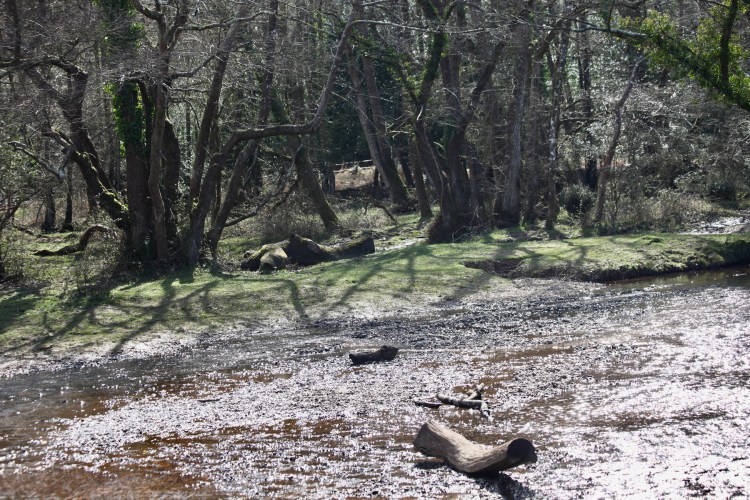
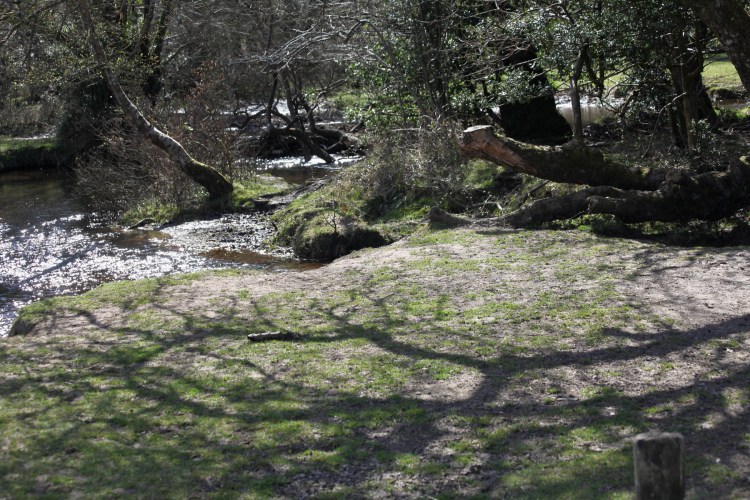
I wandered around the rippling Wootton stream alongside which a pair of discarded wellies aroused speculation. Lengthy striate arboreal shadows criss-crossed water surfaces and cropped banks alike. The last picture in this gallery is by Jackie.
Fluffy cotton clouds soon replaced the earlier heavily laden ones as cerulean skies returned.
The widening of the A35 bridge at Holmsley, scheduled to be completed next week will not now be finished before June. The causeway leading to it is not normally a road on which it is sensible to stop. Now it is closed we were able to sneak along it and I could nip out and photograph the woodland and its denizens below.
The landscape of Longslade Heath was dotted with grazing and reclining ponies.
South Sway Lane’s verges were enhanced by robins and primroses.
This evening we dined on Jackie’s beef pie meal and/or chicken and vegetable stewp with which I drank Patrick Chodot Fleurie 2019.
On this third dull afternoon as winter attempts a resurgence tomorrow Jackie and I took a forest drive after collecting repeat prescriptions from Milford Pharmacy.
Alongside Angel Lane, where we spotted our first clump of bluebells, a pair of forest horses lunched on hay heaps.
Silent crows perched beside Milford Road.
Jackie photographed me photographing oyster catchers and gulls against the backdrop of the Isle of Wight from Tanners Lane where she also pictured
blackthorn in a hedge, and I focussed on a friendly guide leading a young rider.
A couple of donkeys crossed from one side of the lane to the other in order to squabble over a row of chopped carrots. The loser didn’t get much of a look in.
When I disembarked in Sowley Lane to photograph a ploughed field. one pheasant nipped into a hedge and anther enhanced to field landscape. The fourth of this set of pictures is Jackie’s.
A pair of thirsty ponies enjoyed a meal of cold soup in the pool at the corner of St Leonard’s and Norley Wood Roads.
On the roof of the shed of a house opposite we noticed a boat weather vane, and while waiting for a tractor further along I photographed more blackthorn.
As we swung round Lymington River a cormorant stretched its wings atop a red buoy.
For dinner this evening the Culinary Queen produced her wholesome beef and onion pie; boiled potatoes; crunchy carrots and cauliflower; and tender cabbage with which she and Ian drank Hoegaarden and I drank Azinhaga de Ouro Reserva 2019.
Staircase locks are used where a canal needs to climb a steep hill, and consist of a group of locks where each lock opens directly into the next, that is, where the bottom gates of one lock form the top gates of the next. Foxton Locks are the largest flight of such staircase locks on the English canal system.
The Grade II* listed locks are a popular tourist attraction and the county council has created a country park at the top. At the bottom, where the junction with the arm to Market Harborough is located, there are two public houses, a shop, trip boat and other facilities.’
On the day Sam guided Pacific Pete down this staircase, family visitors were out in force. For once I was ahead of my son, and reached the locks in time to learn that the canal-side telegraph was buzzing with the news that a large rowing boat was on its way through.
The audience gathered to watch Sam use his giant oar to steer and propel the boat through the locks where there was no room to row.
Did you notice the Asian man gesturing to his family in the third picture, and shepherding them over the bridge in the last, in order to lead them down the slope to see the rower on his way?
There had been no shortage of helpers to push the long balance beams operating the gates.
There were plenty of narrow boats on the waters, but no other ocean-going rowing boats.
Much of this afternoon was spent on the administration required to access the funds from Mum’s estate. An hour was spent in Barclay’s Bank in Lymington. Before then, Ian, who had driven me, pointed out that I had erroneously entered Lloyd’s Bank. We then had to find Barclay’s. Next, I had to wait for the one available advisor who asked me for I.D. I had no satisfactory photographic evidence and my NatWest Visa card wasn’t acceptable. Furthermore I should be dealing with the bank’s bereavement team. The only three comparatively local branches capable of this were located at Southampton, Ringwood, and Bournemouth.
The very helpful staff member took all my details, filled in a form, scanned this and the grant application document, e-mailed these to the bereavement team, and gave me the direct line number to phone them. I did that when we returned home and was informed that Mum’s account would be freed and I would be sent confirmation of this with the final balance.
I then telephoned the Premium Bond offices to free our mother’s funds in their account. I will be sent forms to complete for this.
Later, I scanned the next three of Charles Keeping’s illustrations to ‘Bleak House’.
‘The Sol’s Arms’
‘ ‘My dear friend,’ says Grandfather Smallweed’
‘Miss Flite’
This evening we all dined on Jackie’s smoked haddock; creamy mashed potato; piquant cauliflower cheese; crunchy carrots and tender runner beans, with which the Culinary Queen drank M & S rosé and I drank more of the Tulga.