The Missing Slides

According to Wikipedia, ‘The Bluebell Railway is a heritage line running for 11 mi (17.7 km) along the border between East and West Sussex, England] It uses steam trains which operate between Sheffield Park  and East Grinstead, with intermediate stations at Horsted Keynes & Kingscote.

The first preserved standard gauge steam-operated passenger railway in the world to operate a public service,[1] the Society ran its first train on 7 August 1960, less than three years after the line from East Grinstead to Lewes had been closed by British Railways.

On 23 March 2013, the Bluebell Railway commenced running through to its new East Grinstead terminus station. At East Grinstead there is a connection to the UK National Network, the first connection of the Bluebell Railway to the national network (in 50 years) since the Horsted Keynes – Haywards Heath line closed in 1963.

Today the railway is managed and run largely by volunteers. Having preserved a number of steam locomotives even before the cessation of steam service on British mainline railways in 1968, today it has the largest collection (over 30) of steam locomotives in the UK after the National Railway Museum. The Society also has a collection of almost 150 carriages and wagons, most of them pre-1939.

By August 1969, therefore, the steam trains that had run past 29a Stanton Road, where I grew up, no longer ran past the maisonette. Perhaps that is why Jackie and I, with Michael and Matthew, joined our then friends, Sue and Keith Bannister for a ride on the Sussex tracks. Keith and I both took our cameras to record the event.Sue, Keith, and Matthew 8.69Jackie and Matthew 8.69

Today I scanned most of my batch of slides. The first set were taken inside the historic train. Matthew probably didn’t appreciate a camera being pointed in his direction.

These old corridor trains contained carriages in which two rows of people occupying upholstered seats that can be seen in the first two pictures faced each other. Not counting those who, in the rush hour, were forced to stand, there was room for perhaps a dozen passengers in each compartment on the national railways. The story of how two of my classmates ensured their sole occupancy of such a set of seats at such a time is told in ‘The Drain’.

Keith and Michael each spent some time standing at the windows in the doors. Keith 8.69Michael 8.69

It is not possible, as is often done in period dramas, to open these doors on the move, and looking out of the windows was not recommended. This is because there were no electronic locking devices in those days. The window was lowered or raised by adjusting the notches holding a leather strap, and the door had an albeit strong levered catch. If you wished to hang outside the carriage, either to get a breath of fresh air or to escape a would-be murderer, you could. Similarly, by doing what Keith was doing, you could risk being decapitated as the conveyance careered through a tunnel. Michael was still short enough not to be tempted into such risky behaviour, and Keith would, no doubt, have drawn his head in when necessary.

The differences in approach to photographing the trains in their yards between Keith and me was interesting. Keith concentrated on the whole train in its setting, whereas I focussed on sections in close up. Unfortunately only one of my efforts has survived. This is because I was so pleased with them I had some A3 prints made by a professional and somehow managed to lose the original slides. Only one of the prints is still in my possession, and that is too large for my scanner.

So how was I to reproduce it for this post?

Obviously I needed to photograph the photograph. But I am no Ken Morse, and without his rostrum camera, there was bound to be some distortion at the edges of the new picture. A very small amount of trimming was required.

Here is the sole representative of an afternoon’s exploration of beautifully polished brass, heavy wheels, and all the other delightful examples of that machine age:Steam dome

I always delight in asking viewers of this print what they think is being portrayed. What do you think? The answer will be provided tomorrow.

This evening we dined on pork rib rack with a barbecue glaze, stir fry peppers and onions, fried rice and green beans followed by rice pudding and strawberry jam. Jackie drank Hoegaarden and I drank more of the Bordeaux.


Dandy’s Spread

Pheasant

This morning, I managed my umpteenth pheasant focussing failure.

Saying this is surely simpler.

For lunch, Jackie drove us to Elizabeth’s at West End, where we had been invited to join the Mothering Sunday party.Mum, Elizabeth and Jackie

Present were three mothers: Jean, Elizabeth, and Jackie.Elizabeth, Mum and Derrick

Jean, of course, is the mother of both me and my sister,Mum, Elizabeth and Danni

who is the mother of Danni, our Mum’s granddaughter.

Danni and her partner Andy, now affectionately known jointly as Dandy, had, for Mothers’ Day, spent a great deal of time and effort in preparing quite the most splendid succulent roast beef dinner the rest of us had ever enjoyed. I am confident that even Jackie, whose culinary expertise is well known to my readers, would agree with me.Dandy's roast beef dinner

The spread was laid out on the circular kitchen table from where we helped ourselves, filling up our capacious plates and trying to make steady enough progress into the dining room to avoid having to eat any of our food off the spotless newly painted wooden floor.

The roast beef, potatoes, and parsnips were just as I like them; the gravy was full of goodies; there were tasty pigs in blankets (small sausages wrapped in bacon); the carrots, brussels sprouts, green beans, and sweet potato were suitably crisp; small button onions and whole cloves of garlic had kept the potatoes company in their roasting dish and naturally joined them on our plates. If you think I could have overlooked any elements of this magnificent repast, I suggest you click on the image above, and examine it closely.

After this we enjoyed lemon tart and apricot flan with cream. Plentiful cheese and biscuits were on offer later, because no-one could contemplate eating anything else immediately after the first two courses. Knowing I prefer bread to biscuits, Elizabeth had bought a very special crusty white loaf just for me. I was unable to cut into it, settling simply for a small square of mature cheddar.

Red wine, fruit juice, and Peroni were variously imbibed, and coffee was to follow for those who had room for it.

Much of the inevitable reminiscing has already been recorded in previous posts, but as is often the case when we have shared a good meal together, we spoke of other foods, calories, and dieting; and, in particular, what we had enjoyed as children. Mum, of course, could go back much further to her own 1920s childhood. One of her father’s favourite meals was tripe and onions. Tripe is the edible offal from the stomach of a cow, a pig, a sheep, or an ox. Although I’ve never tried it, I don’t think it tastes of much, although that of an ox appears to have the most flavour.

tripe-and-onions

This illustration is of what is called the honeycomb type which comes from the animal’s second stomach. The counties of Lancashire and Yorkshire have differing methods of cooking it, viz:

‘Original Receipt in Marjory Houlihan’s ‘Tripe – A most Excellent Dish‘ (2011);

LANCASHIRE
2 Spanish Onions
½ Pint milk
1½ lb pre-cooked tripe
seasoning
1 oz flour
pinch nutmeg
1 oz butter
toast
Peel the onions and stew them with the tripe, just covered with water, until tender. Drain, reserving half the pourings. Cut the tripe into pieces; chop the onions.
Melt the butter in a heat-proof dish and mix in the flour, slowly add the tripe and onion pourings.
Stir until boiling, add the milk, seasoning, tripe and onions, and simmer for 10 to 15 minutes.
Serve with toast. For four people.

YORKSHIRE
1 lg dressed tripe
1 oz butter
1 lb sliced onions
1 oz flour
salt and pepper
2 tbsp grated cheese
½ pint each milk and water
Cut the tripe into bite-sized pieces and put into a saucepan with the onions, milk and water; season to taste.
Bring to the boil, cover and simmer gently for an hour, or until the tripe is tender.
Mix the butter and flour together, and when all the flour is absorbed break into small pieces and put into the tripe, stirring all the time until the liquid thickens.
Transfer to an ovenproof dish, sprinkle grated cheese over the top and brown, either in the oven or under a hot grill.’

In our family this could have been interesting, for Grandpa Hunter was from Yorkshire, and Grandma from Lancashire.

 P.S. Inevitably I forgot something. I am grateful to Kate Loveton for mentioning the Yorkshire pudding.

Procrastination

Desk untidy

This morning was spent making up for procrastination in various ways. My desk sits in the hall that doubles as a study. Despite the fact that I know where everything is, it does become a little untidy. Jackie never complains, but I know she would rather visitors saw some sort of order when they entered the house.

DowelBefore moving some of the material from on and under the desk into the hall cupboard this required a little repair. The door of the Chinese cabinet is hinged with wooden dowels, one of which was broken in the move to Minstead in November 2012. The damaged piece needed to be drilled out to make room for a replacement which Jackie had bought soon after our arrival at Castle Malwood Lodge. I thought I had better get around to that, and fixed it before tidying up the desk. When they were children, Matthew and Becky bought me the slate coasters that are now visible and can serve their proper purpose instead of delegating that to any bit of paper or blotter that could be reached.Desk tidiedDesk after cleaning

It looked even better after Jackie had got at it, made a few adjustments, and cleaned the computer screen.

For a while we have been meaning to check the contents of the oil tank. I did that. It was a bit low, but not crucially so. A similar task was arranging the next emptying of the septic tank. I did that by e-mail.

It must be four or five months since I last had a haircut. Again, we have been saying for some time that I needed one, especially as anyone might think I was trying to recover my long haired days, which would probably be a bit sad. Jackie did it in the kitchen this morning whilst I sat and watched tits, robins, chaffinches, pigeons, and sparrows flitting past the window and enjoying their breakfast.

Derrick reflected in computer screen

When asked to photograph her handiwork for the blog, Jackie had the bright idea that I should repeat my previous unwitting image of a good haircut, so I photographed my nice clean Apple screen.

It was another Six Nations Rugby afternoon. I watched it on television. In the first, quite the best game of the tournament so far, Wales, in Cardiff, beat Ireland 23-16. In a rather less intriguing contest at Twickenham England beat Scotland 25-13.Aaron

Aaron continued his work on the back drive, which is looking very good.

This evening we dined on pork rib rack marinaded in barbecue sauce, and Jackie’s egg fried rice and stir fry vegetables with teriyaki sauce. I drank Chateau Les Mourleaux Bordeaux 2012, and Jackie didn’t.

She Stoops To Conquer

Jackie lunched with her sisters yesterday. As is not that unusual this resulted in a printing project for me. She brought back three more photos of her parents.

Mum R and friend Sheila 1937 back tapeThe first was of her mother and her friend Sheila, the pairing who had featured in ‘A Statuesque Beauty’. My task today was far more difficult than the scanning and printing of the earlier photograph. Indeed, it was the most daunting challenge of this nature that I have, naturally most willingly, taken up. This time I was presented with a print of 8 x 5 centimetres, including the margin, in size. It was badly torn, ink stained, and taped up on the reverse. The tearing had effectively created holes in the print. Correction of all this requires careful application of the retouching tool.

As I understand it, the essence of retouching is that you are transferring pigmented pixels from neighbouring areas in order to mask blemishes. The missing sections are effectively blank paper, and beyond my skills to cover completely. This is what the original looks like:Mum R and friend Sheila 1937 original

And here is the result of my effort:Mum R and friend Sheila 1937

These two sixteen year olds were dressed in their outfits for their school presentation of Oliver Goldsmith’s comedy, ‘She Stoops to Conquer’.Don Rivett c1959 002Don Rivett c1959 001

Compared with this, scanning and printing a couple of photographs of Don Rivett c1959 was a piece of cake. From the little wallet in which these have been contained, they are the work of Penge Studios of 82 High Street, London S.E.20. That building is now occupied by a cycle shop.

Jackie’s father wears his uniform of the Kent branch of the Civil Defence Corps. Wikipedia has this to say about the organisation: ‘The Civil Defence Corps (CDC) was a civilian volunteer organisation established in Great Britain in 1949 to mobilise and take local control of the affected area in the aftermath of a major national emergency, principally envisaged as being a Cold War nuclear attack. By March 1956, the Civil Defence Corps had 330,000 personnel.[1] It was stood down in Great Britain in 1968, although two Civil Defence Corps still operate within the British Isles, namely the Isle of Man Civil Defence Corps and Civil Defence Ireland (Republic of Ireland).’

My favoured paper for making these particular 5″ x 7″ prints is Ilford Gallerie pearl. I only had one sheet left, so this afternoon Jackie drove us to Wessex Photographic in Ringwood, which is the nearest outlet where I have found it. They didn’t have any, so I bought some Canon Photo Paper Plus Glossy II, which is all they had in the size I wanted. As this is also the only place where I can be certain of finding my Series 8 inks, although I didn’t think I needed any, I bought a few spares. Almost as soon as I had begun printing, two of the inks were exhausted. One that I had just acquired was Cyan, and I hadn’t already got a spare. The Canon Pro 9000 printer uses 8 different inks, and, even if you are printing in black and white and have an active black ink, it will not work if there is just one colour missing. So it was a bit of luck to have bought the right one.Mr Pink's Fish & Chips

This evening Jackie drove us both down to Mr Pink’s Fish & Chips shop in Milford on Sea, to buy our takeaway dinner.Fish and chips and pickle fork

We enjoyed cod and chips, pickled onions, and gherkins. So free of grease is this superbly crisp food, that ‘The Great British Take Away’ paper bags in which it is presented are perfectly fit for recycling. Not least is the requirement for pickled onions to be kept crisp. The one on the plate was bought at Mr Pink’s. Those in the jar are Garner’s. In order to retrieve them from their container, we now use the “Auto” silver plated retro pickle fork complete with its original box that Elizabeth bought me for Christmas. If I don’t mention that I was very confused about how to use this very simple implement the first time I tried, I am sure that one of my dear family readers will make the obvious comment.

An Opened Garden

Cuttings on path

Front path lined

Yesterday Jackie carried out some further heavy pruning and clearance in the shrubbery at the front of the house. This meant that before I could continue with the path, I needed to cart several barrow loads of branches and dead plants to the far end of the garden. Well, she is the head gardener, and I did have the dubious bonus of returning each trip with a quantity of stone for the edging recycled from the soon-to-be rose garden.

After this, admittedly rather painfully, given that the knee didn’t really appreciate what it had been expected to do, I wandered around the garden listening to the music of the birds. The tits enjoyed the feeder, and the pheasant, until sent off squawking by my presence, strutted around, returning to be photographed later through the kitchen window. You may need to zoom on the second image here in order to spot this visitor..Blue titPheasantComfrey

IMG_2271Elephants' ears

Comfrey, leucojum, and elephants’ ears are now vying for space with all the other spring flowers.

I felt very satisfied that the garden we had spent all last summer opening up is really coming into its own.Bench on shady path

The bench on the shady path, so called because at first it admitted no sunlight, was suitably inviting.Pansies and daffodils in chimney pot

Plants, like these pansies and daffodils, in the chimney pots are blooming.Five ways

This particular pot is situated at five ways, which takes its name from the number of paths that radiate from it. The prunus in the foreground has recovered from severe pruning. We don’t know what the magnificent evergreen is.Heligan path

The Heligan path, named after The Lost Gardens of Heligan, because we didn’t know it was there, runs alongside the weeping beech. The log pile continues to grow, and the IKEA wardrobe sections keep triffids from next door at bay.Bed alongside weeping birch

The bed we cleared on the other side of the tree is burgeoning.chair and bed head

The bed head behind the chair in this picture was screwed to the tree, and can be seen from the side in the Heligan path shot.Camellia through euphorbia

We have cut down much of the euphorbia which covered the garden but left some, such as that which shrouds this camellia, to bloom later..CamelliasDaffodils, hellebore and fallen camellia

The camellia flowers themselves, as they fall, adorn the paths and the soil where they lie.Daffodil and cyclamen

Almost all the cyclamens have survived the gentle winter.

Later this afternoon I had a bonfire.

I am happy to report that we still had plenty of Jackie’s delicious chicken jalfrezi and fresh savoury rice for our dinner this evening. They were accompanied by paratas and Hoegaarden for Jackie, and the last of the claret for me.

Hoisted By My Own Petard

Front path

This morning, whilst Jackie continued with her planting, tidying, and extensive garden maintenance, I carried out some more work on refining the gravel path in the front garden. This involved marking out a line, digging up and either moving or rejecting stray plants, and  replacing some rocks and concrete that line the side nearest the house. Some of the hellebores were so interested in my activities that their normally shy flowers actually raised their heads. These can be seen my clicking on the image above.

‘A Suitable Boy’, Vikram Seth’s novel, a magnificent saga of an Indian family, came up in conversation recently. Although not normally a name-dropper, I just had to mention that I had received a very complimentary letter from the author a dozen years ago. In ‘The Listener Setters’ Dinner’ I describe how this came about.

The Times Listener Crosswords were ones that I enjoyed setting during a period of about twenty years. They are termed ‘advanced cryptics’ as they are very difficult both to create and to solve. The clue solving was often the easy part, as there is always a final twist that requires further thought and activity. One of my devices was to involve solvers in producing a drawing at the end. Four-Letter Word was one of these that earned the praise of Mr Seth.

Thinking it might be fun to present this to my WordPress readers, I consulted my albums of published puzzles. Because of the nature of this work, I was required to solve the entry method. I couldn’t do it without a struggle that took me quite a long time. Well, it was as long ago as 12th October 2002 that it appeared in the newspaper. The solution, published on 2nd November, for reasons that will become apparent, didn’t have much printed in the grid. Thus, I was hoisted by my own petard.

I am fully aware that most of my readers will not be familiar with cryptic crosswords, so I will not bother you with the clues. It is the theme I would like to offer.

The drawing I wanted to create needed flowing curves. How on earth was I to manage this on a typical square grid? It was after six months thought that I hit upon the idea of using hexagons in a honeycomb. That particular device was not original, but I like to think the use to which I put it was.

Focussing on the preamble and the grid, and ignoring the clue column, this is what solvers were presented with:Four-letter Word 001

The preamble is the paragraph on the left beneath the title. It explains what is required in addition to solving the clues. The grid is where the answers are written.Four-letter Word 003

Examples of entries given in the above illustration are 30 REGRET, 31 RIPPLE, and 32 PENNON.Four-letter Word 002

Once the whole grid has been completed and the correct sequence of letters blocked in, an outline that could be a cat is produced. I have used a highlighter to make it stand out. The initial letters of the 8 letter answers, in clue order, spell out CHESHIRE, helping to identify Lewis Carroll’s character. For clarity I have not confused the issue with a fully completed grid.Cheshire_Cat_Tenniel

With a little artist’s licence, solvers will have reproduced a suggestion of Sir John Tenniel’s famous illustration to Alice’s Adventures in Wonderland.

Four-letter Word 004

In that story, the creature disappears leaving its GRIN. Thus, according to the preamble’s instructions, solvers, having used a pencil, are to rub out everything but the four-letter word appearing above hexagon 38. This location is shown in the entry examples given above.

This evening, for our dinner, Jackie’s delicious chicken jalfrezi and egg fried rice was supplemented by the contents of a doggy bag provided by Lal Quilla last night. We were grateful that Elizabeth hadn’t been able to finish the chef’s special that she had enjoyed. So did we.


In The Verges

Today was sunny and warmer. I made my way this morning down to Roger’s footpath and back. This was more of a hobble than a ramble, but the swelling on the knee has subsided and I have left off the Ibuprofen.

To be found in the verges of Downton Lane are:Crocuses

CrocusesButtercupsButtercupCelandines

Primroses

PrimrosesPrimulas

PrimulasCelandinesCelandine

More celandinesDaffodil

DaffodilsGrape hyacinth

Grape HyacinthsBudweiser can

and drink cans, like this one from Budweiser which will soon be nestling in ladies’ bedstraw.Celandine blue

We have blue celandines in the garden, whereNew bed

Jackie has continued work on the new bed,Chain

and we have erected a plastic chain to enhance the barrier at the end of the drive. This seems at least to have deterred a plumber’s van.

Chaffinch

When the tits give them a chance, chaffinches are now visiting the bird feeders.

This afternoon Jackie drove us to Lymington Hospital for my pre-assessment to see whether I am fit for surgery for the fasciectomy. After completion of a questionnaire, checking of blood pressure and pulse rate; measuring height and weight and calculating BMI; taking swabs from nostrils and groin to check for MRSA; applying an ECG; taking blood tests; and anything else I might have forgotten, it seems that I am. The operation should take place some time in April.

Elizabeth came for a visit and, later, we drove off to Lymington’s Lal Quilla in our separate cars, and enjoyed the usual excellent meal and friendly service, including a chat with the chef who really loves his work. My meal was king prawn naga and special fried rice. We all had onion bhajis for starters and drank Kingfisher.

Emulating The Master

Window box primulas

Primulas ready for plantingOn another dull morning my matinal amble around the garden was again brightened by Jackie’s fresh planting. She has filled the first window box on the front wall with primulas, more of which, in pots, she has placed ready for insertion into the new bed, further built up by Aaron, that was once the compost heap.

Clematis Cirrhosa

Our winter flowering clematis Cirrhosa has developed well over the last five months.Camellia in jungle

A pale pink camellia has forced its way through the jungle of the abandoned garden next door.

Later, delving into my archives, I travelled back to July 1967 and scanned a batch of colour slides of that date. At that time I was very keen on the work of Bill Brandt, who according to Wikipedia, ‘(born Hermann Wilhelm Brandt, 2 May 1904 – 20 December 1983[1]:14), was a British photographer and photojournalist. Although born in Germany, Brandt moved to England, where he became known for his images of British society for such magazines as Lilliput and Picture Post, later his distorted nudes, portraits of famous artists and landscapes. He is widely considered to be one of the most important British photographers of the 20th century.[1]‘bill_brandt_20Nude-East-Sussex-Coast-1959

What intrigued me most was the photographer’s focussing on sections of his models set in the landscape, giving the impression that they were part of it.

With Jackie as my muse, and Brandt as my inspiration, I made a series of photographs including knees and elbows.

Jackie 7.67 002Jackie 7.67 002 - Version 2Jackie 7.67 004Jackie 7.67 004 - Version 2Jackie 7.67 004 - Version 3Jackie 7.67 006Jackie 7.67 006 - Version 2Jackie 7.67 006 - Version 3Back in 1967 I left these images as they were. Brandt worked in black and white. Today, by reducing saturation, increasing contrast, and selecting crops, I had a stab at emulating the master, adding my own touch by using hands and face.

This evening we dined on Jackie’s perfected chicken jafrezi (recipe) and really special fried rice, with minty vegetable samosas. The recipe for the rice is essentially that for the savoury one, with finely chopped omelette mixed in.

My wine was a wonderfully smooth claret, Chateau Gabaron 2012, which came in a hamper from the House of Bruar that Luci and Wolf had sent us for Christmas. Jackie drank her customary Hoegaarden.

A Dictionary Battle

Planted tubs 1Planted tubs 2

A very dull afternoon was brightened by the tubs at the front that Jackie had planted up in the morning; and the trills of songbirds in the trees, as I wandered around the garden.Goldfinch

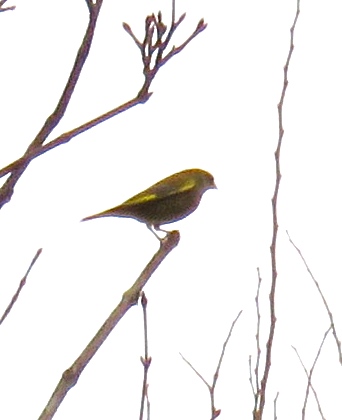
iPhoto, aided by the Canon SX700 HS lens, helped me to transform a tiny black silhouette high up in a tree into a colourful goldfinch. The computer’s dictionary found this bird far more acceptable than yesterday’s greenfinches which it had insisted on changing to goldfinches. After a battle it allowed my word provided I accepted red underlining in the draft. I trust it is happy now.Back drive

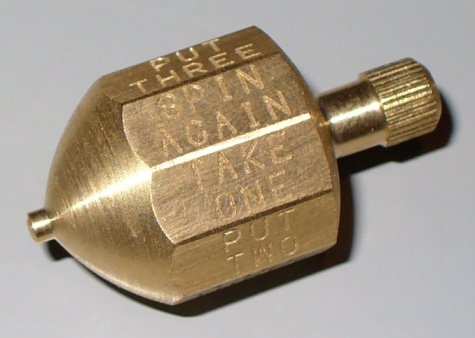
Yesterday Aaron continued with his transformation of the back drive. He has now completed one side and most of the other one. Excess soil has been transferred to the verges and to the rose garden. I had dug out some of the bricks you see in the picture from what was then the kitchen garden. Many of the concrete slabs removed from there have been recycled elsewhere, and now that it has become a two way traffic I am reminded of my mother’s phrase: ‘You are playing put and take’, which she applied when we children were carrying out a similar process for one reason or another.

Mum was referring to the title of a game that first became known during the First World War (1914-18).
‘The full history of the game is unclear but It is thought to have been invented by a soldier in the trenches.
The original game was made from a brass bullet that the soldier shaped into a spinning top with six sides.
Each side had an instruction on that was either Put one, Put two, Put all, Take one ,Take Two, or Take all.
The top was spun by players, who each put an ante in the pot (said to be a cigarette), and depending on how the top fell
either took or put how many cigarettes indicated.
The game became so popular that during the 1920-30s it was introduced as a gambling Game and was predominantly played
in the North of England in Working mens clubs and pubs. Because the top would last virtually forever, being made of brass,
the production of the game did not last for long and during the next 40 years the playing of the game gradually died out.

Rules:
Any number of players can play. Each player puts a coin or chip in the pot.
The first player spins the top. If the top come down “Put” side uppermost the player puts into the pot the amount indicated (i.e. Put one two or All).
For “Put All” the player doubles the amount in the pot. If the spinner lands with “Take” side uppermost the player takes the amount indicated from the pot.
For Take All the player takes the whole pot.
The next player spins and the game goes on until somebody spins “Take All” and the game is re-started with a new Ante.’

The game is still popular today. Here is a modern version of the soldier’s bullet:top-pt_18

IrisPrunusCamellia

The small blue irises are multiplying; the previously pruned prunus is flowering; and the pink striped camellia is in full bloom.Pheasant

Our stately visiting pheasant frequently stretches its talons around the garden. Later this afternoon I was able to get a bead on it through the kitchen window as it pecked up spilled scraps from the greenfinches’ feeder. As soon as I joined it in the garden, it flailed its forelimbs, and flapped off in a flurry far over neighbouring firs. I do hope no-one shoots it before I get it properly in focus.

This evening we dined on Jackie’s charming cottage pie, with piquant cauliflower cheese (recipe), crisp carrots and cabbage; followed by crunchy raspberry crumble. She refrained from imbibing, whilst I finished the Cotes du Rhone Villages.


Sharing A Meal

Unidentified plant 1Unidentified plant 2Unidentified plant 3

When we arrived in Downton on 31st March last year, clumps of large leaves were present in the front garden. Following our policy of giving unrecognised plants time to make themselves known, we refrained from disturbing them. These produced nothing more until now. We don’t know what they are. Does anyone? The holly leaf in the first picture gives the scale of the small blue flowers that have poked their heads out. The next two offer enlargements as an aid to identification. The fresh foliage is much smaller than it will be in the summer.

PrimulasPrimulas 2Allium

Today I took a slightly longer and more gainly hobble around the garden than yesterday. Other new arrivals are different varieties of primula, and the first of the numerous alliums which will crop up everywhere as the year goes on. These latter are very welcome in the beds, but far too many of them pierce the gravel and brick paths. As the weather warms up their heady aroma is nowhere near as appetising as that of the frying onions that tempt you to stop at a hot dog stall. Indeed, when we first savoured it we thought there must be a problem with our septic tank.

Tete-a-tete daffodils

Among the new daffodils are tiny tete-a-tetes.

Brick barrier

A single layer of bricks that, last week, Aaron placed at the end of the back drive in order to deter offending vehicles, has survived unscathed.

During our lunch we watched others enjoying theirs. Through the kitchen window I was able to photograph the avian diners.Greenfinches 1

First, a pair of greenfinches sat opposite each other, as did Jackie and I.Greenfinch

When I reached the window, one flew off, leaving its less timid mate in sole possession.Greenfinch and blue tit 1

It is not usual at the moment for different species to share a meal, but our then unaccompanied visitor seemed content to accommodate a blue tit.Greenfinch and blue tit 2

Once this little creature hopped down to a lower perch,Greenfinches and blue tit

The more cautious greenfinch joined the party, the couple remaining on the alert to repel any more boarders, but allowing their companion to continue lunching.Greenfinches 2

Finally, the smaller bird having had its fill and flown off, the braver greenfinch took its place on the lower berth, whilst its mate emulated the cow in the hedge.

My egg and bacon wasn’t too congealed by the end of this little interlude.

This evening, for our dinner, Jackie produced her classic cottage pie, cauliflower, carrots, and brussels sprouts, followed by a juicy raspberry crumble. She drank Hoegaarden and I drank Heritage de Calvet Cotes du Rhone Villages 2013.

P.S. Jackie thought the plant was possibly borage, and Vicki Haynes confirmed it. This enabled my lady to do further internet research, establishing it as a perennial borage, boraginaceae trachystemon orientalis. In UK it is termed Oriental Borage. In Turkey the plant is eaten as a vegetable.