The Decameron

This morning I got my head around Judy’s Holiday Challenge and published my earlier post of today – the first of 10.

This put me in mind of Giovanni Boccaccio’s Decameron which I read 60 years ago in my Folio Society fifth impression of 1960. The work has been translated by Richard Aldington.

Despite the exquisite, mostly erotic, aquatints of John Buckland-Wright, my recollection of the stories – 100 to be related in 10 days – does not stretch that far. I will therefore reproduce most of the last paragraph of the introduction.

‘The book was probably written between 1348 and 1353 (the oldest known manuscript of it was made in 1368), and Boccaccio was therefore about 40 when he finished it. He brought to it his whole experience of life, shot through for so many years by his desire for ‘Fiametta’, his shrewd but tolerant insight into the hearts and minds of men and women of all kinds, and a literary skill which had been developed by a lifetime of devoted practice. His hundred tales were gathered from many sources, French, Italian and Oriental. All of them were transmuted by his realism and sense of style, so that they were accepted at once as models of their kind. The manuscript was copied so often that in a few years it was known all over western Europe, to be translated and imitated again and again. It was printed for the first time, apparently in Florence, in 1469 or 1470. Since then innumerable writers have used its stories or acknowledged its influence – among them Lope de Vega in Spain, Moliere in France and Lessing in Germany. The first complete English translation did not appear until 1620, but long before that Chaucer had taken from Boccaccio the idea of a linked series of stories, and the realistic, humorous treatment of them, to make his Canterbury Tales, five of which are directly borrowed from The Decameron: the tales told by the Franklin, the Reeve, the Merchant, the Shipman and the Clerk. Shakespeare followed suit in All’s Well that Ends Well and Cymbeline, and after him came Fletcher, Marston, Tourneur, Otway, Dryden, Pope, Keats, Tennyson, Swinburne and many more…..’

This edition comes in a two volume set.

These, including the frontispiece portrait above, are the illustrations from ‘The First Five Days’.

Elizabeth joined us for dinner and convivial conversation. Jackie produced tender roast lamb, crisp Yorkshire pudding, roast potatoes and parsnips; firm Brussels sprouts, carrots and green beans, with meaty gravy, followed by apple pie and cream. My sister and I finished the Recital and my wife drank Hoegaarden.

The Reader

After a little clearance work in the garden I spent much of the day finishing reading

This is Penguin Books 1948 edition of Huxley’s novel first published in 1923. Today’s seven and a half pence is the current coin equivalent of the purchase price of one shilling and sixpence. We could, in 1948 have bought six of De Marco’s 3d ice creams mentioned in https://derrickjknight.com/2012/05/29/the-bees/ for that money.

At that time Penguin books were bound with stitching which must be one reason why this copy remains intact.

Huxley’s novel, allegedly comic, is to my mind a tragic farce focussing on London’s post WW1 promiscuous Bohemian intellectuals. His second work of fiction contains his usual exploration of ideas and includes a number of devices such as the dialogue of a musical play within the story. The writing is as fluid as ever although terms like ‘blackamoors’ and ‘nigger mask’ for a band of musicians and a piece of carving, albeit not meant in a derogatory sense, grate on modern ears.

Regular readers will know of my penchant for leaving bookmarks in my own copies for posterity to find within the pages. Sometime before the mid 1960s someone has beaten me to it

with this compliments slip, from perhaps Joan, who might have been trying to get her pen to work by scribbling as I sometimes do in order to make the ink flow. The telephone number is the key. Before the 1950s very few people had telephones and the early exchanges were operated manually by banks of usually female staff who connected callers to the required recipient. As in the number on this slip the areas were identified by the first letters of the location followed by four digits. All-digit numbers were introduced in the early 1960s, when the TEM of Temple Bar became 836. Later still London numbers were, in two stages, further divided to begin 0207 (inner) or 0208 (outer).

Watching me reading, and correctly assuming that this would all appear on today’s blog post, Jackie decided to make her own contribution in the forms of

her photograph of me and this Father’s Day card Becky sent me some years ago.

Shortly before sunset we drove to Barton on Sea to have a look at it. These are my photographs;

and here are Jackie’s,

with a couple of me.

This evening we dined on Jackie’s spicy paprika pork, tender runner beans, and boiled new potatoes, with which she drank Hoegaarden and I finished the Médoc.

Brave New World

The increasing domination of technology controlled by self-centered powerful elites at the expense of caring consideration in our current world and the efforts of a rampant virus to wake us all up to the need for mutual cooperation has spurred me to interrupt my reading of Aldous Huxley’s ‘Antic Hay’, to return to his ‘Brave New World’, a visionary dystopian novel published in 1932 that I last read almost fifty years ago. Here is the frontispiece and the title page of my Folio Society copy:

Perceptive readers will appreciate that this has been prompted by my current difficulties in gaining refunds of fraudulent removal of sums from my bank account. I have today received the payments in my on line banking statement, but the e-mail informing me about this stated that it would be ‘a temporary credit …. pending investigation’, so I am not holding my breath.

I began the day with skim-reading revision of Huxley’s philosophical masterpiece. I skimmed along at a reasonable rate. The pace slowed as I was drawn in by the author’s fast moving prose and intriguing story. Soon I ceased skimming and savoured every word.

This was another of Huxley’s explorations of the dichotomy between reason and passion; between uniformity and individuality; between science and art.

The binding of my Folio Society edition has a shiny silver coating reproduced as black by my scanner, and this front board carries a faceless version of one of the

powerful full page drawings by Leonard Rosoman, totally in tune, as is his wont, with the text.

This evening we dined on Jackie’s delicious cockaleeky stoup (chicken and leek stew/soup) and fresh bread with which she drank Hoegaarden and I drank Patrick Chodot Fleurie 2019.

The First To Finish

This fine, sunny, morning didn’t go quite according to plan. When settling an electricity bill on line, I discovered a banking problem which took about an hour to reach a real person on the telephone who informed me that it could be resolved by another department which was only available on weekdays. Watch further space.

My first task had been to recreate the watering can station. Regular readers will be aware that this is situated outside the stable door looking towards the Head Gardener’s favourite view. What has perhaps not been apparent is that the makeshift platform has been constructed of now crumbling IKEA wardrobe sections balanced on two lidless dustbins. It metaphorically fell upon me to retrieve a plastic fold-up table from behind a more substantial wooden one laden with plant pots behind the garden shed. When I rescued the originally flat-packed furniture a leg literally fell on me. I then had the job of reassembling it, clearing away the delapidated materials, and, with help from Mrs Knight, setting it in place. Jackie then washed and scrubbed it and

arranged her cans.

Wikipedia tells us that In 1998,[2] the Modern Library ranked Point Counter Point 44th on its list of the 100 best English-language novels of the 20th century.[3]

‘The novel’s title is a reference to the flow of arguments in a debate,[3] and a series of these exchanges tell the story.[4] Instead of a single central plot, there are a number of interlinked story lines and recurring themes (as in musical “counterpoint“).[5] As a roman à clef,[6] many of the characters are based on real people, most of whom Huxley knew personally, such as D. H. Lawrence, Katherine Mansfield, Sir Oswald Mosley, Nancy Cunard, and John Middleton Murry, and Huxley is depicted as the novel’s novelist, Philip Quarles.[7]‘ https://en.wikipedia.org/wiki/Point_Counter_Point

After lunch I finished reading my 1958 Folio Society edition of this work, originally published thirty years earlier. The book is illustrated with imaginatively composed exquisite line drawings by Leonard Rosoman which capture the mood of the cast and their period.

The jacket incorporates one of the

full page illustrations

Prolific writer Huxley was acknowledged as a pre-eminent intellectual of his time. Indeed, this beautifully written book is an example of his fascination with the tensions between passion and reason particularly in matters of love, politics, and religion. The characterisation is complex and well constructed in fluid language. Intellectual he may have been, but he also understood the passions of the human body and soul. Evidence of the author’s learning unobtrusively enhances the text.

Occasionally I have come across a copy of a book which bears uncut corners making pages inaccessible without a blade – in this a case a Stanley. As I performed the necessary surgical procedure I reflected that I must have been the first, after all these years, to have finished reading this copy. There was no appendix.

Elizabeth visited later this afternoon and was able to join us for a second sitting of yesterday’s spicy lamb Jalfrezi and pilau rice with the addition of plain parathas.. My sister drank Hop House lager; my wife drank Hoegaarden; and I drank Valle Central Reserva Privada Syrah 2019.

Familiar Trees

My post https://derrickjknight.com/2013/02/13/back-in-england/ from my very early days of blogging tells of how the thirteen year old me began his book collection in 1955 with

The only illustration in that post, before my current scanning facilities, was of the decorated cover. I scanned the images today. Above we have the frontispiece and the title page.

The eminent arboriculturist offers detailed informative botanical, geographical and historical text which I guess I must have read more than once in the last 65 years.

Here are the colour plates, some of which bear the signature of A. Fairfax Muckley. I can only assume that the others are the contribution of W. H. J. Boot, R.B.A. I chose not to reproduce the black and white photographs.

My illustrations of apples in https://derrickjknight.com/2014/02/21/beckys-book/ were inspired by the watercolour in this book.

Although social distancing was maintained by the crowds occupying areas of the forest, such as these figures at Barton on Sea, we made our later outing a short one.

This evening we dined on spicy pork chops on a bed of peppers and leeks; creamy mashed potatoes; crunchy carrots; and tender cabbage, with which we finished our New Zealand Sauvignon Blanc, paying our respects to our late friend, Pauline King.

Love In The Time Of Cholera

During a heavily overcast yet warm morning I took a walk around the garden with my camera.

At the front of the house I photographed just one example of our fuchsia Delta’s Sarah and pink pelargoniums; a severally-hued hydrangea alongside white marguerites with yellow buttery centres; and the first of three rich red lily plants to bloom.

Another Delta’s Sarah is found among pink sweet peas and verbena bonariensis in the Weeping Birch Bed

which can be approached via stepping stones across the Cryptomeria Bed which is named from

the tree seen behind the standing lamp to the right of top centre in this picture of the Gazebo Path.

The white rose, Winchester Cathedral, and the peachy Lady Emma Hamilton are enjoying further flushes in the Rose Garden.

The blue and white petunias in the Ali Baba planter are beginning their descent which will have them cascading like those in this container accompanied by sweet peas, hot lips, and lobelias.

Just before mid-day we drove through a busy Highcliffe intending to brunch at The Beach House café on Friars Cliff. Both the car park and the beach were so crowded that we turned back and lunched at home.

I spent the afternoon finishing reading ‘Love in the time of Cholera’ by Colombian Nobel prizewinner Gabriel Garcia Marquez. This is the entry from brittania.com written by Roberto Gonzalez Echevarria:

Gabriel García Márquez, (born March 6, 1927, Aracataca, Colombia—died April 17, 2014, Mexico City, Mexico), Colombian novelist and one of the greatest writers of the 20th century, who was awarded the Nobel Prize for Literature in 1982, mostly for his masterpiece Cien años de soledad (1967; One Hundred Years of Solitude). He was the fourth Latin American to be so honoured, having been preceded by Chilean poets Gabriela Mistral in 1945 and Pablo Neruda in 1971 and by Guatemalan novelist Miguel Ángel Asturias in 1967. With Jorge Luis Borges, García Márquez is the best-known Latin American writer in history. In addition to his masterly approach to the novel, he was a superb crafter of short stories and an accomplished journalist. In both his shorter and longer fictions, García Márquez achieved the rare feat of being accessible to the common reader while satisfying the most demanding of sophisticated critics.

It must be 30 years since I first read this marvellous novel, and now, I hope, have done so with far greater understanding.

I do not know Spanish, but I am quite certain that Edith Grossman’s translation has contributed greatly to the fluidity of Jonathan Cape’s 1988 edition. The author is clearly a master of the long, eloquent, sentence and it must have taken great skill to convey this.

The book is filled with wisdom, insight, and humour, penned in flowing, natural language. Its theme is a lifetime of loves described in emotional and physical detail with all the accompanying passion, anxiety, intrigue, anguish, guilt, jealousies – you name the feelings – they are there.

What, wondered this reader in the midst of the 2020 pandemic, has cholera to do with the story, which is well told? After all the disease barely merits a mention until the penny drops; I will refrain from telling you when.

This evening we dined on oven fish and chips, peas, gherkins, and pickled onions, with which Jackie drank Hoegaarden and I finished the Fleurie.

A Fine Set Of Choppers

‘A Short Walk from Harrods’ is the fifth volume of Dirk Bogarde’s autobiography, and, to my mind, the best. I finished reading it last night, and would have been saddened had I not had one more to come.

This work deals in more depth and detail with material that has been featured in earlier books, notably the years in France. Without giving too much away I would say that this is the mature writer honestly facing endings and renewal with his gifted descriptive writing. Pondering on the flowing language it occurred to me for the first time that Bogarde brings his actor’s ear to his prose. He knows how the words and their placement would sound when spoken, and he works on adapting his undoubted skill. I have not read any of his novels but this book could well read like one.

Today was free from rain, but winds gusted at more than 40 m.p.h.

Aaron of A.P. Maintenance is an ace and generous recycler. He takes our logs to another client whose heating comes solely from an open fire. To us he brings paving and other materials without charging for them.

He really enjoys what he says is “making something from nothing”. Here he stands beside an extra compost bin he is building. The burnt plywood sheet came from his friend’s garage; the pallet from another; the perspex sheeting from our garden; the boards from his own supply. The bricks along the front is a typical finishing touch.

So far the winds have not created too much damage. The galleries in this post can be accessed by clicking on any image in each one. These may be viewed full size by clicking on the boxes beneath them. Further enlargement is also possible with a click. The pictures are labelled individually.

Jackie did her best to repair some of the windburn and other damage to plants, and later we drove to the north of the forest.

There was much waving of manes and twitching of tails from the ponies on the green outside the converted school in South Gorley. One creature, keen to make my acquaintance, met me nose to muzzle as I stepped out of the car, shook her head about a bit, and repeatedly presented a fine set of choppers for inspection.

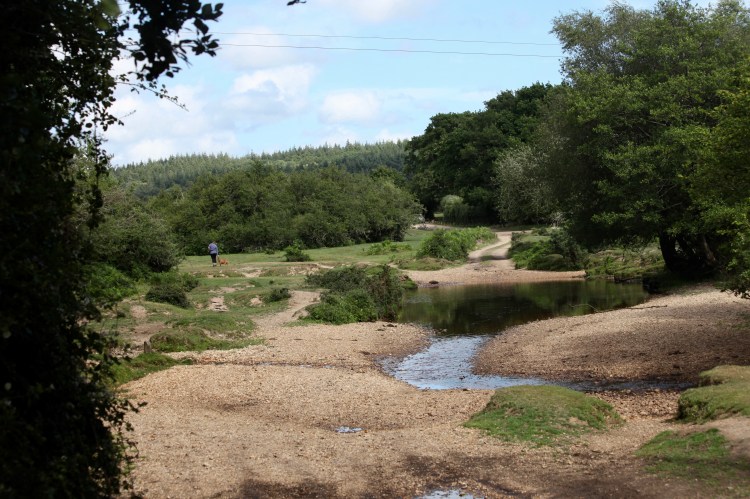
The stream at Ogdens North was now very shallow, so that pebbles on the bed could be seen beneath the reflections from above.

This evening we dined on Jackie’s spicy piri-piri chicken, marinaded throughout the day in a tangy sauce; her most colourful ratatouille; boiled baby Jersey Royal potatoes; and mature, yet tender, cauliflower and broccoli, with which she drank Hoegaarden and I drank Western Cape Malbec 2019.

Skill In His Genes

Today the weather was dull throughout without even the relief of the forecast drizzle. Jackie was trapped this morning in a dreaded two hour Tesco shop. While waiting for her in the car I had plenty of time to finish reading my book.

As so often years ago, when a book review had prompted me to buy a copy, I would leave the newspaper article slipped inside my purchase.

Normally I would write the date and source on the cutting. On this occasion I didn’t. I was therefore pleased to see

this snippet about Andy Irvine on the reverse. A little research established that the piece would have been published some time in March 1981.

I don’t normally give away much of the story of a volume I am featuring.

Philippa Toomey’s review, being itself an essential part of my tale for today, has, on this occasion, done it for me. Any review ending with ‘a very strange book indeed’ linked with the name Wyeth was bound to send me off to the Baker Street Bookshop managed by my friend Graham Charnock to order a copy, the delivery note of which, dated May 1981, fits with my research.

My copy of The Helga Pictures by Andrew Wyeth was the reason the name appealed. I now know that the Wyeths are dynasty of leading American illustrators dating back to N. C. Wyeth from the golden age of the early 20th Century.

Andrew was the husband of Betsy James and the father of Jamie.

This book was published simultaneously in America and Canada by Farrar Straus Giroux in 1979. To Pilippa Toomey’s review I would add that the narrative of Mrs Wyeth flows, surging with life, as do the exquisite drawings of her son, whose skill is in his genes.

In this selection of pages from the work I have been constrained by the format and the breadth of the artist’s vision. I could not include everything. As usual, a click on any image will access the gallery, each member of which can be viewed full size by clicking the box beneath the right hand corner. Further enlargement is also possible.

This evening we dined on roasted chicken thighs; crisp Yorkshire puddings; creamy mashed potato; crunchy carrots and broccoli; and tender green beans with tasty gravy. Jackie drank Hoegaarden, which, of course, was the reason for the Tesco shop; and I drank Western Cape Malbec 2019.

To The Lighthouse

On another overcast morning Aaron, tasked with improving our stepping stone escape route from the Dead End Path to the patio, fetched some spare paving from his own home and

produced this level work. He was one stone short and will bring that next week.

I first read

in 1989. About 20 years later I read it again for the Upper Dicker Book Reading Group. Today I finished it once more in order to test my response to Louise DeSalvo’s biography. https://derrickjknight.com/2020/05/19/seeking-acquaintance/

I don’t remember ever reading another novel three times.

I enjoyed the work once more, no doubt with greater understanding. Perhaps all first novels are to some extent autobiographical, and, having been enlightened to the story of this most gifted writer’s childhood and adolescence, I have to agree that Mr and Mrs Ramsay are undoubtedly based on Mrs Woolf’s own parents. As it is my custom not to reveal spoiler details of the story, I will say no more about this.

This novel is an exceptional work of art. The symbol of the trip to the Lighthouse underpins the developing dissection of a family group’s relationships evoked with remarkable insight. As always the author’s language, given her abundance of detailed description, is elegantly economical. Every adjective, every adverb, every metaphor, every simile is made to count. (She makes good use of parenthesis and would not have countenanced this last sentence). Her punctuation is flawless, and her phrasing perfect, reflecting the numerous revisions she apparently made to her well crafted works.

Gilbert Phelps’s introduction is knowledgeable and educational.

The cloth boards are embossed with a design by the artist.

I confess to having been initially ambivalent about Maryclare Foa’s colour illustrations. Although very well composed with good palettes I found the distorted figures rather ponderous. Now, however, I believe the painter has captured the isolation of the individual characters much as Virginia’s sister Vanessa Bell did in her faceless paintings. It is a policy of the Folio Society to choose an illustrator who can represent the period.

This evening we dined on Jackie’s super savoury rice; a rack of pork ribs in barbecue sauce; salt and pepper prawns; and spring rolls with which she drank Becks and I drank more of the Douro.

Further Down The River

We continued the garden manicure this morning. My contribution was to set up a further compost bin and to dead head roses and poppies. We each filled a further trug.

Sadly, Jackie found the undamaged body of Nugget Junior this morning. His Dad visited us often, perhaps in mourning.

Shortly before lunch heavy, steady, rain set in for the afternoon, during which I scanned my final pages of Agnes Miller Parker’s flowing engraved illustrations complementing the exquisite pastoral prose of “Down The River” by H.E. Bates.

As usual, click on any image to access the gallery. Just beneath each picture, to the right, a box invites you to ‘view full size’, which can be further enlarged.

This evening we enjoyed a second sitting of Mr Chan’s splendid Chinese Take Away, with which Jackie drank Becks and I drank Alma da Vinha Douro Doc 2018.