On this further dully overcast and windy morning we virtually finished the front garden pruning.
I photographed a few hanging baskets in the rest of this area, involving bacopas, lobelias, diascia, begonias, petunias, pelargoniums, and gladiolus. These have all regenerated well after the recent heavy winds.
Here are the bags of woody clippings which we will need to take to the recycling centre. Unfortunately we now have to register our vehicle and make an appointment to dump this material.
On my way through the garden I photographed more views which are each identified in the gallery. The second-flush kniphofia in the last picture is proliferating.
The first apples Jackie picked polished up nicely.
This afternoon we visited Mudeford harbour where, now the area has been left to the locals, I was able to wander across the green and photograph a sailboarder whizzing among moored boats;
gulls, including a preener;
and a low-flying murmuration of starlings for whom the race was on for dropped morsels of food.
As is her wont, Jackie photographed the photographer against the backdrop of his subject.
This evening we dined on lamb chops in mint and rosemary gravy; boiled new potatoes; crunchy carrots and broccoli; and swede and carrot mash, with which Jackie drank Beck’s and I drank more of the Malbec.
Between further bouts of dis-tressing Félicité Perpétue I checked on the current condition of the rest of the garden.
In the meantime Jackie continued her weeding and clearing, leaving offerings for me to transport to the compost bin.
This climbing Cobaea Scandens, or Cup and Saucer plant is now blooming on the kitchen wall near one of the many
petunia and pelargonium planters,
all of which have perked up nicely since the storm. The ornamental grass in the first image of this pair,
like the Addams Family’s Cousin It, has returned to its righted perch.
A number of fuchsias, like Delta’s Sarah in the first of this triptych, Mrs Popple, and Garden News, have benefited from the rain
which has given this Absolutely Fabulous example pink spots, caused Alan Titchmarsh to flag a bit, refreshed Crown Princess Margareta, and kept the red climber bent over.
Nicotiana Sylvestris stands proud,
as do hollyhocks; Japanese anemones remain abundant; black eyed Susan cascades down the chimney pot; and kniphofia penetrates the gap between wooden chair struts.
We are wondering whether to replace this rather struggling little lawn with some York stone paving. Otherwise I might have to mow it before it gets out of hand.
After lunch Jackie bagged up my further rose clippings, then took over the pruning. The hard, woody, old stems we have now reached are not suitable for composting.
This evening we dined on Jackie’s toothsome cottage pie; additional fried potatoes; tender cabbage and kale; with crunchy carrots and cauliflower and tasty, meaty, gravy, with which she drank Hoegaarden and I drank Flores de Seligmar Rioja 2018.
In an earlier post Tangental asked for suggestions for flowers that would be blooming in the last week of August when he hopes to host a family event. Although, he, the Textiliste, and Dog themselves have an enviable garden I promised to let him know what we have currently flowering. Needless to say they will be aware of most of what I have to offer, but, here goes.
This month does not finish until next Monday, the 31st, but this will be the last full week. We are predicted to be hit by another fierce storm tomorrow so I decided to post what we still have today.
The second of these two pictures demonstrates that gladioli are vulnerable to gusts of wind and need to be supported with stakes strong enough to see off Count Dracula.
Carpet roses come in a variety of colours and drape everything in sight. The red one might be appropriate for the special occasion.
Super Elfin is a fast growing prolific climber.
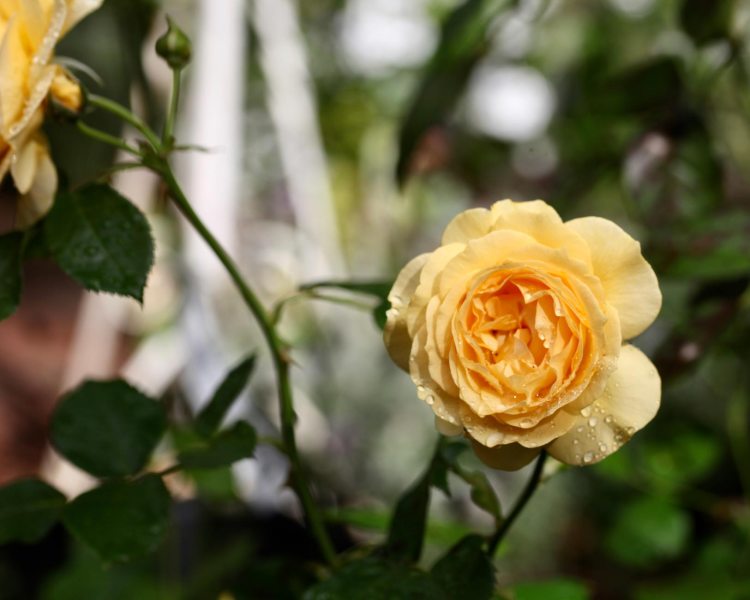
Given the occasion, the red Love Knot, might be appropriate; this one, and the sweetly scented peachy Mamma Mia and yellow Absolutely Fabulous survived our heavy pruning yesterday. The latter two are most prolific repeat flowering.
This is all that is left of For Your Eyes Only, the most prolific rose of all, but so resilient is it that all our snips will have prepared the way for plentiful new shoots within the next sennite (Archaic English WP).
At this time of year Rosa Glauca converts clusters of delicate pink and white flowers to rosy hips.
A variety of hydrangeas still thrive,
and hibiscus,
seen also with red and white dahlias and tall, strongly scented, bronze fennel, has come into its own.
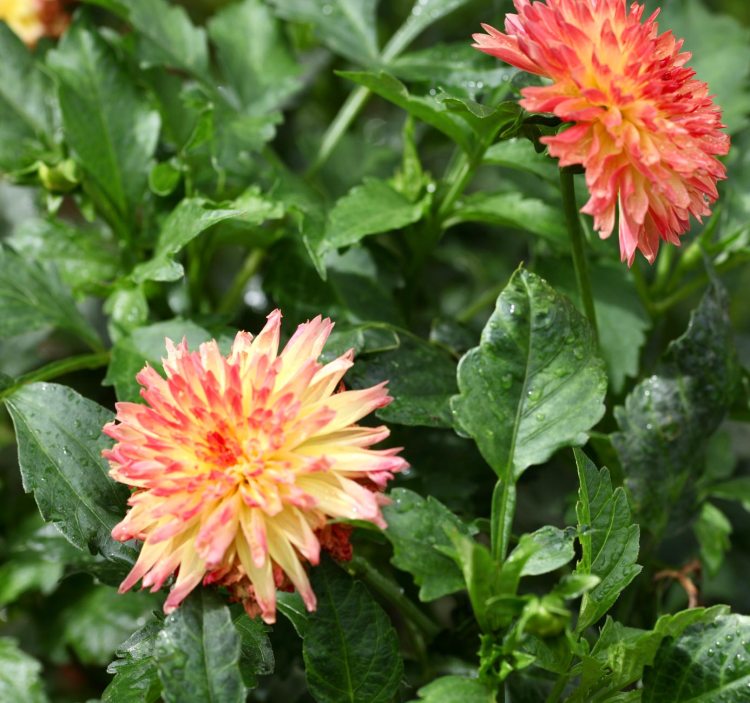
This is of course the time for dahlias, of which we have a range.
Our Japanese anemones come in two shades of pink and in white. In the third of these images they blend well with pink pelargoniums and fuchsia Delta’s Sarah.
Pelargoniums and geraniums will grace any hanging basket,
as will begonias of any shape, size, or hue;
likewise sometimes scented petunias.
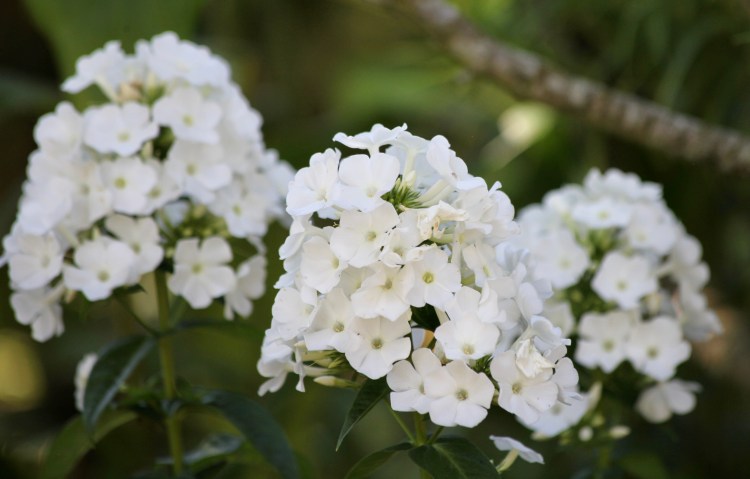
Provided you keep up with dead-heading, as with most of these plants, sweet scented phlox of many different colours will continue to delight.
We find rudbeckia hard to grow a second year, but this Goldsturm variety returns.
A number of crocosmia, like Emily MacKenzie and the yellow one we can’t identify for certain, are still blooming, although others such as Lucifer have finished, but, like Arnie, will be back.
The daisy-like erigeron and yellow bidens offer points of highlight throughout the garden. Erigeron thrives in paving, steps, and stony soil; all our bidens are self seeded survivors from last year.
Sedums begin to blush towards the end of the summer. The second picture has a backdrop of ornamental grass, some of which puts us in mind of Cousin It from the Adams Family. All good space fillers.
Eucomis, or pineapple plants, are a fun talking point;
nasturtiums trail everywhere until the first frost.
Nigella is a little blue flower.
This white solanum has flowered consistently for more than twelve months, far outstripping its neighbouring honeysuckle, now transformed into not very attractive berries. The solanum comes in blue, too.
Jackie produced a dinner this evening consisting of her special savoury rice served with prawns, some of which were spicy, and others tempura, with which she drank Hoegaarden and I drank more of the Saint-Chinian.
As I sit drafting this post bright sun shines, speeding clouds scud; wild wind howls along Christchurch Road sweeping through the garden, rustling the kitchen door curtain and setting tinkling charms jingling.
We are now into our third consecutive day/night of fierce breezes. Tentatively I ventured out to survey the damage and was able to report to the Head Gardener that she was in for a pleasant surprise.
Even the patio chairs had stayed upright, while its planting, and that of the Pond Bed, remained intact. Bigifying the third picture in this gallery will show that the whirling ladybird with the white wings enjoys full gyration whereas her red-winged sister has been somewhat restrained by an amorous verbena bonariensis.
Other views of the Pond Bed are equally encouraging. Dahlias remain strong and a solitary bee was attracted by the hibiscus;
Japanese anemones feature there and elsewhere. The Brick Path in the second picture here needs no current sweeping, although that is not a task we will undertake until the wind drops.
A few trugs have been blown about, although this bright green one remained static whilst being photographed from two separate angles. The first of these two pictures shows an empty brick plinth with the pot that should stand on it having been blown down. The container is a bit chipped and the planting spoiled, but it will no doubt recover.
Of the very few other broken plants we have this pretty, elegant, gladiolus, and the unfortunate Mum in a Million.
The tall red climbing rose in the Oval Bed has bowed enough for me to photograph it head on;
The yellow crocosmia has also dropped a little, but remains intact.
Rose Alan Titchmarsh has drooped a little and a stem of Super Elfin has come adrift from the Gothic arch where
a somewhat aged Doctor Ruppel remains in place.
The weeping birch, the copper beech, and the cordyline Australis, although swaying somewhat, are not shedding too many twigs.
White begonias shaded by the wisteria, and similarly hued petunias in the rose garden still have all their petals.
This final triptych shows the Oval Bed pictured earlier from the corner of Margery’s Bed; nicotiana sylvestris towering over the rest of the Dead End Path planting; and a small owl toppled beside the Shady Path.
All in all we are getting off surprisingly lightly.
This evening we dined on baked gammon; crisp roast potatoes, the sweet variety being soft-centred; piquant cauliflower cheese; crunchy carrots; and tender cabbage, with which Jackie drank Hoegaarden and I drank Saint-Chinian 2017.
Even at 8.30 this morning garden watering was shirt-soaking weather without having gone anywhere near the sprinkler.
I also produced a few photographs. Jackie said I made life difficult for myself with the camera slung round my neck. As usual, the gallery can be accessed by clicking on any image, each of which may be enlarged. This may be useful to find the camouflaged bee in the last picture.
Later, we set off for a picnic lunch. I should have known that the cattle drinking from the stream crossed by Holmsley Passage would have been inquisitive enough to
leave by the time I extricated myself from the car, and proceed to block the road.
The usual string of ponies did the same with considerably more effect than the bovines. Jackie considered that the traffic problem had been exacerbated by “old man in the road”. Well, it was a little difficult for me to round the obstacles to meet up with my Chauffeuse who had moved on ahead.
Outside Hyde CE Primary School a donkey foal stopped during feeding time for a scratch while waiting to be enrolled into ‘The Family in the Forest’.
Eventually we found a shady car park in Godshill Wood. We hadn’t bought chairs and there were no benches, so we could not emulate other, better prepared, picnickers and stayed in the open-windowed car watching
a trio of ponies clustered together for protection against the myriad of flies they had diverted from our lunch.
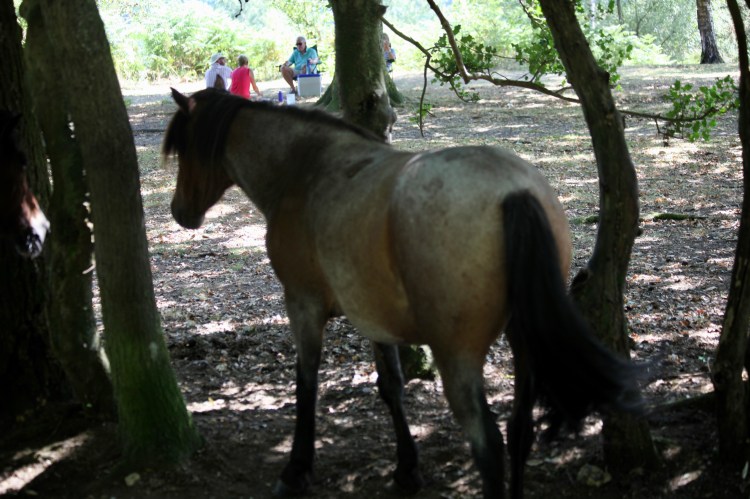
Another equine pair took direct shelter beneath the trees.
Occasionally a combination of the carelessly parked grey car and the cluster of ponies presented drivers with difficulty. One young lady left her car and proceeded to push a pony in an attempt to shift the group. She was pushed in turn, declared that the pony was either too hot or too grumpy, and returned her transport which threw up dust as it sped off into the distance.
This evening we dined on Hordle Chinese Take Away’s excellent fare with which Jackie drank Hoegaarden and I drank more of the Malbec.
Early this sultry morning, before setting off to meet her sisters for lunch, Jackie carried out necessary garden irrigation which I continued after enjoying the lunch she had left prepared for me. After giving pots a fresh-water- and myself a sudorific-drenching I proceeded to a little dead heading that I had failed to ignore.
Aaron, working at Mistletoe Cottage, dropped in for a chat.
Later, my clammy shirt now cold, like James Joyce’s wet bed sheet (“When you wet the bed first it is warm then it gets cold.” – ‘A Portrait of The Artist as a Young Man” ),
I wandered around with my camera.
The random photographic results are all labelled in the gallery that can be accessed by clicking on any image each of which may be enlarged in the usual manner.
This evening we completed the watering and I cut off a few more heads before dining on spicy pepperoni pizza and plentiful fresh salad with which Jackie drank Hoegaarden and I drank more of the Carles.
On another sweltering, humid day we made short trips into the garden largely for the purposes of watering, mainly plants in hanging baskets.
Speaking for myself, I needed to wait until I had stopped soaking my T-shirt and recovered from my efforts before I was almost fit enough to wander around to admire our work and produce a few photographs.
As usual the images are titled in the gallery which can be accessed by clicking on any one. They include various petunias; a golden sunflower; a variety of dahlias; a bee on a geranium Rozanne; a bunch of begonias; mauve Japanese anemones purple and red fuchsia Mrs Popple; roses Margaret Merrill, Special Anniversary, For Your Eyes Only, Lady Emma Hamilton, Mamma Mia; and pelargoniums.
This evening we dined on Jackie’s luscious liver and bacon casserole; boiled potatoes; and crunchy carrots and cauliflower, with which the Culinary Queen drank Hop House Lager and I drank more of the Carles.
Late yesterday evening Jackie raced round the garden with her camera, gleefully photographing
her pride and joy. Petunias, pelargoniums, phlox, fuchsias, clematises, alliums, agapanthuses, dahlias, verbenas, campanulas, erigeron, lilies, Japanese anemones, diascias, begonias, eucalyptus, roses, and no doubt many I’ve missed. As usual, clicking on any image will produce the gallery, each member of which is separately labelled and can be viewed full size by clicking on the box beneath it, and further bigified with subsequent clicks.
As if that weren’t enough, the Assistant Photographer dashed out later to capture
the full moon, and again this morning to add
crocosmias Emily McKenzie and Solfatare,
and finally Lycesteria.
I had my work cut out today to select from 56 images, load them into the iMac, edit and crop them, then transfer them to WordPress retyping each title. I left my own camera alone, and for the first time ever rejected the offer of a forest drive, otherwise I would have been at the computer until midnight.
This evening we dined on Forest Tandoori takeaway fare with which Jackie drank Hoegaarden and I drank more of the Malbec.
This morning my gardening occupations combined dead heading and making photographs.
These roses Summer Wine and Altissimo, both coming again, were too high for me to reach with hand secateurs, and I couldn’t be bothered to fetch the steps.
Bigifying will probably be necessary to appreciate these bees on bidens, on Japanese anemones, and coming to land on crocosmia. Just click on any image to access the gallery and enlarge further with clicks on the ‘view full size’ box underneath and again if required. The bees swarming the Japanese anemones must be welcoming the plants’ early blooming.
Crocosmia blend well with other plants such as these bell-like alliums and the Japanese maple with its fingers singed by recent violent winds.
From beside this latter crocosmia I was able, through the maple, to view the petunias and pelargoniums featured alongside the kitchen wall.
We haven’t identified all the clematises in the garden. The first of this triptych above, for example, is a Lidl unnamed purchase; we do know that it is Niobe who shares the arch with the fuchsia, Chequerboard; the Head Gardener was determined to track down ‘clematis viticella purpurea plena elegans’, which took her some time, because when we arrived seven years ago this then weakly specimen was ailing in the rubble jungle that we eventually turned into the Rose Garden – it was fostered out in another bed until we returned it to its native soil, and has taken three years to reach the top of its supporting beam.
One of these yellow evening primrose blooms has survived the night well; this phantom hydrangea is also a survivor – it is the plant after which the eponymous path is named – first planted on one side of the Phantom Path it was really rather poorly for its first two years, until Aaron moved it into Margery’s Bed where it has enjoyed more light. We hope it will soon be in the shape in which we bought it.
Hemerocallis still thrive and we also have stargazer lilies in the main garden.
Four hours later, in mid afternoon I set out once more with my camera, giving me shifted lighting conditions.
A bee did its best to weigh down a verbena bonariensis.
Niobe could now sunbathe, and the clematis at the barrier between the garden and the back drive enjoyed light and shade;
the freckled lilies kept out of the direct sunlight;
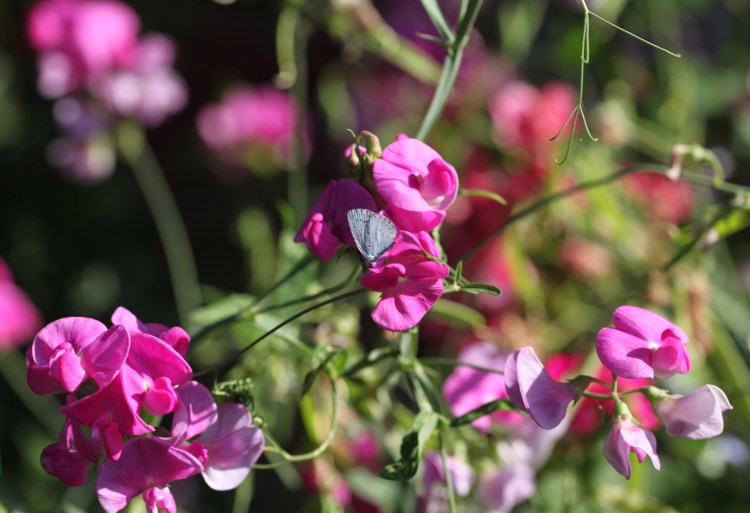
sweet peas and hollyhocks could take it stronger.
My lens found the white flowers the best beneficiaries: sweet scented petunias, powerfully aromatic phlox, a clutch of dahlias, different Japanese anemones and the phantom hydrangea sheltered in shade this morning.
This evening we dined on prawn fish cakes, peas, and fresh crispy bread and butter with which Jackie drank Hoegaarden and I drank more of the Carles from a second bottle.
During a heavily overcast yet warm morning I took a walk around the garden with my camera.
At the front of the house I photographed just one example of our fuchsia Delta’s Sarah and pink pelargoniums; a severally-hued hydrangea alongside white marguerites with yellow buttery centres; and the first of three rich red lily plants to bloom.
Another Delta’s Sarah is found among pink sweet peas and verbena bonariensis in the Weeping Birch Bed
which can be approached via stepping stones across the Cryptomeria Bed which is named from
the tree seen behind the standing lamp to the right of top centre in this picture of the Gazebo Path.
The white rose, Winchester Cathedral, and the peachy Lady Emma Hamilton are enjoying further flushes in the Rose Garden.
The blue and white petunias in the Ali Baba planter are beginning their descent which will have them cascading like those in this container accompanied by sweet peas, hot lips, and lobelias.
Just before mid-day we drove through a busy Highcliffe intending to brunch at The Beach House café on Friars Cliff. Both the car park and the beach were so crowded that we turned back and lunched at home.
I spent the afternoon finishing reading ‘Love in the time of Cholera’ by Colombian Nobel prizewinner Gabriel Garcia Marquez. This is the entry from brittania.com written by Roberto Gonzalez Echevarria:
Gabriel García Márquez, (born March 6, 1927, Aracataca, Colombia—died April 17, 2014, Mexico City, Mexico), Colombian novelist and one of the greatest writers of the 20th century, who was awarded the Nobel Prize for Literature in 1982, mostly for his masterpiece Cien años de soledad (1967; One Hundred Years of Solitude). He was the fourth Latin American to be so honoured, having been preceded by Chilean poets Gabriela Mistral in 1945 and Pablo Neruda in 1971 and by Guatemalan novelist Miguel Ángel Asturias in 1967. With Jorge Luis Borges, García Márquez is the best-known Latin American writer in history. In addition to his masterly approach to the novel, he was a superb crafter of short stories and an accomplished journalist. In both his shorter and longer fictions, García Márquez achieved the rare feat of being accessible to the common reader while satisfying the most demanding of sophisticated critics.
It must be 30 years since I first read this marvellous novel, and now, I hope, have done so with far greater understanding.
I do not know Spanish, but I am quite certain that Edith Grossman’s translation has contributed greatly to the fluidity of Jonathan Cape’s 1988 edition. The author is clearly a master of the long, eloquent, sentence and it must have taken great skill to convey this.
The book is filled with wisdom, insight, and humour, penned in flowing, natural language. Its theme is a lifetime of loves described in emotional and physical detail with all the accompanying passion, anxiety, intrigue, anguish, guilt, jealousies – you name the feelings – they are there.
What, wondered this reader in the midst of the 2020 pandemic, has cholera to do with the story, which is well told? After all the disease barely merits a mention until the penny drops; I will refrain from telling you when.
This evening we dined on oven fish and chips, peas, gherkins, and pickled onions, with which Jackie drank Hoegaarden and I finished the Fleurie.