Perhaps it was the two dogs in this picture that prompted me, about a dozen years ago, to say to my mother “Mum, I’m not going to buy you anything else that I wouldn’t want back eventually”. It would have been more than thirty years ago that I bought her these Balinese carvings from a friend of Jessica who shipped them over here., along with the reindeer whose story is told in “Surprise”, from a friend of Jessica who shipped them over here. These artefacts were very in vogue at the time. I knew Mum would like them. I don’t. They remained on either side of her fireplace until she moved to Woodpecker’s Care Home.
It had long been her custom to stick a label beneath each of her store of ornaments and other treasures indicating whoever had given them to her and consequently to whom they should pass at her death. There has been a limit to what she has been able to to take with her to Woodpeckers so she and Elizabeth have begun decanting them now.
I have quite forgotten donating many of these gifts, some of which were given with Vivien who died in 1965. I suspect the ceramic basket is one of those.
The copper bowl and ceramic vase both bear the name of Jessica who died in 2007.
The glowing, perfectly fitting, treen container was bought with Jackie at Chichester’s Christmas market c2011.
Apparently my daughter, Louisa, bought the china dish, and I bought the Royal Grafton thimble.
This collection was brought over by Elizabeth yesterday. It is the first batch of my share of the presents of a lifetime.
This evening we dined on succulent roast pork; sage and onion stuffing; crisp roast potatoes; firm carrots and cauliflower; tender runner beans, and meaty gravy, with which Jackie drank Hoegaarden and I drank Repasse de Montagne 2019.
Late this afternoon we took a drive into the forest.
The deciduous trees shielding Sway Tower from South Sway Lane are turning chestnut brown.
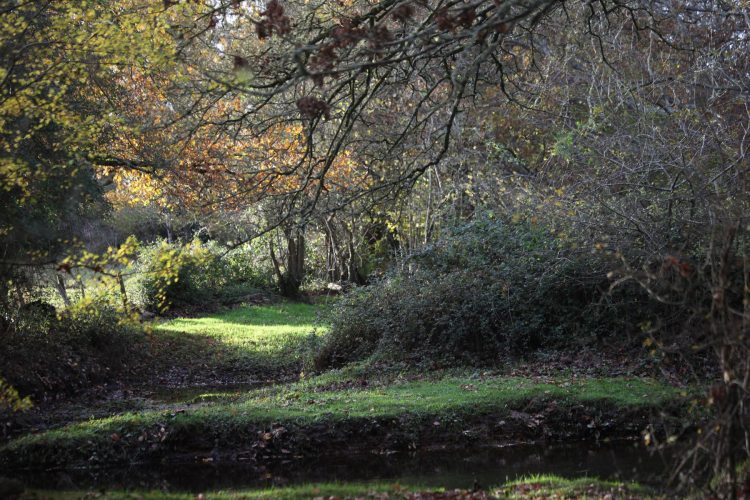
Jackie parked beside Beaulieu Road, Brockenhurst on a verge beside which an exhaust box kept pace with the turning of fallen oak leaves. From there I walked along
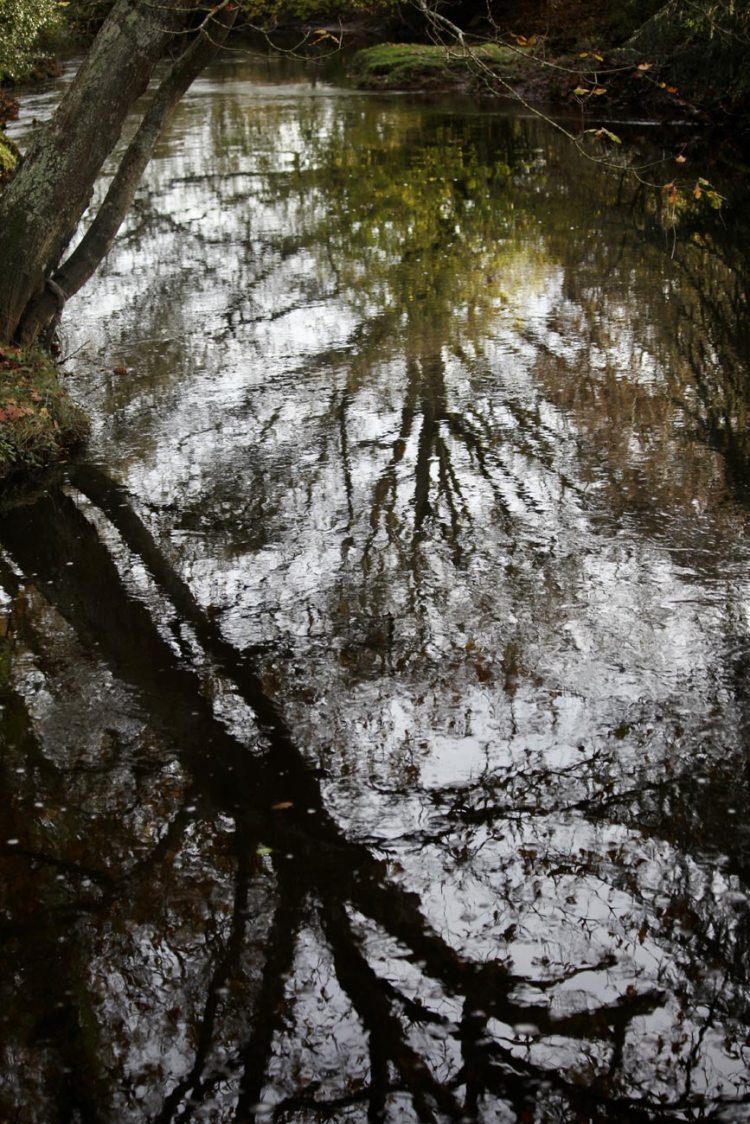
the undulating banks of the reflecting waters of Lymington River.
The woodland floor, like most, is littered with lichen coated twigs. Ponies basked in hazy sunlight in fields on the opposite bank.
We visited Hatchet Pond where
ponies wandered among gulls, swans, and dog walkers; a solitary donkey tried its luck among the parked cars; a rooks cawed from the trees.
Jackie also photographed the pond with its swans; me on my return to the car;
and the signs explaining the need for restoration and the nature the wildlife.
Elizabeth joined us this evening for dinner which consisted of succulent roast pork with baked apple slices and sage and onion stuffing; crisp brown roast potatoes and Yorkshire pudding; carrots, cauliflower and Brussels sprouts al dente; and tasty gravy with which the Culinary Queen drank Hoegaarden and my sister and I drank Patrick Chodot Fleurie 2019.
On another mild, sunny, morning we visited Mum in Woodpeckers Colten Care Home.
Firstly, Jackie parked in Butts Lawn along which I wandered with a camera.
At one end the ford water left its mark on the measuring gauge.
I walked alongside the rippling, fast-flowing stream watching swaying underwater weeds, scum-forming bubbles, and leaves whizzing by putting me in mind of Hans Andersen’s “Little Tin Soldier” in his paper boat speeding along the gutter. Sunbeams revealed autumn leaves and pebbles carpeting the bed, and a red-brick house was reflected in a roadside puddle.
At the other end stands a Telephone Box Book Exchange decorated with children’s drawings and a notice of Lockdown Precautions advising that the library contents will not have been sanitised.
The stream continues under the road bridge beside a splendid oak. The wooden railings are reflected in the crystal clear water.
Attempting to claim the last resilient leaf clinging to a maple on Meerut Road the gentle breeze tugged and twisted in vain.
‘Morant Hall, also known as New Forest Hall, once stood on the Lyndhurst Road approximately opposite Greenways Road, Brockenhurst.
Soon after the establishment of the Lady Hardinge Hospital for Wounded Indian Soldiers in c.1914 at what is now Tile Barn the facilities quickly became overcrowded. The hospital had tented and galvanized roofed buildings as patient accommodation and had commandeered Balmer Lawn and Forest Park Hotels.
Morant Hall was set up to take some of these patients in an attempt to relieve some of the overcrowding treating the Indian troops of the Meerut and Lahore Divisions, who fought on the Western Front, and were patients at the Lady Hardinge Hospital. The hall became known as the Meerut Indian General Hospital and was managed by a committee of local citizens and could provide accommodation for up to 120. …..Meerut Road in Brockenhurst [is named] in their memory.’ (Gareth Owen in https://nfknowledge.org/contributions/morant-hall-meerut-indian-general-hospital-morant-war-hospital/#map=10/-1.57/50.82/0/24:0:0.6|39:1:1|40:1:1 )
Despite the current Covid-inspired lockdown Colten Care continue to provide visiting facilities. We can see my mother through a glass screen for half an hour once a fortnight.
Mum was wheeled in and provided with a rug which she didn’t need to use. Jackie, who sits socially distanced beside me, and the garden behind our open door are reflected in the screen. Mother was on good, talkative, form.
In Sway Road, not far from Woodpeckers, a family of donkeys enjoyed scratching and tearing at the shrubbery. One left its post in order to discover whether I bore any treats.
This evening we dined on a rack of pork ribs in barbecue sauce, salt and pepper prawns, and Jackie’s savoury egg rice, with which she drank Hoegaarden and I finished the Cotes du Rhone Villages.
As we gradually return items to our sitting room we faced a dilemma that Nick has set us.
How on earth can we bang nails and hooks for pictures into his sublime walls? We certainly won’t being doing that for some time yet.
Nick Hayter, Painter and Decorator, is to be highly recommended for his skill, his attention to detail, his tidiness, his punctuality, his reliability, and his pleasant company. He charges by the hour and works hard and fast throughout every one.
Of all the out-of-season blooms our garden currently enjoys perhaps this gladiolus is the most extraordinary.
This evening we dined on Jackie’s flavoursome savoury rice topped by a large fluffy omelette, accompanying prawns of three different preparations, namely tempura, spicy, and salt and pepper. The Culinary Queen drank Hoegaarden and I drank more of the Cotes du Rhone Villages.
blooming yesterday morning. Here are the Assistant Photographer’s contributions. The first three are of Mrs Popple fuchsias and a giant which has lost its label; next is a white solanum with the bright blue Ali Baba planter in the background; the hanging baskets following contain petunias and bacopas; next, not actually a flower, are bejewelled weeping birch catkins; and finally we have raindrops on black eyed Susans.
Mine were chrysanthemums of varying hues, still hot lips, and, believe it or not, yellow antirrhinums.
Before lunch today we took a short drive into the forest, via
Lower Sandy Down which offered
a number of autumn scenes.
Church Lane, running up and down from Boldre to Pilley, came next.
Jackie parked on a verge while I stood on the road bridge contemplating
the now fast-flowing stream and its reflections.
This tangle of oak branches and the weeping willow tresses were also visible from my vantage point.
At Pilley we encountered a number of ponies beside the lake,
and noticed that Foxglove and Twinkle now have chickens for company.
The cyclist who squeezed past these donkeys on the road must have been intrigued at the number of times we passed him as we wandered around in circles at this point.
Back at home Nick continued working proficiently yet at a rate of knots. Moving from room to room as he put curtains back up and another coat of paint on the door in the sitting room; he further prepared the kitchen and added paint to walls and ceiling. One of the horrors he had to deal with was the hole in the lath and plaster wall into which had been driven by our predecessors a bracket on which swung a large fridge that blocked the doorway during their residence.
Unfortunately our craftsman will have to leave the work in the kitchen until after 19th January which is the earliest that Barry Chislett-Bruce can repair our leak. Reflecting their reliability and the quality of their work, both these men, thorough experts in their fields, are very busy, so we are happy to wait.
This evening we dined on crisp oven fish and chips; green peas; piquant pickled onions and gherkins, with which Jackie drank Hoegaarden and I drank Prestige de Calvet Cotes du Rhone Villages 2019.
On an unseasonably mild morning of sunshine and showers we drove into the deserted forest where Jackie decanted me at a few unpopulated points where I wandered with my camera.
Had we been in a hurry down Beckley Road we might have had a closer than comfortable encounter with an approaching van.
Fortunately Jackie had parked on a verge while I photographed autumnal woodland with its yellowing leaves fallen on soggy ground and clinging to dripping trees.
Our next stop was along Rhinefield Road where I rustled leaves underfoot while seeking further fall images.
Passing under the A31 and pausing on Linwood Road I walked back to photograph
reflections in a recently replenished pool, whilst taking in
pleasantly hazy landscapes,
one of which camouflaged a pair of grazing ponies.
Cattle hunkered down among the gorse.
We continued through Appleslade where
the glowing hillsides whispered to the sunlit trees opposite a naked windswept silhouette.
From our high vantage point I watched a close encounter as a pair of horse riders approached and, hopefully keeping social distance, crossed paths with a pedestrian couple. Perhaps they passed the time of day.
On the road above Ibsley ford as I photographed
sunlit woodland we could hear cries of children playing in the grounds of Moyles Court School, like others, currently being kept open. This is not so for pubs, which must be disappointing for the staff of
Elm Tree on Hightown Road who have installed a magnificent poppy display in the now closed garden.
Nick has continued painting woodwork in the sitting room
and wrestling with preparation in the kitchen.
This evening we dined on a second sitting of Hordle Chinese Take Away’s fine fare, with which Jackie drank Hoegaarden and I drank more of the Malbec.
On this drizzle-dismal day Jackie cut my hair and I scanned another batch of Black and White negatives from
Brompton Cemetery in September 2008. The entrance gates bear the name of West London and Westminster Cemetery Company which opened the facility in 1840. Freshly dug graves, awaiting the settling of the soil, occupy the foreground of the penultimate picture.
Two notable tombs in Brompton are those of pugilist John “Gentleman” Jackson, shared with his beloved niece and adopted daughter, Elizabeth; and of actor and dramatist Henry Pettitt.
Jackson (1769-1845) lies beneath the apt figure of a lion. ‘He was considered an exceptional amateur boxer prior to 1788. On 9 June 1788, aged around nineteen, Jackson defeated William Futrell at Smithham Bottom, England, in a bout lasting one hour, seven minutes.[1] Futrell was a giant of a man, undefeated, and held a string of 18 victories, when he faced the younger Jackson.[4]
In his second bout on 12 March 1789, against John Ingleston, on a rainy day at Ingatestone, England, he lost in five rounds, in a bout lasting twenty minutes and suffered a broken leg, not entirely uncommon during the brutal English bouts of the late 18th century. His injury was likely caused by a slip from the muddy ground. Many present believed Jackson would have won the bout if not for his unfortunate accident. Likely distressed by his injury, he announced his retirement after his loss, but would return six years later in his most important win.[2][1]‘ (Wikipedia)
In 1795 he defeated Daniel Mendoza to become Champion of All England from which he retired the following year. In 1803 he opened a Boxing Academy in London’s Bond Street. ‘Jackson’s academy was popular with the nobility and gentry and became a profitable business. His friend, the famed English poet George Gordon Byron, known as Lord Byron, an avid boxing fan, related in his diary that he regularly received instruction in boxing from Jackson. Jackson also profited from providing exhibitions for English and foreign lords and celebrities. Included among those for whom he arranged exhibitions were the Emperor of Russia, the King of Prussia, the Prince of Wales, and the Prince of Mecklenburg. Jackson’s introduction of the sport to English and European royalty, made boxing a more admired and to some extent accepted sport in England.[2] Jackson was charitable and held benefits for numerous charities, once raising £114 for a Portuguese town destroyed by the French, and later £132 for the benefit of British prisoners in France.[3]‘ (Wikipedia)
His Pugilistic Club, in which he arranged fights adhering to honest rules, followed in 1814. ‘In 1821, Jackson was asked to supply a force of unarmed men to preserve order at [3] King George IV’s Coronation, where he also served as a page. With his boxing connections, he selected 18 prizefighters to protect the King, and to keep back those unauthorized to attend.[1][3]‘ (Wikipedia)
‘Henry Alfred Pettitt (7 April 1848 – 24 December 1893), was a British actor and dramatist [whose portrait appears in bas-relief on his monument] .
With Augustus Harris, he wrote the play Burmah, produced on Broadway in 1896. With G. R. Sims, he created a substantial body of very successful works, including In the Ranks (1883, 457 performances at the Adelphi Theatre) and The Harbour Lights (1885, 513 performances at the Adelphi). Their Gaiety Theatre musical burlesques included Faust up to date (1888), which remained a hit for several years and coined a new meaning for the phrase “up-to-date”, meaning “abreast” of the latest styles and facts. Their next hit was Carmen up to Data (1890). Both of these were composed by the Gaiety’s music director, Meyer Lutz.’ https://peoplepill.com/people/henry-pettitt/
This evening we dined on Mr Chan’s excellent Hordle Chinese Take Away fare, with which Jackie drank Hoegaarden and I drank Mendoza Malbec 2019.
From our bedroom window we are still greeted in the morning by a scented pink climbing rose, sweet little solanum, and ripe crab apples so far eschewed by blackbirds; and from our en suite bathroom Paul’s Scarlet still soaring above the wisteria.
While I up there taking these images
I made several garden view photographs, all featuring the Gazebo.
At ground level, we have golden mushrooms on the stumpery;
a number of thick-pile carpet roses;
and, in the rose garden, Crown Princess Margareta, Shropshire Lad, Absolutely Fabulous, and Mama Mia, all blooming well with burgeoning promise of more to come.
This afternoon I continued reading “The Guns of August”, the first volume of Barbara W. Tuchman’s history of the First World War, which I began yesterday.
This evening we dined on tender roast lamb; Coleman’s mint sauce; creamy mashed potatoes; crisp Yorkshire pudding; firm, tasty, carrots and Brussels sprouts, with meaty gravy. Jackie drank Hoegaarden and I finished the Faugeres.
This afternoon we shopped at Tesco and at Milford on Sea Pharmacy. There were queues at neither outlet.
From Tesco we drove to Milford on Sea via Angel Lane alongside which Jackie parked and I walked a while, photographing
woodland, a mossy oak, a mushroom, and autumn leaves floating on ditch water.
Along the coast road the air was so hazy as to obscure the cliffs of the Isle of Wight and a cruise ship quarantined outside Southampton.
The sea was quite calm, and more than one couple found the weather warm enough to enjoy ice creams from the nearby kiosk.
We moved on to Keyhaven and, from Saltgrass Lane, watched
walkers on the spit,
and were entertained by the aerial gymnastics of an impressive kite surfer.
This evening we dined on Jackie’s wholesome shepherds pie served with al dente carrots, cauliflower, and green beans, with which she drank Hoegaarden and I drank more of the Faugeres.
First published in 1936, just three years before the outbreak of World War 2, “Eyeless in Gaza” is possibly Aldous Huxley’s most acclaimed work. His familiar themes of the tension between emotional and intellectual lives of his privileged hedonistic characters are explored in depth with his usual insightful knowledge of these self-centred human beings. He also deals with the conflict between warfare and pacifism in a far-sighted way which resonates uncannily with our modern conflict between self-seeking hate and generous love. Sexuality in this work is seldom generous, sometimes manipulative, and often short-lived.
The language and the dialogue is always fluent with much easy, poetic, description, and occasional adventurous episodes.
I finished reading my somewhat careworn first edition today.
The remnants of the green shield logo of Boots Book-lovers’ Library and what looks like a peel-resistant borrowers record inside the back one suggest that my copy began life as an item on those shelves.
The lending libraries were established within branches of Boots across the country, employing dedicated library staff whose training included examinations on both librarianship and literature.[2] Boots’ libraries displayed books for browsing on open shelves[3] at a time when many public libraries had closed access. A catalogue of the books available was first published in 1904.
Subscriptions were available in Classes A and B, the latter being restricted to borrowing books at least one year old, as well as a premium ‘On Demand’ subscription.[4]Boots Booklovers Library edition of The Saint in Europe
Books carried the ‘green shield’ logo on the front and an eyelet at the top of the spine.[5] Membership tokens were rectangles of ivorine[6]with a string similar to a Treasury tag; the string could be secured through the eyelet so that the token acted as a bookmark.[7]
Boots also briefly reprinted classic books at the start of the 20th century under the imprint ‘Pelham Library’,[8] named after the flagship Boots shop on Pelham Street in Nottingham,[9] and later sold books as ‘Boots the Booksellers’.’
My mother was regularly taking my brother and me to Wimbledon Public Library from the late 1940s, (https://derrickjknight.com/2012/05/25/miss-downs/) so the 1964 Act mentioned above obviously had no effect on our town.
Like dogs marking their territory, previous readers had left deposits throughout the pages. The burn marks on page 17 we assumed had been left by a pipe smoker – they singed through three pages; other small greasy spots, about which it was best not to speculate too much, filtered through an equal number of pages; I wondered whether any of the numerous finger prints of varying hues had been held on any national data bases.
Nick began to make headway on the coloured walls in the sitting room, whilst adding coats to the white and to the ceiling.
We left him to it this afternoon and shopped at Ferndene Farm Shop where there was no queue, then took a short drive into the vicinity of Burley.
I wandered among the woodland on the outskirts. The tree fungus sprouts from the fallen tree. Roughly in the bottom centre of the last picture can be discerned
a bouncing squirrel on its way to climb a small holly carrying a chestnut which looked rather more than it could chew.
The spreading oak tree on the way down the hill into the village now wears a golden cape. The Queen’s Head is Covid-closed.
The pool on Forest Road has completely filled up now, and was reflecting nicely in the late afternoon sun.
Autumn leaves rested beneath the water.
On Bisterne Close a young foal was undertaking an apprenticeship in hedge clipping.
We have become Elizabeth’s bubble; she joined us for dinner which consisted of Jackie’s cheese-topped shepherd’s pie; crunchy cauliflower and carrots; firm green beans; and meaty gravy. Cherry pie and cream was to follow. The Culinary Queen drank Hoegaarden while Elizabeth and I drank more of the Faugeres, which involved opening another bottle.