On a bright, crisp, afternoon Jackie drove us to Bisterne Close,
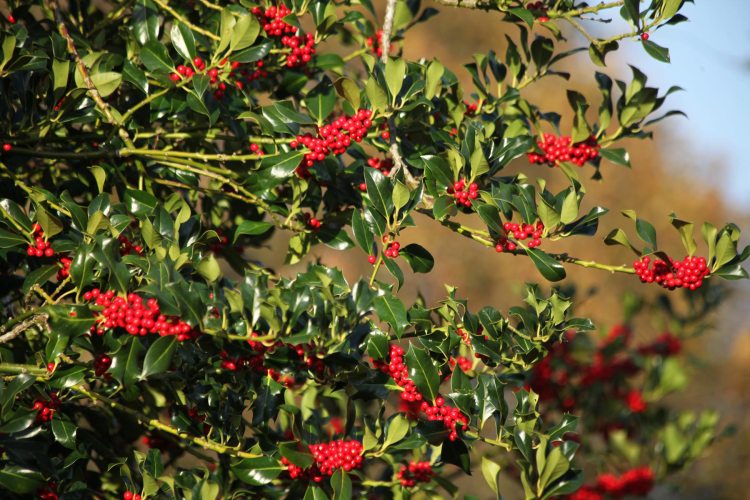
where she parked and sat in the car while I wandered into the forest with my camera, rustling the dried autumn leaves, across which the low sun cast long shadows. One lone cow wandered off into the distance. Golden gorse glowed; a few beech and oak leaves lingered on the branches; some fallen limbs bore lichen and fungus; holly berries shone for Christmas.
Jackie photographed a bouncing squirrel
and a pedestrian me.
Ponies were mostly waiting expectantly at the far end of close. What for was unclear.
This evening we dined on well roasted gammon and parsnips; creamy mashed potatoes; piquant cauliflower cheese; firm carrots; and tender green beans, with which Jackie drank Hoegaarden and I finished the Comté Tolosan.
This morning I finished reading the justifiably Pulitzer Prize- (for Non-Fiction, 1963) winning work ‘The Guns of August’ (1962) by Barbara W. Tuchman. With painstaking research, shrewd judgement, and skilful prose, the author analyses and describes the first month of the First World War. We are so accustomed to books and films about the madness of the four years’ destructive trench warfare that I found Ms. Tuchman’s tour de force most informative.
I knew the war had been sparked off by the assassination of Franz Ferdinand, Archduke of Austria, but had no idea why such a conflagration had followed. This book explains the reason and the method.
Germany had been preparing for war on both Eastern and Western fronts for two decades. It was simply accidental that the blue touch paper was lit in the east.
We learn of the desecration of the Belgian neutrality, the courage of its population; the invaders’ belief in the spread of fear as a method of quelling resistance, and their means of exercising it; the speed of the German advance; the infighting within and between the leaders of the allies.
Tuchman closes with an eye to the following four years. I would have welcomed such a work on them.
The details of manoeuvres would probably be more fascinating to serious students of military history than to me, for I found the passages of descriptive writing rather more to my liking.
My Folio Society edition contains copious notes, clear maps, and two batches of photographs which are not really of good enough quality to reproduce here.
On another comparatively mild afternoon we visited Elizabeth and invited her to dinner, which she accepted with alacrity.
We returned home via South Baddesley from where we could view the Isle of Wight in the distance,
and autumn scenes in the fields.
Beside the unnamed lane down which I walked lay moss covered fallen branches.
Gradually a jogger came into view running up the lane. Soon after he passed Jackie’s parked Modus, my Chauffeuse followed me down and picked me up.
As we neared Lymington I photographed a silhouetted tree line.
This evening we dined on succulent roast gammon; creamy mashed potato; piquant cauliflower cheese; crunchy carrots; and tender green beans, with which Elizabeth and I drank Chevalier de Fauvert Comté Tolosan Rouge 2019, and Jackie drank Hoegaarden.
On a gloomier and warmer afternoon than yesterday we took a drive into the forest.
The pannage season has this year been extended into December.
A group of snuffling, snorting, competitive, piglets on the muddy verge at Ibsley burrowed as far into the leafy coverlet as they could to emerge with acorns from the tree above. The little fellow in the road in the last picture was making his way to plant a round snotty kiss on my trousers.
Further along, at North Gorley, much of the green was now under water which reflected the trees, one of which had now lost all its leaves; ponies grazed beside a Winterbourne stream.
The recently filled ditches of South Gorley did not deter a pair of Gloucester Old Spot sows from unearthing acorns. Sloshing and grunting they nose-dived, grabbed their mast, and rose to the surface dripping, grinning, and crunching. The year 2020 has been lucky for pigs.
Half way down Pentons Hill at Stockton, a thatcher’s straw ducks waddled across a roof he had produced.
This evening Jackie reprised yesterday’s delicious roast chicken dinner with her savoury vegetable rice and green beans. She drank Hoegaarden and I finished the Merlot.
This afternoon I printed photographs for Aaron, Mark, and Steve, of their tree-cutting work of three days ago. Some profile pictures are about to be changed.
Late on a very dull afternoon we drove to Keyhaven to catch the last of the meagre light.
There is so very little graffiti in the New Forest that our granddaughter, Flo thought she must be an “alternative universe” when she saw no graffiti on carved wooden benches in Ringwood. A rare example adorns the
Electricity Sub-Station in Barnes Lane, where we now notice crosses on the trees alongside warning signs on the gates.
Saltgrass Lane in Keyhaven was clogged up with the transport of
visitors walking, kite surfing or sailboarding.
This evening we dined on chicken thighs marinaded in Nando’s chilli and mango sauce served with Jackie’s savoury vegetable rice accompanied by Hoegaarden in her case and more of the Merlot in mine.
The sun kept away today, and the cloud-wrapped air was mild.
To increase seasonal confusion the winter flowering cherry has bloomed early and nudges crab apples normally stripped by blackbirds by now.
This camellia is a very early spring bloomer, but never a November one.
Fuchsias like Delta’s Sarah and Mrs Popple just go on and on;
what is Margaret Merril doing distributing her summer scents over the latter?
This pink climber; the deep magenta Gloriana; gently blushing Crown Princess Margareta; never-ending For Your Eyes Only; dewy Mamma Mia; and ever-prolific Absolutely Fabulous still, beyond their normal spans, cling to life.
Even Winchester Cathedral has turned its back on Autumn.
Fatsia knows when to flower;
as for bidens, pelargoniums, and penstemon, they have no idea when to stop.
This afternoon the skies gently leaked and I scanned the last few black and white negatives produced from Kensal Green Cemetery in May 2008.
One of the most skilfully carved monuments in this, the earliest of “The Magnificent Seven” landscaped London cemeteries, stands in honour of Ninon Michaelis (c1864-1895) who ‘was the first wife of Maximilian (Max) Michaelis (1852-1932), a German-South African financier and diamond magnate. Max Michaelis was a partner in the mining company of Wernher, Beit & Co., and came to England in 1891 as the firm’s London director. An avid collector of paintings, he donated a magnificent collection of Dutch masters to the South African government, and endowed the Michaelis School of Fine Arts in the University of Cape Town. He was knighted in 1924. Ninon Michaelis was named as a popular figure in reviews of troops in South Africa. In May 1895, at the age of 31, she died of syncope (fainting), pneumonia and alcoholism. Also deposited in the vault beneath the monument are the remains of Max’s brother Gustav Michaelis (c1858-1901). Ownership of the vault passed to Maximilian’s second wife, Lillian Elizabeth Burton, whom he married in 1908, and who is recorded as the owner of the plot in 1932……..’
‘The monument is attributed to Henry Alfred Pegram (1862-1937). Pegram entered the Royal Academy Schools in 1881 and exhibited at the Royal Academy from 1884.’ (https://historicengland.org.uk/listing/the-list/list-entry/1246089).
A side view of this sculpture of artist Wiliam Mulready appears in the book so I will not reproduce it here.
Sorrowful angels populate these Victorian burial grounds.
Another sealed up mausoleum is this one erected for Sir Patrick O’Brien.
His obituary in the International Catholic News weekly reported ‘The death of SIR PATRICK O’BRIEN, BART., on April 25, is announced. The deceased Baronet was the eldest son of the late Sir Timothy O’Brien, Bart. When the Corporation of Dublin was reformed in 1840, Daniel O’Connell was elected the first Catholic Chief Magistrate of the City since the penal times. Sir Timothy O’Brien was the second, and he was again subsequently elected when it became known that the Queen was to pay her first visit to Ireland. It was on this occasion, 1849, that the honour of a Baronetcy was conferred. He had then been member for Cashel since 1845 and continued such till 1857.’ (http://ukcdngenealogy.blogspot.com/2016/08/a-london-cemetery-blumberg-obrien-and.html)
This evening we dined on Jackie’s well-matured spicy pasta arrabbiata and tender green beans with which she drank Hoegaarden and I drank Valle Central Reserva Privado Merlot 2019.
This morning Ronan of Tom Sutton Heating gave our boiler its annual service and investigated our inability to control the heating by thermostat. He found a piece of equipment was malfunctioning and will book in another visit to fix it. I didn’t really take in what it was.
After lunch we drove to Elizabeth’s to return the suitcase in which she had packed Mum’s presents. She wasn’t in so we left it on the doorstep and ran away. The day was cool, clear, and bright, so we didn’t think it would rain.
On the outskirts of Brockenhurst skeins of cloud stretched across the moors on which ponies cropped the sward.
Jackie parked the Modus on the verge of Church Lane where pools reflected the now skeletal trees and the woman of this friendly couple expressed pleasure at seeing the sun again and its perfect light for my photography.
More reflections were visible in the bubbling, swirling, stream, and the autumn leaves bore the touch of Midas.
Jackie photographed the stream as it ran through the garden beside which she had parked, and the autumnal trees above it.
I produced pictures of a gentleman paddling a boat; moored yachts; starlings perched on masts; and a couple of young female cyclists engaged in a reflective conversation.
Jackie, meanwhile, also photographed starlings claiming crows’ nests; a gull taking a rest; a street lamp lit up in readiness for the evening; and swans approaching gulls in a row alongside vacant rowing boats.
This evening we dined on oven fish and chips, cornichons, and pickled onions followed by custard tart, with which Jackie drank Hoegaarden and I finished the Shiraz.
We have an old saw that states “Red sky at night, shepherd’s delight, red sky in the morning shepherd’s warning”. This certainly rang true today. Jackie had only a few minutes to photograph a
rosy pink dawn. Afterwards there was barely a tinge left for Florence sculpture’s portrait.
On this decidedly dank, dismal, day, Aaron, Mark, and Steve lopped two trees and removed another,
leaving their initials on the stump.
In a little more than half a day, the A.P. Maintenance team carried out this task, leaving the garden as if they had never been here except for
the neatly piled debris on the back drive. Because Aaron’s van is still in hospital they could not remove all this until it is back on the road.
This process is well choreographed, each man knowing his specific tasks.
Mark wielded the chain saw, first from the shed roof, then whilst climbing the trees.
Because the first holly seriously threatened the shed it was cut down and shaved to the level of the initialled image above.
Aaron received Mark’s cut branches, sometimes catching them from him as they were tossed down;
he and Steve gathered them together
and toted them down the garden to the neatly stacked piles.
The second holly and a sweet smelling bay tree were left standing but considerably reduced in height.
This evening we dined on Jackie’s spicy pasta arrabbiata with minced beef, followed by unusually spicy custard tart which, had she remembered to include the extra prepared ingredient, would have been pumpkin pie, with which she drank Hoegaarden and I drank more of the Shiraz.
Quite early this morning we drove to Mudeford to look at the sea. The sun briefly outlined the horizon; the waves were very choppy and
determined to bubble over the wall onto the promenade. I needed to be unaccustomedly quick on my feet to keep them dry, whereas
a reflecting fisherman just paddled patiently.
As I watched the water dripping from a walker’s uplifted foot I wondered whether his dog really wanted a walk as it hopefully hugged the bollards yet would probably pick up wetter paws when circumventing each vacant bench ahead.
Sailboarding was under way –
more so in the more sheltered harbour away from the open sea. Some of these gentlemen, nevertheless couldn’t keep out of the water for long.
One came a cropper behind a capsized sailboat against which the thud of the waves syncopated with the
tinkling of the rigging of the parked sailboats
and drowned the gentler lapping of the soft sea foam frothing over the coastal pebbles.
From her car Jackie focussed on a more distant fisherman who was himself beset by spray battering rocks.
Nearer at hand she was so engrossed with a clutch of iridescent-flecked starlings that she might have missed the one perched upon her wing mirror had it not begun to shout at her.
Gulls soon moved in, one pointing out the necessity to pay for parking, and another
attempting to join in the starlings’ communal bath.
Finally she snapped her fisherman packing up.
The evening we dined on “definitely the last serving” of Jackie’s still succulent beef and mushroom pie, boiled potatoes, carrots. cauliflower and runner beans, with which she drank Hoegaarden and I drank The Second Fleet Lime Stone Coast Shiraz 2019.
A friend of Aaron managed to tow away his truck which needs a new fuel pump. He hopes to have it repaired as soon as possible.
On another very grey day I scanned more black and white negatives from May 2008 that didn’t appear in The Magnificent Seven publication.
The first selection is from Kensal Green cemetery, opened by The General Cemetery Company in 1833, the oldest of London’s landscaped cemeteries.
‘The Cemetery of All Souls at Kensal Green was the earliest of the large privately-run cemeteries established on the fringes of London to relieve pressure on overcrowded urban churchyards. Its founder George Frederick Carden intended it as an English counterpart to the great Père-Lachaise cemetery in Paris, which he had visited in 1821. In 1830, with the financial backing of the banker Sir John Dean Paul, Carden established the General Cemetery Company, and two years later an Act of Parliament was obtained to develop a 55-acre site at Kensal Green, then among open fields to the west of the metropolis. An architectural competition was held, but the winning entry – a Gothic scheme by HE Kendall – fell foul of Sir John’s classicising tastes, and the surveyor John Griffith of Finsbury was eventually employed both to lay out the grounds and to design the Greek Revival chapels, entrance arch and catacombs, which were built between 1834 and 1837. A sequence of royal burials, beginning in 1843 with that of Prince Augustus Frederick, Duke of Sussex, ensured the cemetery’s popularity. It is still administered by the General Cemetery Company, assisted since 1989 by the Friends of Kensal Green.’ (historicengland.org.uk)
This still working graveyard contains a number of family mausoleums, some of which are now bricked up.
This one is that of Andrew Ducrow (1793-1842)
‘This Graeco-Egyptian mausoleum, designed ostensibly for his wife, but mainly (as the epitaph says) “by genius for the reception of its own remains.” Condemned in The Builder in 1856 as a piece of “ponderous coxcombry. “
Ducrow was a circus stunt rider as well as the owner and producer of the wildly successful hippodramas, The Battle of Waterloo and Mazeppa. Note ……. the flanking sphinxes……… See also winged horse visible on left of relief. Other motifs included shells, beehives, angels etc.’
Caption and commentary by Jacqueline Banerjee 2007′. (http://www.victorianweb.org/art/parks/kensalgreen/13.html)
This memorial to Major General The Hon. Sir William Casement (1788-1844) ‘was’, according to collection.nam.ac.uk, ‘erected in Kensal Green Cemetery by his widow’. ‘He died of cholera at Cossipore (Cossipur or Kashipur) in 1844 shortly before he was due to return to England. Casement delayed his departure when he received a letter requesting him not to return, due to unrest in the Madras Army, that was signed by the members of the Supreme Council (the letter is in British Library). He is buried in Lower Circular Road Cemetery, Kolkata (Calcutta)’ There is, according to Historic England an identical monument in Kolkata. I remain confused about where his remains actually lie.
findagrave.com tells that the resident of the next monument, Sir Samuel Wilson, was ‘Pastoralist and owner of much land in Australia, author of “The Californian Salmon With an Account of its Introduction into Victoria”, Conservative MP for Portsmouth, he was knighted in 1875.’
‘Eustace Meredyth Martin (1816-92) [for whom this resting place was built] was a barrister, traveller and writer. His books include ‘A Tour through India in Lord Canning’s Time’ (1881), ‘A Visit to the Holy Land, Syria and Constantinople’ (1883), and a children’s novel entitled ‘Round the World'(1883)’ (historicengland.org.uk).
A group of Italian families a buried here.
Brompton Cemetery bears the grave of Flight-Sub-Lieut. Reginald Alexander John Warneford, V.C., R.N.A.S..
‘On 7 June 1915 at Ghent, Belgium, Warneford, flying a Morane-Saulnier Type L, attacked another German Army airship, LZ 37. He chased the airship from the coast near Ostend and, despite its defensive machine-gun fire, succeeded in dropping his bombs on it, the last of which set the airship on fire. LZ37 subsequently crashed in Sint-Amandsberg[a] (51°3′43.2″N 3°44′54.7″E).[8] The explosion overturned Warneford’s aircraft and stopped its engine. Having no alternative, Warneford had to land behind enemy lines, but after 35 minutes spent on repairs, he managed to restart the engine just as the Germans realized what was going on, and after yelling “Give my regards to the Kaiser!”, he was able to achieve liftoff and returned to base.[9][1]
On 17 June 1915, Warneford received the award of Légion d’honneur from the French Army Commander in Chief, General Joffre. Following a celebratory lunch, Warneford travelled to the aerodrome at Buc in order to ferry an aircraft for delivery to the RNAS at Veurne. Having made one short test flight, he then flew a second flight, carrying an American journalist, Henry Beach Needham, as passenger. During a climb to 200 feet, the righthand wings collapsed leading to a catastrophic failure of the airframe. Accounts suggest that neither occupant was harnessed and were both thrown out of the aircraft, suffering fatal injuries. In the case of Needham, death was instantaneous.’ (Wikipedia)
Just 10 days after he earned his V.C. This man died in a flying accident.
Beatrix Potter grew up in the nearby fashionable Kensington, and seemingly spent much of her childhood behind the walls of Brompton Cemetery where it is believed she found inspiration for her characters’ names on the gravestones,
one of which was suitable for a Squirrel.
This evening we dined on more of Jackie’s super-tasty beef and mushroom pie, this time with roast potatoes and parsnips; tender cabbage and runner beans; firm carrots and cauliflower, with thick, meaty, gravy. The Culinary Queen drank Hoegaarden and I finished the La Repasse.
This morning I was lulled into enough of a false sense of security to imagine that, although the heavy winds that have beset us during the last two days and the rain had desisted, the storm may be over.
The late or very early blooming gladiolus, bowed but not broken, rested on Delta’s Sarah fuchsia now basking in sunshine.
Other fuchsias, such as Mrs Popple, Hawkshead, and Army Nurse continue to thrive.
As I wandered around in the glinting sunlight which licked the eucalyptus stems, the grasses and cordyline Australis, and the lingering beech leaves, I grew in confidence of an unexpectedly fine day. Madame Alfred Carriere shared the entrance to the Rose Garden with Summer Wine hips, while Paul’s Scarlet still soared above the wisteria arbour. The house formed a bright backdrop to the view from the red carpet rose in the Rose Garden.
The fallen pot and trug were easily righted, which is more than could be said for Aaron’s truck which had broken down as he tried to leave yesterday. After an hour he sought our blessing to leave it where it was, which of course we gave.
After lunch, in the blink of an eye, the rain returned.
A few more minutes’ respite was soon granted, after which the wind and rain continued to do their worst to blow our house down.
For tonight’s dinner Jackie produced a delicious beef and mushroom pie with boiled potatoes, carrots, cauliflower, and runner beans. She drank Hoegaarden and I drank more of the La Repasse.