Charles Holden’s Legacy

TO ENLARGE AN IMAGE, CLICK ON IT. REPEAT IF REQUIRED

I have used the London Underground almost all my life. My earliest memory is of visits to South Kensington where my maternal grandparents lived in the early 1950s.

Bright Underground Spaces

It was not until Helen and Bill gave me this book for Christmas that I had ever paid attention to the architecture of the stations, despite many thousands of trips through many of the total of 270.

This beautifully presented work, which I finished reading today, would appeal to anyone even vaguely interested in our capital, its history, its buildings, or its communication networks. Lavishly illustrated with contemporary photographs and original drawings., the author tells of what must have been the boom period in the 1920s and ’30s of the laying down of the underground veins of the metropolis. These were the decades of Holden’s architectural influence, before progress was interrupted by World War 2. Although he continued to operate into the 1950s, this was largely in a consultancy capacity.

I suppose, like most of us today, I concentrate on battling my way through the crowds, having ‘no time to stand and stare’ at the truly amazing complete design projects that are these working stations, now far more busy than could have been originally envisaged. Nevertheless, most of these early facilities, albeit many adapted and updated, are still in use today, although some have been renamed. Most have survived well, and are still up to the task.

Piccadilly Circus Station

I could not estimate the number of times I have walked around the splendid underground ring of Piccadilly Circus without understanding that it replicated the overground ring surrounding the statue of Eros.

Drawings for Eastcote

These drawings for Eastcote demonstrate the thought and skill that was applied to all furniture and fittings.

Morden Station

When we lived in Morden, I used that terminal station of the Northern Line frequently. The sight of the classy shops and sparse populace would amaze anyone currently fighting their way into the station, and being depressed by the current items on offer in the rather less attractive outlets. (Like many illustrations, this one was a double spread).

Clapham Common Station

Anyone who has not read of or does not remember the use to which the Gents at Clapham Common, outside which a gentleman stands with his arms folded, has now been put, may care to follow this link to A Bit Of A Bummer.

Trinity Road Tube station

In https://derrickjknight.com/2012/10/31/curry-a-biography/ I feature a photograph of Tooting Bec station as it is today. When first built it was called Trinity Road, on the corner of which it stands. From 1980 until moving to Newark in 1987, a pack on my back, I ran past this building every weekday on my way to Edgware Road in North London. The Camp Coffee advertised on the wall to the left in Trinity Road was a treacly mixture to be stirred into a cup of hot water, administered by my maternal grandmother. If it is still available today, I don’t want to know.

As mentioned in https://derrickjknight.com/2014/01/25/all-is-flux-nothing-stays-still/,in the summer of 2013, the public house ‘The Colliers Tup’, opposite Colliers Wood tube station, has undergone a complete facelift and has been renamed ‘The Charles Holden’. I will look upon his legacy with fresh eyes in the future.
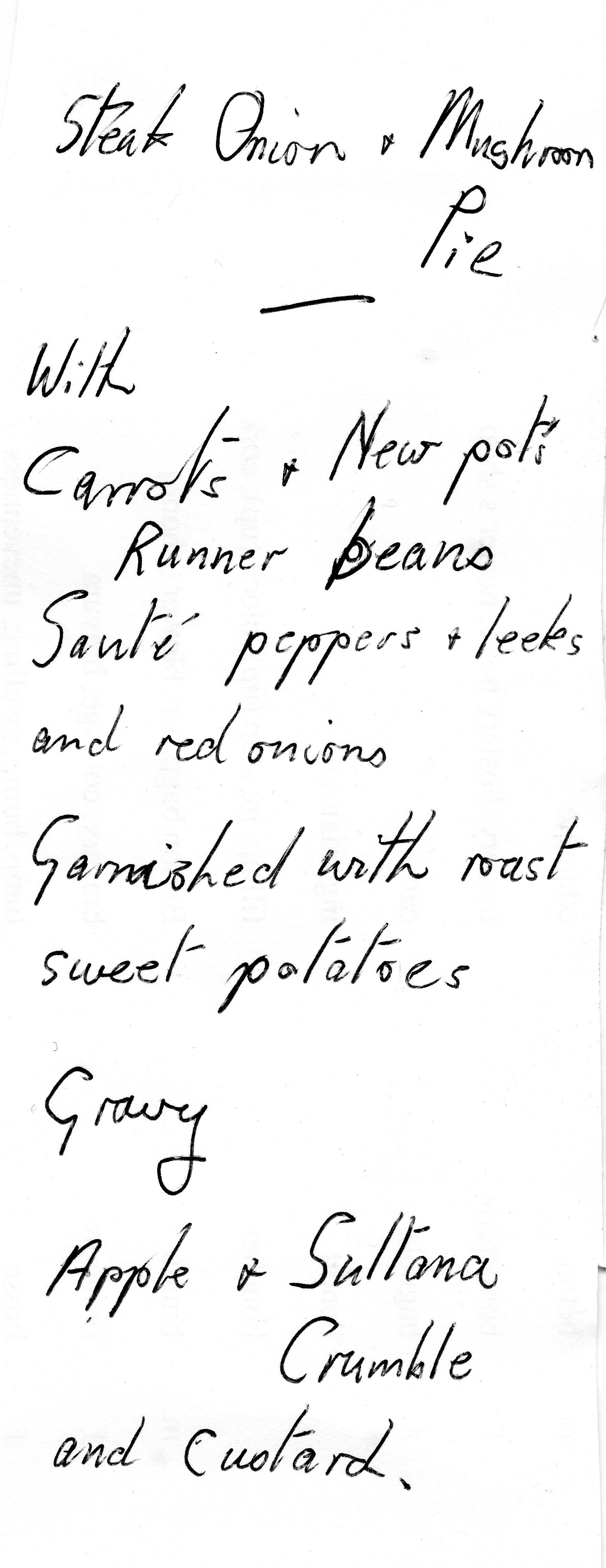
Menu

Our friends Vicki and Barrie joined us for the evening, which was as hilarious as we expected. In her own fair hand Jackie wrote me out a menu in order to expedite this post. She was too humble to add the necessary superlatives, but I’m sure you could supply some yourselves. Cabernet sauvignon, Hoegaarden, water, and fruit juices were imbibed

Whose Book?

Some weeks ago I wrote of a contact who had come to me through this blog, and left my readers with the prospect of a story. This post is that story, the result of a collaboration between me and Dr Neil Gibbs.

Dr Neil Gibbs recently purchased a copy of the Bird Lovers’ Manual ‘How to Know British Birds’ from a well-known internet auction site.

How to know British Birds

He was delighted to have found this treasure,

S. Denny inscription

and intrigued by the child’s pencilled inscription inside the front cover.

Who was this young lady?

I've always kept a unicorn

The name suggested a very popular singer/songwriter from the 1960s and ‘70s; Sandy Denny. Neil sought confirmation of this by researching biographies of the Fairport Convention singer/songwriter, who made successful solo albums during the second of these decades. Interestingly, in these books the only home mentioned was Worple Road. Stanton Road is an L-shaped side road off that main thoroughfare between Wimbledon and Raynes Park.

Our researcher’s next step was to type Stanton Road into Google, which took him to my blog where he learned that I had grown up just 24 dwellings away from S. Denny.

He left a comment on my blog asking if I had known the Denny Family. I responded with an e-mail saying I had, and inviting a telephone conversation.

Without giving away his thoughts Neil asked whether I knew of a Denny family living in Stanton Road. I did, and it was, of course, Sandy who had, at least in the 1950s, lived at 53 Stanton Road. I could be sure of that.

Sandy and David Denny

I was unable to be certain whether this photograph features a Stanton Road or a Worple Road home. It could indeed be either.

I can happily vouch for the veracity of the Stanton Road address. I lived there from 1944 until 1960 when I was 18 and Sandy would have been 12.

Sandy Denny died tragically young (aged 31yrs) in 1978, but her contribution to folk music is being recognized this month (April 27th 2016) when she will be inducted into the BBC Radio 2 Folk Hall of Fame at an Awards ceremony in the Royal Albert Hall.

Screen Shot 2016-03-24 at 12.09.29

Link for Sandy Denny website:

http://www.sandydennyofficial.com

Link for BBC Hall of fame:

http://www.bbc.co.uk/programmes/articles/3bsXpkXhDfSfYBsK91C7Ts6/hall-of-fame

Lupercalia

Two days ago I mentioned that our reception at The Fishers Pond had been so insulting that we left without a meal. A rather more generous complaint than mine would have been is detailed here in a copy of my sister Elizabeth’s e-mail received today:

‘After a recent visit when I was so well received and looked after by  the staff team and enjoyed a really delightful meal I was eager to introduce my brother and his partner to what I had hoped would be another lovely evening and a new venue for them to try.
Unfortunately I was really shocked by the contrasting experience at reception. I had rung ahead and was told that a table would be made up for us right away and 20 minutes later we arrived at the venue. We waited a very considerable time at the reception area and eventually my brother’s partner walked around to the seating area and raised a menu to draw attention of the waitresses who on seeing her turned away ignoring her.
After some considerable time the member of reception staff arrived and when I gave my name and said that I had a table reserved, he abruptly said that we were early and we would have to wait for a table to be made up. I replied that we were not early and at the same time two other people arrived saying that they had a table booked. Without responding to me, or any other acknowledgement  he spoke with the new arrivals, rudely speaking right across our little group and took the couple to their table leaving us standing open mouthed in surprise..
I am afraid this rudeness after already having been kept standing for some considerable time at the greeting area was too much for my guests and we therefore left without having a meal.
Even if there had been a delay in making up our table there were plenty of empty tables and at the very least we could have been appropriately greeted and offered somewhere to sit and wait.
Thank you for taking the time to read this complaint.’
This morning, we noticed a greenfinch pair pecking prize primulas in the front garden. Faster than it is possible to repeat that, The Head Gardener was out there investigating. She found that
Primula heads
 the plants had been decapitated. Naturally she found a use for them.
Brick path 1Brick path 2
 Aaron almost finished weeding the brick paths, while Jackie continued clearing and planting the borders of the back drive. We are really quite ahead of spring this year.
Ted_Hughes.jpgThis afternoon I finished reading Lupercal, being the second collection of the poems of Ted Hughes (1930-1998), one of our greatest modern poets, who served as Poet Laureate from 1984 until his death.
The poems are mainly about the animal life he would have known in his native Yorkshire. His muscular language and powerful imagery, presented with supreme poetic skill, depicts the violence of nature, shrieking of the harsh landscape with which he would have been familiar. Just as he would have wrested his verbal sculpture from the world about him, we must wrestle with it fully to understand his work. I can’t say I totally succeeded, but I responded viscerally to the experience.
The final offering is Lupercalia.
Wikipedia tells us that ‘The Lupercalia festival was partly in honor of Lupa, the she-wolf who suckled the infant orphans, Romulus and Remus, the founders of Rome, explaining the name of the festival, Lupercalia, or “Wolf Festival.” The festival was celebrated near the cave of Lupercal on the Palatine Hill (the central hill where Rome was traditionally founded[8]), to expiate and purify new life in the Spring. A known Lupercalia festival of 44 BC attests to the continuity of the festival but the Lupercal cave may have fallen into disrepair, and was later rebuilt by Augustus. It has been tentatively identified with a cavern discovered in 2007, 50 feet (15 m) below the remains of Augustus’ palace.’
This evening we dined at Dynasty in Brockenhurst. The food and service was, as usual, top quality. My main course was chicken chilli garlic, and Jackie’s was chicken tawa. We shared special fried rice, an onion bhaji, and an egg paratha; and both drank Kingfisher.

The Battle Of The Atlantic

This afternoon, I finished reading Jonathan Dimbleby’s excellent history, ‘The Battle of The Atlantic’, the story of a series of ocean conflicts that occupied the best part of the Second World War. Having been born in 1942, I unwittingly, along with the rest of us at home, bore the consequences of the shortages of basic living requirements for a good decade after Victory in Europe Day three years later. But I kept my life. Unlike those many thousands of sailors of the Royal Navy and the Merchant Marine; not forgetting the German crewmen, who died such terrible deaths in the struggles to supply the Allies.

Dimbleby has written a thoroughly engaging book detailing not only the political and strategic decisions of the combatants, but also the horrors of the battles, and the effects on the lives of civilians ashore.

The author’s concentration on the conditions endured by both the merchant seamen and the enlisted crew-members brings home to the reader the horrific nature of those years at sea. His description of the consequences of the severe weather on navigation and the impossibility of prolonged survival in the water makes the scenes in and around the lifeboats in the film ‘Titanic’ seem like coping with a capsized pleasure craft in a municipal boating lake. It had, for example, never occurred to me that the vessels on the Arctic convoys could become so iced up that the weight of the frozen water on deck would be capable of sinking a ship.

Sam, after his solo Atlantic row, told us how the waves could toss his little boat considerable distances through the air. Dimbleby describes much larger vessels being given similar treatment.

Waves 1Waves 2Waves 3Waves 4Waves 5Waves 6Waves 7Waves 8

Since the last few negatives of our March 2004 visit to Barbados are of the Atlantic’s multicoloured waves, albeit in the shelter of the Barbados shore, it seemed appropriate for me to scan them for today’s illustrations.

Tonight we dined on Jackie’s excellent chilli con carne and savoury rice, followed by treacle and apple tarts with thick cream.

Dead Flies And Sherry Trifle

Geoff Le Pard, who entertains us so hugely with stories on his TanGental blog, would have us believe that he was once a lawyer. This cannot be true. No teenager could have had such a past profession. And Geoff is surely in his teens. Who else could so convincingly represent the mind of a nineteen-yer-old, as he does in ‘Dead Flies and Sherry Trifle’, which I finished reading yesterday?

Dead Flies...026We know that this writer is a master of dialogue, which he uses to great effect in this tale of intrigue, crooked dealings, bullying, and burgeoning sexual angst. It is funny too. I won’t reveal the story, but every time I read the name of the character ‘Nigel Sodding Parsons’ – almost always ‘Nigel Sodding…….’, I heard the voice of the hapless Harold Spittle, and could hardly stifle a giggle. Doesn’t that strike a chord with anyone who has experienced the pungent wit of adolescent relationships?

The setting is on the fringes of The New Forest, where Geoff grew up, and where I now live. The story, with its focus on interplay between the characters, and its rising tensions, could take place anywhere. The period, for those of us who lived through the UK’s scorching summer of 1976, is well described; the heat of the sun synchronising so well with that of Harry’s hormones.

Nice one, Geoff.

Amaryllis

Today, the amaryllis that Frances gave us for Christmas produced its final bloom;

Crocuses

whilst our crocuses are reaching their peak.

Billy

Helen brought her grandson, Billy, for a visit this afternoon. I made a print for him to take home to Stephanie and John, his Mum and Dad.

Shelley joined us later on.

After our guests had retuned to their homes, Jackie drove me,

Lymington River 1Lymington River 2

via the Lymington River mirror,

Hatchet Pond 1Hatchet Pond 2Hatchet Pond sunset 2Hatchet Pond sunset 3Hatchet Pond sunset 4Hatchet Pond sunset 5Hatchet Pond sunset 6

 to catch the sunset reflected on Hatchet Pond,

Sunset on heathland

and the flooded heath near Beaulieu.

This evening we dined on Thai prawn fishcakes followed by smoked haddock and Davidstowe cheddar cheese fishcakes, with ratatouille, carrots, green beans, and mashed potato. We both drank Louis de Camponac sauvignon blanc 2014.

The Watchmaker Of Filigree Street

By late morning today, the recent storm that has left the population of America’s eastern states digging out heaped piles of snow, having warmed itself on the way across the Atlantic, petered out to heavy rain that lasted all day and is expected to continue for a few more.

The Head Gardener is a regular customer of Otter Nurseries. Like all garden centres, this one, especially in the winter months, must diversify to survive. Like all regular customers, Jackie receives a collection of bargain tokens. One of these was a ‘buy one, get one free’ offer for lunch in the cafe. Like all bargain tokens this had a limited life span – the end of this month to be precise. It had to be done.

Otter Nurseries

Leaving the soggy, scantily clad, sylphs and cute, damp, cherubs beneath the falling rain and among the flickering plant labels; and passing through the main showroom with its staccato overhead pattering precipitation; we entered the warm cafe, its rooftop raindrops silenced by effective double glazing. It was clear from the other token-clutching silver-haired diners, that one had to belong to the third age to be there at this time.

Otter Nurseries meals

My choice was steak and Stilton pie; Jackie’s was scampi, chips, and peas. Not at all bad.

Later, I finished reading a Christmas present from Tess, Mat, and Poppy. This was ‘The Watchmaker of Filigree Street’ by Natasha Pulley.

Who made the bomb? is the essential mystery forming the theme of Ms Pulley’s fantastical novel. The lives of English and Japanese protagonists are interwoven into the fabric of Victorian England and Japan in an intriguing tale which holds the interest throughout. The writer is an imaginative storyteller, the elements of whose plot are indicated on the front board. There is no great character building in this tale which would probably make quite a thrilling film, especially given that the key theme could easily be translated to today’s world.

The Watchmaker001The Watchmaker002

The said cover, designed by David Mann demonstrates similar imaginative skill of the artist. A circular panel cut out from the board represents the glass of a fob watch, the chain of which stretches down Parliament Street in the frontispiece. Filigree Street does not exist in this part of London.

This evening we dined on Tesco’s Finest Mixed Meats pizza, and Jackie’s fin salads, including the tomatoes and basil in balsamic vinegar and olive oil, to which I am rather partial. We shared Fortnum & Mason’s Chablis 2014 – a Christmas present from Luci and Wolf.


A Day Of Two Casseroles

Jackie drove me to and from New Milton Station today to facilitate my visit to Wolf and Luci in Clapham. From Waterloo I took the Northern Line underground to Clapham South and walked from there to Hambalt Road. I returned via Clapham Common.

‘Mister God, this is Anna’, by Sydney Hopkins under the pseudonym Fynn is a beautiful fable about a little girl whose ‘middle’ or essential spiritual core enables her to bear and surmount her experience as an abused runaway.

On my up journey today I finished reading ‘I Belong to No One’ by Gwen Wilson. What makes this personal memoir stand out is that the author is gifted writer whose creativity shines through her story told with deep honesty about her own feelings, and a sensitivity to those who fell short in caring for, or mistreated, her.

Albeit on the other side of the world, I have considerable knowledge of the contemporary social circumstances, ignorance, and legal constraints about which Gwen writes so eloquently.

The dramatic cover photograph does depict the despair the author describes, but what is demonstrated throughout the book is the author’s ‘middle’. Her story is for her to tell, so I will repeat none of it here, but simply urge you to read for yourself.

We have learned much since the middle of the 20th century. Nevertheless Gwen Wilson has appended an important epilogue.

The route I chose to walk this lunch-time took me along Clapham Common South Side, where skeletal trees provide a backdrop for the busy traffic.

Despite the careful maintenance of the houses on the side streets, such as these in Lynette Avenue,

you never know what you might find dumped on the pavements.

The Coach House in Shandon Road seems to have been converted into a home.

Other frontages bear the elegant detail of an earlier, more decorative age.

It must be thirty years or so that Abbeville Road has been experiencing the gentrification that brings trendy eating places.

Here is Hambalt Road.

I enjoyed a pleasurable visit with my friends, and the benefit of Luci’s excellent lamb casserole, boiled potatoes and mashed winter vegetables, followed by delicious fruit crumble. She and I drank a very good Kumala cabernet sauvignon shiraz 2013.

On my return walk a screeching and squawking heard above the roar of the traffic on the other side of the road outside Lambeth College emanated from a London Plane in which a pair of parakeets sent a squirrel scarpering.

Just before I reached the tube station the pedestrian crossing  had been closed on account of water main works which are a not unusual sight in our capital.

I can’t pretend to understand this advance warning on the main road. I don’t imagine it really has anything to do with the people of Finland. Is it to be abandoned on the given date, because of engineering problems? Any ideas?

On my return home, the smell of Jackie’s sublime boeuf bourguignon was too much for me to resist having a small portion. I passed on dessert and wine.

Agnes Miller Parker

Jackie drove me to and from New Milton for me to lunch with Norman at Tas, in The Cut, EC1.

Leycesteria

In the rather neglected station garden a Leycesteria is blooming rather early. Note the dumped supermarket trolley visible beyond the stems.

The Cut SE1

From Waterloo Station I approached The Cut, as congested as ever, via Lower Marsh

Food stall 2

with its cosmopolitan food stalls preparing for the lunchtime custom.

Food stall 1

I wasn’t the only photographer focussing on food.

Tas Special meal

Norman and I had our usual enjoyable discussion over the Anatolian cuisine. We both chose the Tas Special lamb meal, which was very tender and tasty. Before that we had each chosen soups. Mine was fish with coriander and ginger. For dessert we each enjoyed baklava, and shared a bottle of the house red. We finished with coffee before I made my way back to Waterloo for my return home. Further sustenance was not required this evening.

Two days ago, I featured the dust jacket of Eiluned Lewis’s ‘Honey Pots and Brandy Bottles’. This was to display the work of Agnes Miller Parker. I had bought this 1954 publication some forty years ago, essentially for the illustrations. Perhaps, I thought, it was time I got around to reading it. I finished it on the train today.

The book is a collection of essays and poems gathered to represent the four seasons of the year. Published by Country Life the writing is pleasant, if, for this reader, unexciting.

What lifts the publication well beyond the ordinary are the wood engravings of a woman I regard as one of the best illustrators of her day.

SpringSummerAutumnWinter

The clarity, perspective, and depth of field evident in these masterpieces would be impressive if they were simply pen and ink drawings. When one considers the technical skill required to bring light and life to images worked into blocks of wood, admiration can only be enhanced.

A Shropshire Lad

Last year’s Folio Society edition of ‘A Shropshire Lad’ by A. E. Housman contains Agnes Miller Parker’s 1940 wood engravings to this timeless set of poems. Much as I admire this superb artist’s work, I already possessed the Society’s 1986 edition illustrated in a more modern vein, so, I was not tempted to buy it. Well, not greatly. It is the latter version I finished reading today.

Here is the book jacket to another of my treasures, illustrated by the great engraver:

Agnes Miller Parker book jacket

This is how The Folio Society publicise their latest edition:

“Beloved by both scholars and general readers, A Shropshire Lad was self-published in 1896 and has been continuously in print ever since. Housman, who was also the greatest classical scholar of his age, wrote the cycle of 63 poems after the death of his friend Adalbert Jackson. Among his themes are the transience of youth, the sorrow of death, the loss of friendship and the beauty of the English countryside. The poems’ depiction of young, brave soldiers made them widely popular during and after the Boer War and the First World War. They also captured the imagination of many composers, with George Butterworth, Ralph Vaughan Williams and Samuel Barber among those to set them to music.

Housman evokes a semi-imaginary pastoral landscape, his tone often rueful and elegiac as he evokes the ‘golden’ years of youth and the realm of classical myth. But it is perhaps for the directness and poignancy of his language that the poems have endured. On the vagaries of feeling and the fragility of human kinship, he is at once emotional and unsentimental, lyrical and frank.”

I enjoyed the poems and would concur with the above blurb.

Patrick Procktor’s illustrations suitably complement the text.

A Shropshire Lad

Here is the frontispiece;

A Shropshire Lad endpaper

and here the design for the endpapers.

For many years now, Folio Society publications have come in stiff cardboard slipcases. These are mostly unembellished. This one, however, has this portrait on the back:

A Shropshire Lad slipcase

Does it represent Adalbert Jackson?

This evening we dined on Jackie’s perfect pork paprika, savoury rice, and green beans, followed by lemon and lime merengue tart. The Cook drank Hoegaarden and I drank more of the malbec.

12342653_490921431079669_5710528345196685012_nP.S. I am indebted to Judith Munns for the information and Barrie Haynes for the photograph of this statue of Housman that stands in Bromsgrove, where Judith once lived:

Roanoke

You know when you buy a new car and for some time thereafter you seem to see others of the same model every time you venture out?

Well, I haven’t bought a Chesapeake, but, ever since my mention of Chesapeake Mill on 4th, it has followed me around. First, Barrie Haynes sent me details of how the mill got its name, with a picture of USS Chesapeake, which I added to my post; then Chesapeake Bay turned up in a book I have just finished reading.

The volume is a history of the first thirty years of England’s attempts to colonise Virginia. This, ‘Big Chief Elizabeth’, by Giles Milton, is no dry tome. It reads as the rollicking adventure story that it is. It is also a mystery tale concerning the fate of the first settlers on Roanoke Island. The reader is gripped from the start. The writing is fluid, with judicious use of quotations that enhance the text rather than simply fill it out. More than half a millennium on, and in full knowledge of the European taking of America, we really want to know the outcome. That, of course, is why I can give no more detail. It is perhaps fortuitous that I should have begun reading this at Thanksgiving time.

My Folio Society edition is well illustrated, with photographs,

Chief's wife and daughterChief Wingina

such as these of John White’s portraits from 1485,

Roanoke map 001Roanoke map 002

and useful maps by Reginald Piggot;

Big Chief Elizabeth001

and sports a front board decoration by Gavin Morris.

This evening we dined on Jackie’s superb sausage casserole; mashed potato; boiled carrots, cabbage, and Brussels sprouts. I consumed more of the cabernet sauvignon.