About A Boy

Our sister-in-law, Frances, is nearing the completion of her collecting and coordinating Chris’s colossal accumulation of detailed family history documentation dating back to the 17th century.

One gap she and our nephew Peter have identified is a contemporary childhood chronicle of my late brother. Who better, they decided, to create this than the sibling who shared his life from its very beginning?

Some shared milestones illustrate ‘Christopher Michael Knight 1.10.1943 – 17.10. 2014’

Without this photograph from 1945, depicting a street party celebrating Victory in Europe at the end of that sphere of World War Two, neither of us would have any memory of the event.  For anyone below the age of about 75 to imagine the jubilation of that heady, optimistic, summer is virtually impossible.  Chris and I are in the centre of the front row.  My chubby little brother, then not yet two, looks, as would any other toddler, as if he had no idea what was going on or why he was there.  

Our mother had made our outfits, dressed us up for the occasion, and had a studio photograph taken.

It was perhaps about this time that I mangled my brother’s finger, or maybe a thumb. In mid-war London, Mum just 21, with Dad away in the army, there were none of today’s domestic appliances, or other conveniences. Without a washing machine an old fashioned mangle, as depicted in ‘Then The Tableau Spoke’ helped squeeze excessive moisture before hanging clothes up in the kitchen to dry. Chris was probably trying to help as he placed his hand between the rollers while I turned the handle.

Holidays were non-existent, unless we were staying with our maternal grandparents, as in the picture above, in which Chris plays opposite Grandma’s feet. Uncle Bill once drove us to Brighton for the day.

Mum’s iron was one that was heated up on the stove; we had no telephone; no car; neither fridge nor freezer; and used ration books into the 1950s.

Chris might have been a touch disaster prone. I forget exactly when he scalded himself by reaching up for a boiling kettle or saucepan, but his family will know that it scarred him for life – as did picking his chicken pox scabs.

The next accident came early in 1947. I don’t remember how he did it, but he managed to break his leg in our garden at 29a Stanton Road. Photographic evidence and an explanation of our attire appears in ‘Pink Petticoats’. I rushed upstairs to tell our mother. “Don’t be silly. He can’t have”, she replied, and yanked him to his feet to find that he had. There was no National Health Service in those days. The treatment was paid for from public funds because Dad was still in the army.

Ten years later, Mum stands with Jacqueline on the exact spot from which she tried to heave Chris to his feet. The steps behind continued up to our kitchen where we spent much of our indoor time. The kitchen range was similar to the one illustrated in ‘Then The Tableau Spoke’, highlighted above. We lived beside the railway which we could see clearly from the kitchen window and collect train numbers and the names of Pulman carriages drawn by steam engines. Always eager to “get down”, or leave the table after a meal, the rule was that we had to wait for six trains to go by before we could do so.

As mentioned in the also highlighted ‘Pink Petticoats’, Chris and I spent several months with our maternal grandparents in Durham while Mum was struggling with Jacqueline’s gestation.

We all attended St Mary’s Primary School in Russell Road, Wimbledon. It is essentially my experiences that are related in ‘Maureen Potter And Plasticene‘, but, although my brother was far too well behaved to warrant any of the punishments described, he would undoubtedly have witnessed their administration.

In those days it was a mortal sin to miss mass on a Sunday. Mum was not a Catholic and Dad was not practising. We, however, were expected to do so because our mother had vowed on her wedding day that any offspring should be raised Catholic. We were therefore sent off alone to church every Sunday with a penny each for the collection plate, before continuing to Auntie Gwen’s for breakfast. We had, however, worked out that the crucial section was the stretch between the reading of the gospel and the distribution of communion. We would therefore arrive late and leave early so we had fulfilled the compulsory requirement and wouldn’t go to Hell. What we didn’t know was that my class teacher was also a member of the congregation and had spotted our little scam. She tackled me about this at school, which seemed a bit sneaky to us.

We travelled to school by trolley bus along Worple Road. Often we would spend our bus fare on such as a bag of broken biscuits from the old style grocers in Wimbledon Broadway, and walk home. It was on one such perambulation that we climbed into a wasp’s nest.

We made dens on waste land beside the railway path that ran beside Wimbledon and Raynes Park. There is more about this and about our childhood home in ‘Cricket In The Street’.

As we became old enough we travelled further afield, and would walk up to Cannon Hill Common attempting to catch newts.

Chris followed me to Wimbledon College where he excelled at maths and cricket. It was here that we learned some of our basic differences. I really struggled with new concepts such as algebra and geometry with which he was happy; my forté was English.

Neither of us had played cricket before, so I may have been considered to have led the way, having started a year ahead of him. It was he, however, who spent two years in the 1st eleven while I captained the 2nd in my final year. We were both allegedly fast bowlers. Chris, although less accurate, was a great deal faster. This he achieved by swinging his delivery arm over twice. He would, no doubt, question my accuracy statement, given that his favourite sporting story concerned his feat of bowling five victims in successive balls. When I once mentioned that this was in a school practice match, Peter quipped that he had thought it was a Test Match. In the only school game in which we played against each other, he also bowled me, which was more than somewhat chastening. While on the subject I would add that he played for a short time with me for Trinity Cricket Club where his bowling was less successful, but, some 50 years later, he remained very high on the list of six hitters. The club had an annual single wicket knockout competition. Both our names are on the cup, although Chris managed it first.

I indicated earlier that Chris kept himself out of trouble at primary school. He did the same at The College. Whereas I was quite a regular recipient of stinging strokes of the ferula pictured above, my brother spent his whole career there pain free, prompting me to call him a creep.

As I understand it, women are the multi-taskers. Chris, at 17, was able to play his guitar; listen to music, not necessarily Hank Marvin or Buddy Holly; and do his homework, apparently simultaneously.

I will leave the rest of his life story in Frances’s capable hands.

This afternoon I watched the Six Nations rugby match between Ireland and Scotland.

For dinner tonight Jackie produced her tasty sausages in red wine; creamy mashed potatoes; crunchy carrots; and firm Brussels sprouts, with which she drank Hoegaarden whilst I opened another bottle of the Malbec and drank some of it.

The Old Curiosity Shop

Early this morning I finished reading ‘The Old Curiosity Shop’ by Charles Dickens, and scanned the last three of Charles Keeping’s illustrations to my Folio Society edition of 1987.

This book bears all the qualities of Mr Dickens’s story-telling. We have mystery, suspense, moving prose, humour, and more than a touch of sarcasm. There is a wealth of characters intricately knitted together. As is typical the personages are uncomplicated; they are either sinners or saints.

The prose flows at quite a rate; the descriptions of a range of locations from city to countryside are often lyrical, and at times unattractive. Dialogue expands characterisation, while refraining from irritating attempts at the vernacular such as sometimes employed elsewhere. Cameo introductions of various contemporary environments and individuals are informative. I find it is quite helpful that the author reminds us of characters we may have forgotten about.

Christopher Hibbert’s knowledgeable and informative introduction expresses the commonly held view that in this work Dickens is attempting to write out his grief at the death of his idealised and adored young sister-in-law.

Normally when I review a book I try not to reveal anything of the story. This has been largely adhered to despite my decision to feature every one of the artist’s exemplary illustrations. Mr Keeping’s final image does indicate the ending, but hopefully there is still much to discover for new readers.

‘The water toyed and sported with its ghastly freight’ is suitably grim.

The young gentleman in ‘Bidding the travellers farewell’ is recognisable from previous portraits, notably in the dock. It is clear that the young lady does not want him to leave.

‘She was dead, and past all help, or need of it’

For a number of years around the end of the last millennium, I performed a consultancy role at Portugal Prints, the Westminster Association of Mental Health project then situated in Portugal Street, WC2. This was around the corner from Portsmouth Street where stood the 16th century building which had inspired Charles Dickens as a starting point for this novel. I never actually entered the establishment in that incarnation because it was never open when I walked past and I probably couldn’t have fitted into it. Google now tells us that it is a high-end shoe shop.

A parcel arrived from Becky and Ian this morning. It contained a splendid Mother’s Day bouquet with small packet of fudge chocolates. Becky made the vase for Jessica and me when she was an art student at Newark in the early 1990s. The book is one of Becky’s presents to me for Christmas 2020. It lives on the coffee table. Jackie produced this photograph.

Just as I settled down to watch Six Nations rugby this afternoon, we suffered a power cut which meant I missed the first half of the game between Italy and Wales. Jackie decided to go shopping. There was some difficulty for her leaving the house, because

temporary traffic lights were in place to enable the electrical engineers to fix the problem of a line tangled in the conifers central to her picture.

The second rugby match was between England and France. While I watched that

the Assistant Photographer focussed on the sunset which signalled that the gale is over.

This evening we dined on oven haddock and chips, small peas, pickled onions, and gherkins with which Jackie drank Hoegaarden and I finished the Malbec.

Mounting The Verge

With a penultimate scanning session today ‘The Old Curiosity Shop’ is almost closing for Charles Keeping’s exquisite illustrations

‘They descended the narrow steps which led into the crypt’. Was the old man here based on Alastair Sim, even though he never made a film about this novel? Here is the trailer for his Scrooge: https://youtu.be/WqbQYsjrDR4

‘Mr Swiveller took another pull at the tankard, and waited for her lead’

‘Kit suffered them to lead him off’

‘During this melancholy pause, the turnkey read his news-paper

‘The gentleman who was against him had to speak first’

‘The pony reared up on his hind legs’

Although the strong winds began somewhat to subside during the day, we were treated to frequent changes of light as sunny periods alternated with violent precipitation; dark clouds with blue skies.

After a shopping trip to Ferndene Farm Shop this afternoon we drove around the lanes for a while.

Sometimes we experienced the changes described above all together.

I only had to swivel on the spot in Thatchers Lane for a very few minutes to acquire these images.

On London Lane Jackie began backing up when coming nose to nose with a monster. Quick as a flash the very young man in the driving seat mounted the verge to allow her space to pass. The tractor’s rear wheels were higher than the Modus.

Most verges sport a proliferation of daffodils, like these on

Charles’s Lane.

This evening we reprised yesterday’s delicious steak pie meal with more of the same beverages.

Habitual Head Hangers

Blues skies returned today for our first visit to Mum in Woodpeckers since before the Christmas lockdown, which has been somewhat relaxed.

We were able to use the screen room. Jackie photographed Mum behind the screen in which I am reflected. My mother was in good spirits, but not hearing too well, especially at the beginning, probably because of having to adjust after the long absence.

The Assistant Photographer also pictured the view from the window, containing

ponies in a neighbouring field, and

small birds in a tree. Unfortunately Mum would not be able to see all this.

As can be seen from the pictures above, we experienced some sunny periods today. This afternoon I entered the garden with trepidation, to be pleasantly surprised. So far the gale force winds have inflicted virtually no damage.

A few empty trugs have been transported; a watering can has taken refuge in the compost container outside the kitchen door; and one basket is down.

Smaller plants, like primulas, violas, and trailing vinca remain unperturbed.

Daffodils which we feared would be flattened, and the tulips which had been flattened, and spiked, by a recent frost, stood proudly erect.

Apart from a few blown down blooms, our camellias are all unscathed.

Many of our hellebores, habitual head hangers, unusually held theirs high.

Elizabeth came to dinner for the first time since lockdown. Jackie produced one of her splendidly succulent steak, onion, and mushroom pies; roast potatoes; boiled purple potatoes; crunchy carrots and Brussels sprouts; firm cauliflower, and meaty gravy with which the Culinary Queen drank Hoegaarden while my sister and I drank Mendoza Malbec 2019. This was followed by a lemon tart.

Spume

On this wet, windy, Wednesday morning I passed four more of Charles Keeping’s splendid illustrations on my visit to ‘The Old Curiosity Shop’ by Charles Dickens.

‘Kit’s mother and the single gentleman, speeding onward in the post-chaise-and-four’ occupies a double page spread.

‘ ‘Aquiline!’ cried Quilp, thrusting in his head, and striking the feature with his fist’, follows with another.

‘ ‘Mr Quilp, elevating his glass, drank to their next merry-meeting in that jovial spot’. Here Mr Keeping produces three recognisable characters, depicting the scene described with sarcasm by Mr Dickens.

‘Nell went out alone to visit the old church’

Having reached this point on such a day, I was prompted to return to my cemeteries project after lunch.

My next batch of colour slides was produced at West Norwood Cemetery in May 2008.

Perhaps the most splendid memorials in Victorian London were those erected here by the Greek shipping community.

An example is the Mortuary Chapel, C1872, attributed to ‘J Oldrid Scott, to the memory of Augustus Ralli. Small Doric temple with tetrastyle portico at each end, all of fossiliferous limestone white for the stylobate and golden for rest of building. In front, pediment and metopes are marble sculptures of religious subjects although compositions are based on Parthenon models. Set back lower side wings with rusticated ends, angle pilasters, plain metopes and narrow windows. Double door with fanlight of fishscale glazing. Handsome painted ceiling inside.’ in 2019 the National Lottery Heritage Fund awarded the Local Authority [Lambeth] a grant under the Parks for People programme which secured funding for the repair of priority monuments. Work is currently progressing on surveys and statutory approvals prior to starting the repair works, which are now anticipated to start in 2021.’ (https://historicengland.org.uk/listing/the-list/list-entry/1064989). The young man was at Eton College when he died.

There is much skilful statuary. Perhaps a reader may be able to translate the inscription on the child’s plinth.

Yes. I found this mother and son mesmerising from almost any angle.

With the gale winds picking up by mid afternoon, and the sun having spent the day in hiding, we nipped down to

the coast at Milford on sea for some comparison shots with yesterday. The woman had left the shingle and Hurst lighthouse was no longer visible; the Isle of Wight had been towed away.

Colourless rocks and waves had lost their sparkle and breakwaters were largely obscured.

Spray had turned to flying spume-balls carpeting steps to the sea wall over which they sped sailing across the road.

Black headed gulls hung almost stationary on the wind. From the safety of the car

Jackie photographed me failing to focus on them yet having a little more success with the sea.

This evening we dined on firm pork chops topped with sage and onion stuffing; crisp Yorkshire pudding; boiled new potatoes, crunchy carrots, broccoli and cauliflower, with which Jackie drank Hoegaarden and I finished the Primitivo Salento.

“Tomorrow Will Be A Good Day”

Knowing that we are about to experience strong gales for three days I lay down the garden chairs and the new water feature as a precaution this morning, and this afternoon we visited the coast at Milford on Sea to make calmer photographs than we would anticipate for a while.

Although from a distance the sea looked calm enough as I focussed on the Isle of Wight and a woman on the seafront shingle,

it wasn’t that tranquil.

Jackie focussed on me photographing

waves advancing in a rush, and seeping back across the shingle.

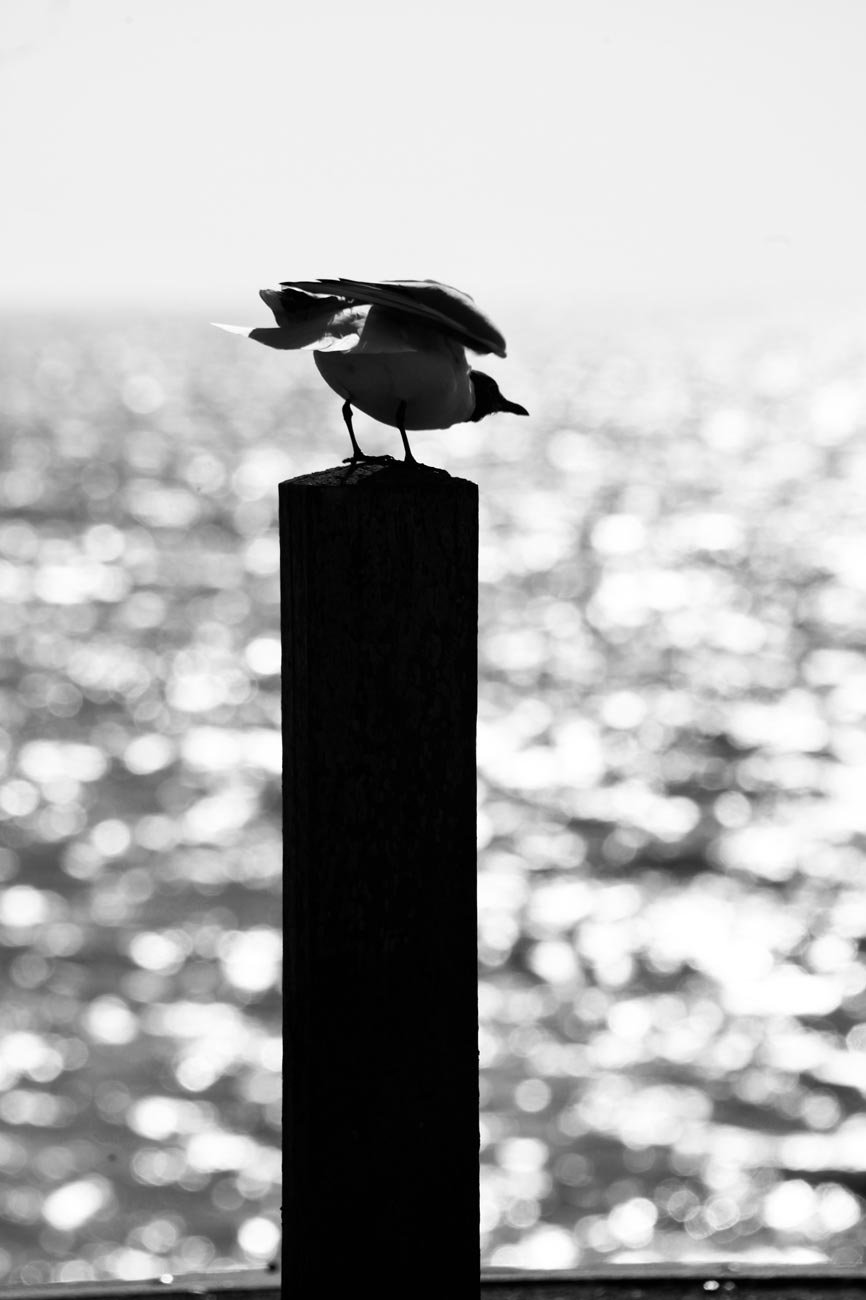
As we left, a black-headed gull was perched for takeoff.

Should there be anyone who does not know of Captain Sir Thomas Moore, you are advised to consult https://en.wikipedia.org/wiki/Captain_Tom_Moore to read about the inspirational gentleman approaching his 100th birthday who, during 2020 raised our nation’s spirits; £34,000,000+ for the NHS; and, ultimately Queen Elizabeth II’s dubbing arm. This man’s favourite phrase, “Tomorrow will be a good day”, has been celebrated in yarn on the Pilley Street letter box.

After passing this, we drove on to Lepe where, from Inchmere Lane

we looked out over the flats, where I photographed

a solitary oyster catcher, and Jackie photographed

a motor boat.

I disembarked beside a seasonal pool on Exbury Road where I photographed

reflections of overhead trees;

fallen branches; and a mossy bank.

Do ducks lay eggs on a bare scratched circular area of ground? If so, I found one.

This evening we dined on Jackie’s chicken and vegetable stewp with fresh bread, followed by her spicy pasta arrabbiata and tender runner beans, with which she drank Hoegaarden and I drank more of the Primitivo Salento.

School Was Out

Despite our recent sunshine The Head Gardener remained convinced that Jack Frost had not yet kept his icy fingers out of reach of the garden.

Early this morning she took her camera outside to prove her point.

Later, Callum of Metro Rod brought his specialist camera to investigate a blockage in the drainage to our septic tank. His diagnosis was that the tank needed emptying. There was no additional obstruction. We are normally on an 18 months rolling cycle for clearance, yet it is only nine months since it was last emptied. I telephoned CSG, increased the frequency of the pump out, and booked one for next week.

The temperature was warmer this afternoon when we drove into the forest.

Blackie, photographed by Jackie,

and Splash, by me, two Highland bulls to whom I have been introduced, with their herd, occupied the green at Bramshaw. After a good scratch the red bovine let me know what he thought of me.

Among the others on which I focussed,

one sported a mud pack by rubbing the grass of well-placed mound.

Jackie also captured me at work, refusing to accept that it was a portrait of the muddy cow I was making, and not the other creature’s bum.

Moving on to Nomansland, an assortment of ponies were employed on keeping down the grass in the cricket outfield.

Today, most primary schoolchildren in England, have returned to school after the latest Covid-19 restrictions.

Those in the village of Hale share their playing fields with ponies on the green. The school bus driver had to shift the pony from the path in order to pick up some pupils. Meanwhile families gathered, safely distanced, to collect their charges. School was out.

I believe this was a herd of English White cattle on a hillside outside the village.

Primroses now line many of our verges, like those beside the field above, beyond which

stretch extensive landscapes.

This evening we dined on Jackie’s spicy pasta arrabbiata, and tender green beans, with which she finished the Sauvignon Blanc and I drank Primitivo Solento 2019

The March Garden

Bluebell is the young lady I photographed yesterday between her partner, Aaron, and the Shetland pony he was photographing.

She photographed me photographing them from beside my trusty steed, and has e-mailed me a copy of it, for which I am very grateful.

This morning I made a further five illustrations into ‘The Old Curiosity Shop’. Regular readers will know that these are by the inimitable Charles Keeping.

‘Messrs Codlin and Short’ were extremely uncomfortable in their unaccustomed environment. Keeping has depicted this just as Dickens described it, even to the extent of their perching on the edges of their seats.

In the theatre ‘Everything was delightful, splendid, and surprising’. The artist has captured the whole gamut of audience reactions.

‘ ‘Stay, Satan, stay !’ roared the preacher again’. Charles Keeping leaves us in no doubt as to the kind of cleric he was.

‘The boat was towed by a couple of horses who were resting on the path’ of a most evocative waterside scene presented as a double page spread.

‘Tall chimneys poured out their plague of smoke and made foul the melancholy air’ subtly depicted in the wavy lines across the background.

This afternoon I gathered

a few garden views, each of which is identified in the gallery which can be accessed by clicking on any image.

This evening we dined on boned chicken thighs marinaded in mango and lime sauce; boiled new potatoes; and tender green beans, with which Jackie drank Hoegaarden and I finished the Coonawarra Cabernet Sauvignon.

Rolling Over And Thinking About It

This morning I watched the Channel 4 broadcast from Ahmedabad of the last rites of the English Cricket tour of India.

Soon after lunch we visited the pharmacy at Milford on Sea, then drove into the forest.

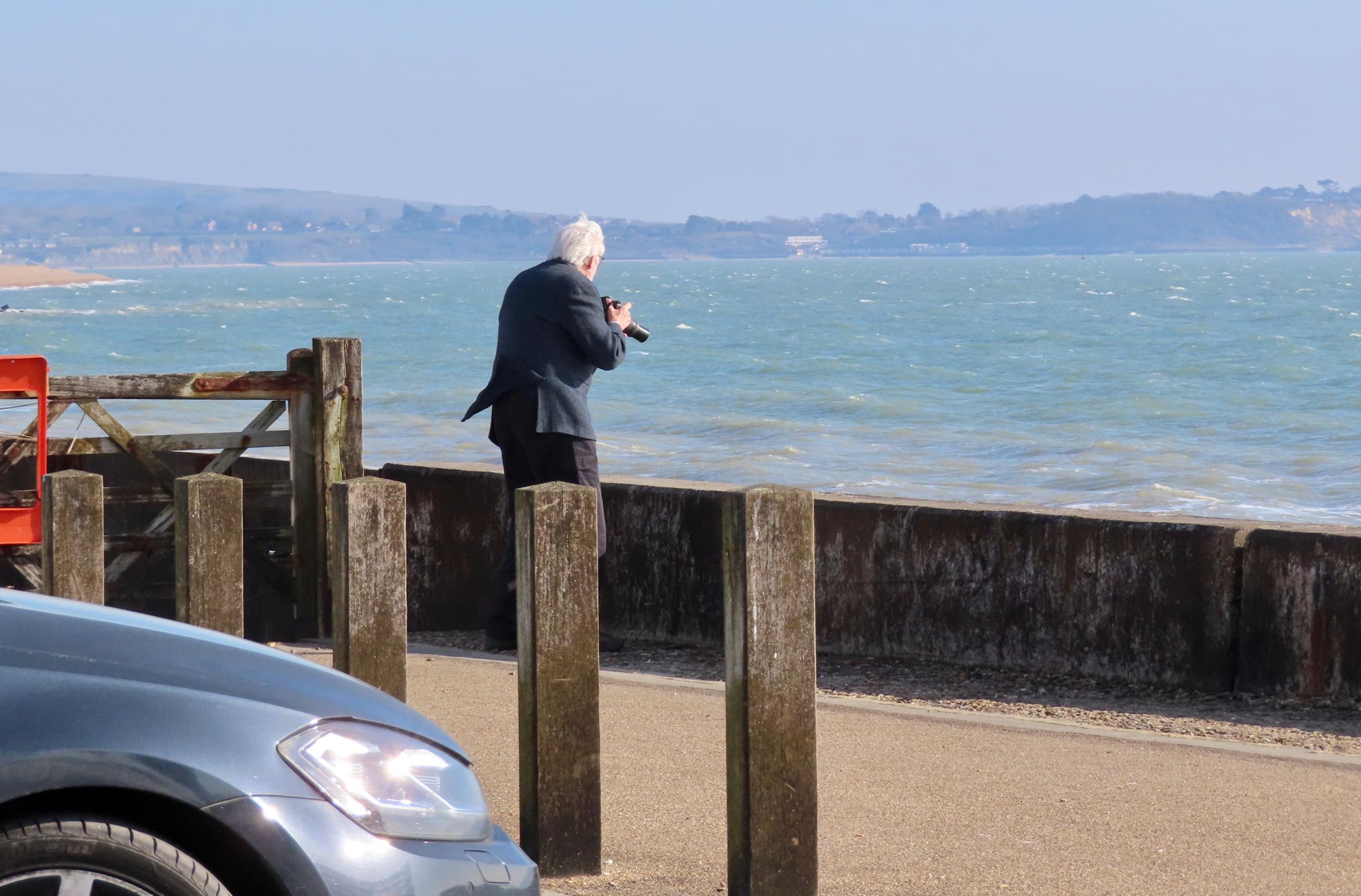
At Norleywood Car Park we found I was not the only person interested in photographing the wild life. The gentleman in the last two images in this gallery adopted an enviable position from which to obtain his pictures. I was happy to explain to the woman in the first three photographs the story of

the Shetland ponies, which cropped the grass,

ignoring the fallen trees.

Along the road to Beaulieu, many of the trees stand in nature’s water buckets throughout the winter.

Perhaps the ponies gathered here today wished to be near their water source.

I really identified with the seated pony in the final image of the above gallery. All these equine adults when seeking to rise to their feet adopt the practice of first rolling over and thinking about it before stiffly staggering up. This, of course, is why I found the earlier photographer’s position enviable.

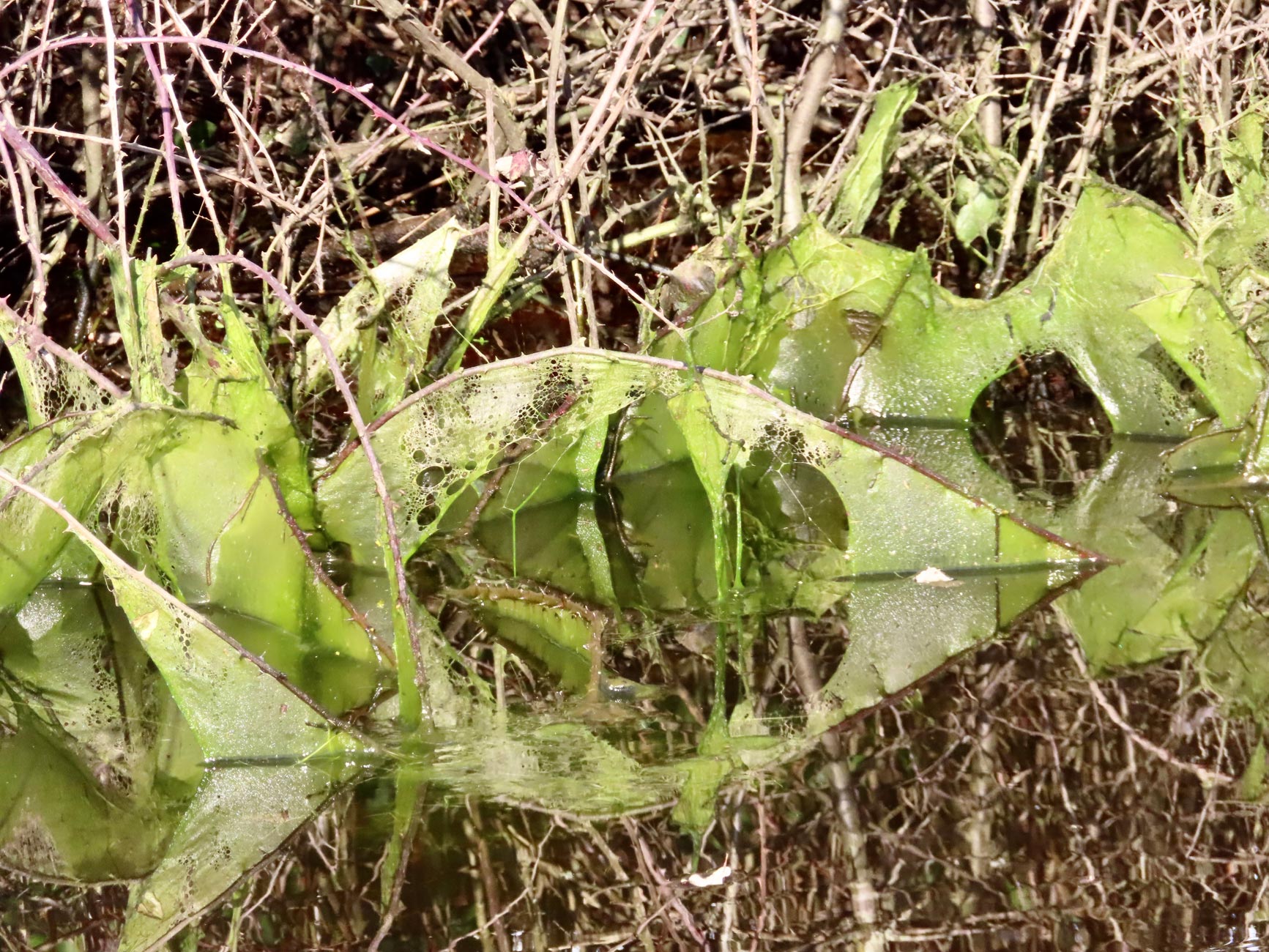
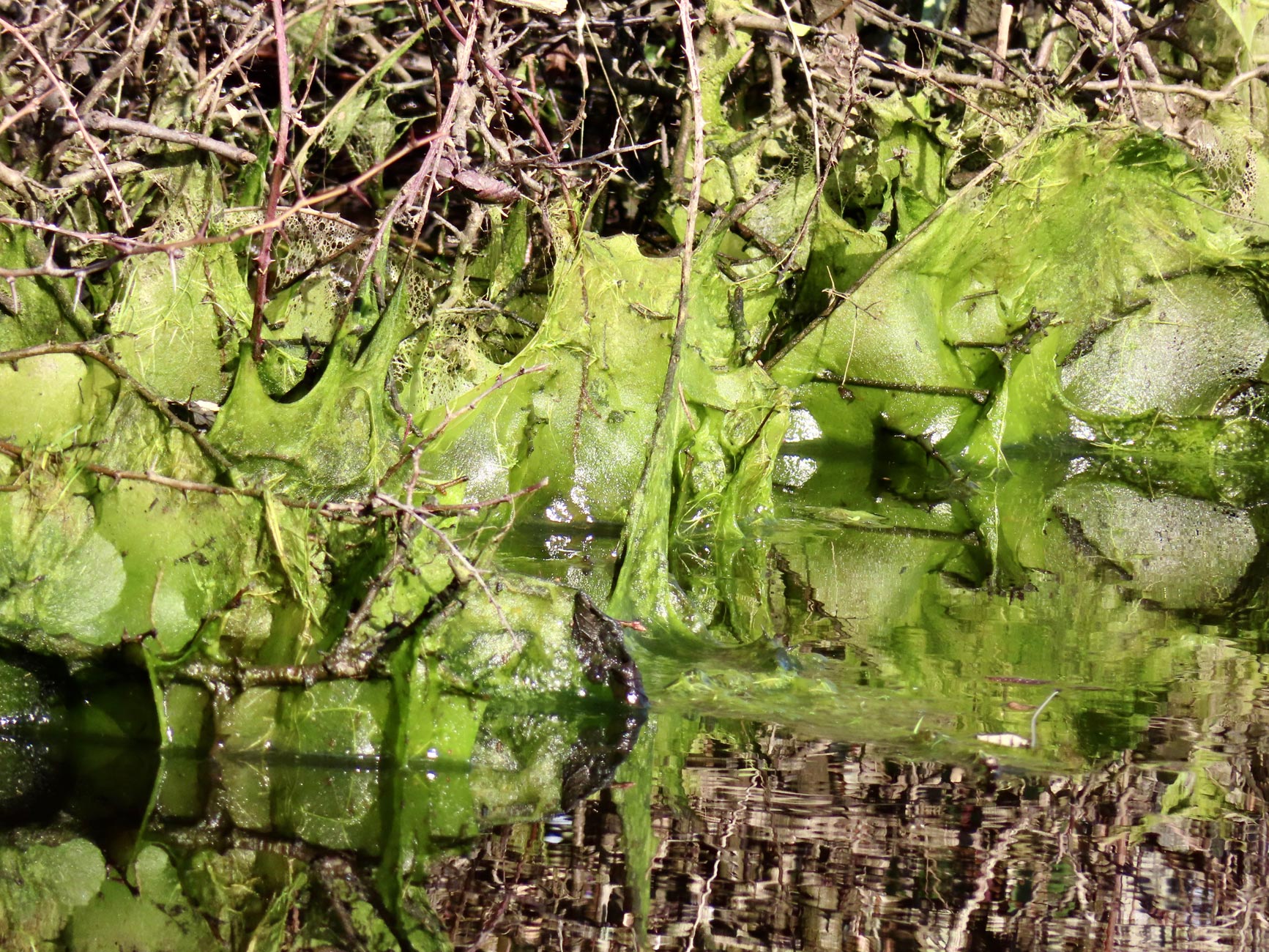
Driving along Saint Leonard’s Road past a waterlogged verge, Jackie noticed that the recent drop in the water level had left the surface algae drying on reflected bramble washing lines. These are her pictures;

these are mine.

At the corner of Saint Leonard’s and Norleywood Roads a pony drinking gazpacho soup took umbrage at my attention, shook her head, and sped off into the gorse.

It was a rather startled cockerel that I photographed along South Baddersley Road. Seconds earlier he had been canoodling with a group of guinea fowl. When I unsuccessfully attempted to focus on them they took off, loudly flapping and squawking. He must have wondered what he had done to upset them.

This evening we dined on oven fish and chips, pickled onions, and wallies, with which we finished the Sauvignon Blanc.

Sunny Intervals

Early in the day I watched Channel 4’s transmission of the enthralling second day’s play in the Test Match between India and England.

The forest was still overcast when, this afternoon, we set off for a drive.

Lanes like Bockhampton Road were quite clarty. Beside this one

a whiteness of swans occupying a field attracted my attention as, their serpentine necks sinuously swaying, they foraged in the grass and reflected in one small pool.

The next pale reflector paddled in weed soup in a seasonal pool during a sunny interval at Ibsley. When she became aware of my circling her spot, she emerged from the water and joined

her cousins on the green. I exchanged greetings with the dog walkers as they drew near.

Glowing golden gorse enlivened the landscape below Abbots Well. The second of these images containing another dog walker employing an extending lead shows the difference in light created by a sunny interval. Only the distant slopes are lit; those nearer are overshadowed by cloud.

This evening we dined on tasty smoked haddock; piquant cauliflower cheese; creamy mashed potatoes; crunchy carrots and broccoli, with which we both drank Western Cape Sauvignon Blanc 2020.