Agnes Miller Parker

Jackie drove me to and from New Milton for me to lunch with Norman at Tas, in The Cut, EC1.

Leycesteria

In the rather neglected station garden a Leycesteria is blooming rather early. Note the dumped supermarket trolley visible beyond the stems.

The Cut SE1

From Waterloo Station I approached The Cut, as congested as ever, via Lower Marsh

Food stall 2

with its cosmopolitan food stalls preparing for the lunchtime custom.

Food stall 1

I wasn’t the only photographer focussing on food.

Tas Special meal

Norman and I had our usual enjoyable discussion over the Anatolian cuisine. We both chose the Tas Special lamb meal, which was very tender and tasty. Before that we had each chosen soups. Mine was fish with coriander and ginger. For dessert we each enjoyed baklava, and shared a bottle of the house red. We finished with coffee before I made my way back to Waterloo for my return home. Further sustenance was not required this evening.

Two days ago, I featured the dust jacket of Eiluned Lewis’s ‘Honey Pots and Brandy Bottles’. This was to display the work of Agnes Miller Parker. I had bought this 1954 publication some forty years ago, essentially for the illustrations. Perhaps, I thought, it was time I got around to reading it. I finished it on the train today.

The book is a collection of essays and poems gathered to represent the four seasons of the year. Published by Country Life the writing is pleasant, if, for this reader, unexciting.

What lifts the publication well beyond the ordinary are the wood engravings of a woman I regard as one of the best illustrators of her day.

SpringSummerAutumnWinter

The clarity, perspective, and depth of field evident in these masterpieces would be impressive if they were simply pen and ink drawings. When one considers the technical skill required to bring light and life to images worked into blocks of wood, admiration can only be enhanced.

Santa’s Little Helper

Bathroom door 1Bathroom door 2When Aaron, continuing his work on the bathroom, engaged Jackie and me in a debate about whether or not he should paint both sides of the bathroom door, he observed that he loved a difference of opinion. Jackie said he could do what he liked – the other side of the door will be painted anyway when he does its companions on the landing. I pointed out that that left him in the position of having to choose between us, and likened it to Christmas at Mat and Tess’s a few years ago.

I have two Antipodean daughters in law. Tess is from New Zealand, and Holly is an Aussie. They each presented me with a bottle of their native wines, asking which I would like to open first. I was between the rock of Marlborough and the hard place of Margaret River. Aaron suggested I might have taken a nice French one out of the cupboard. Sitting firmly on the fence, I said we would no doubt drink them both, so I would open them together – a somewhat difficult manoeuvre, especially for one who is not exactly a dab hand with a corkscrew.

Yesterday afternoon in New Milton, and today in Lyndhurst, we had far more success with Christmas presents than hitherto.

Lyndhurst, the tourist hub of The New Forest, was very busy.

Post Boxes and Santa's little helper

Santa’s Little Helper stood by the twin post boxes, keeping her eye on a cardboard container on the wall surrounding the Christmas tree. I imagine this was for the collection of letters to Father Christmas. (In truth she was selling cup cakes, but let’s not allow the truth to spoil an idiotic idea.)

It is normal for our post boxes to bear a bas-relief of the sovereign’s initials. The one against which our subject is leaning is embellished with GR and the other with EIIR. I don’t know which of the six Georges was on the throne when the first was installed; and since there were no such amenities during the reign of the first Elizabeth, the II on the second is probably a little superfluous.

Skyscape

On our way home, as the sun was thinking about calling it a day, we diverted to Milford on Sea. The concave section of the cliff edge in this shot, is where another section has fallen away.

Jogger on shore

A number of joggers were about. Here one runs along the shoreline.

This evening we enjoyed a dinner of Jackie’s glorious sausage casserole; crisp carrots and Brussels sprouts; boiled potatoes; and fried leeks. I drank Old Crafty Hen.

A Shropshire Lad

Last year’s Folio Society edition of ‘A Shropshire Lad’ by A. E. Housman contains Agnes Miller Parker’s 1940 wood engravings to this timeless set of poems. Much as I admire this superb artist’s work, I already possessed the Society’s 1986 edition illustrated in a more modern vein, so, I was not tempted to buy it. Well, not greatly. It is the latter version I finished reading today.

Here is the book jacket to another of my treasures, illustrated by the great engraver:

Agnes Miller Parker book jacket

This is how The Folio Society publicise their latest edition:

“Beloved by both scholars and general readers, A Shropshire Lad was self-published in 1896 and has been continuously in print ever since. Housman, who was also the greatest classical scholar of his age, wrote the cycle of 63 poems after the death of his friend Adalbert Jackson. Among his themes are the transience of youth, the sorrow of death, the loss of friendship and the beauty of the English countryside. The poems’ depiction of young, brave soldiers made them widely popular during and after the Boer War and the First World War. They also captured the imagination of many composers, with George Butterworth, Ralph Vaughan Williams and Samuel Barber among those to set them to music.

Housman evokes a semi-imaginary pastoral landscape, his tone often rueful and elegiac as he evokes the ‘golden’ years of youth and the realm of classical myth. But it is perhaps for the directness and poignancy of his language that the poems have endured. On the vagaries of feeling and the fragility of human kinship, he is at once emotional and unsentimental, lyrical and frank.”

I enjoyed the poems and would concur with the above blurb.

Patrick Procktor’s illustrations suitably complement the text.

A Shropshire Lad

Here is the frontispiece;

A Shropshire Lad endpaper

and here the design for the endpapers.

For many years now, Folio Society publications have come in stiff cardboard slipcases. These are mostly unembellished. This one, however, has this portrait on the back:

A Shropshire Lad slipcase

Does it represent Adalbert Jackson?

This evening we dined on Jackie’s perfect pork paprika, savoury rice, and green beans, followed by lemon and lime merengue tart. The Cook drank Hoegaarden and I drank more of the malbec.

12342653_490921431079669_5710528345196685012_nP.S. I am indebted to Judith Munns for the information and Barrie Haynes for the photograph of this statue of Housman that stands in Bromsgrove, where Judith once lived:

‘Strike While The Iron’s Hot…….’

A comment from my blogging friend, Mary Tang, on yesterday’s post led me to contemplate first names. Mary has met many people who share her prenomen. Apart from my Uncle Derrick, I have only come across three others who share my spelling. Strangely enough, they also all had the same surname.

The first Derrick Knight to create a certain amount of confusion was a documentary film maker who began working in the 1950s. Some of his films were used in Social Work training. I never met him, and I didn’t make films. But I needed to convince a certain amount of Social Workers that it wasn’t my name on the credits. The above photograph is borrowed from Guy Coté’s site.

When my picture appeared on Google’s images page heading the story of a man on Death Row, this causes a little consternation for half a day. As a black American footballer he may have shared my name, but not my appearance.

The one namesake I did actually meet put a flier through our letterbox sometime in the 1970s when we lived in Soho. He was the proprietor of a new shop called Knight Games, just opened in Dean Street. I just had to walk round to meet him. Imagine our joint amazement when I entered the establishment and we found ourselves staring at our doppelgangers. We were the same height, the same build, the same hair colouring, with similar features, and wearing similarly framed spectacles.

This morning a courier called Phil delivered my brother Chris’s chair which Frances has sent me from Wroughton in Wiltshire.

On a warm, wet, and overcast afternoon, after visiting the bank in New Milton, Jackie drove us out to Ace Reclamation at Parley, beyond Christchurch.

As we negotiated the bumpy potholes of the mile and a half long track to this architectural salvage outlet, Jackie observed that ‘you must really want to get to this place to come down here’.

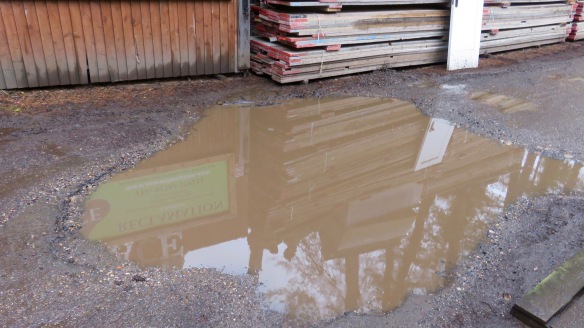
Once we had parked outside the truth of this came home to me as we clambered over a pallet laid alongside a large puddle in the entrance. I was reminded of Walter Raleigh spreading his splendid cloak over one such, so that Queen Elizabeth I wouldn’t spoil her shoes.

The yard and and the sheds comprise a cornucopia of reclaimed artefacts. A giant cock perches above an old telephone box. New corrugated iron sheets are piles alongside covered planks. Pub and Post Office signs are suspended above various garden ornaments of dubious provenance. Just opposite The Crown, for the past two years, has stood a very tasteful item of garden statuary. Not so today. The figure I had intended for Jackie’s Christmas present had been sold.

We had a look around anyway, if only to confirm that we had aimed for the best piece there. The red Egyptian replica bearing implausible bare breasts didn’t quite cut the mustard, although one of the staff members did suggest she might.

Neither did we fancy the two huge dogs standing between an assortment of vacuum cleaners and an ancient bath. They appeared to be guarding an assortment of doors, roof tiles, and paving.

Another hound, set up a warning clamour when I presumed to photograph a jumble of chairs, radiators, bath, mirror, and fireplaces. Fortunately, he was penned in.

Autumn leaves adorned part of a carding machine

and a heap of rusting grates.

Wooden planks and metal posts stood opposite them.

Some items are deemed requiring protection from the elements. These are kept inside,

which can get rather dusty.

A string of fairground horses line up alongside everything including the kitchen sink.

Finally, pinned to an arrangement of doors was a sign pertinent to our predicament today. Examples of various fireplaces were also displayed.

As a parting quip the manager advised me to ‘strike while the iron is hot next time’.

We drove on to Lyndhurst where we intended to buy another present. We didn’t find that either.

Never mind, we dined on a juicy chicken and bacon pasta bake, with a medley of roasted vegetables. I drank Cimarosa Reserva Privado malbec 2013.

Roanoke

You know when you buy a new car and for some time thereafter you seem to see others of the same model every time you venture out?

Well, I haven’t bought a Chesapeake, but, ever since my mention of Chesapeake Mill on 4th, it has followed me around. First, Barrie Haynes sent me details of how the mill got its name, with a picture of USS Chesapeake, which I added to my post; then Chesapeake Bay turned up in a book I have just finished reading.

The volume is a history of the first thirty years of England’s attempts to colonise Virginia. This, ‘Big Chief Elizabeth’, by Giles Milton, is no dry tome. It reads as the rollicking adventure story that it is. It is also a mystery tale concerning the fate of the first settlers on Roanoke Island. The reader is gripped from the start. The writing is fluid, with judicious use of quotations that enhance the text rather than simply fill it out. More than half a millennium on, and in full knowledge of the European taking of America, we really want to know the outcome. That, of course, is why I can give no more detail. It is perhaps fortuitous that I should have begun reading this at Thanksgiving time.

My Folio Society edition is well illustrated, with photographs,

Chief's wife and daughterChief Wingina

such as these of John White’s portraits from 1485,

Roanoke map 001Roanoke map 002

and useful maps by Reginald Piggot;

Big Chief Elizabeth001

and sports a front board decoration by Gavin Morris.

This evening we dined on Jackie’s superb sausage casserole; mashed potato; boiled carrots, cabbage, and Brussels sprouts. I consumed more of the cabernet sauvignon.

Reflecting On Centuries Of Building

Jackie drove me to and from New Milton for me to travel to The Tas Turkish restaurant in The Cut to lunch with Carol.

For a little variety I walked from Waterloo Station through the early Victorian terraced streets to the East of Waterloo Road.

Roupell Street SE1Roupell Street SE1 2Cornwall Road SE!

Typical is Roupell Street which has Valentino Hairdressers on one corner and Konditor and Cook’s attractive bakers on the other. Typical of the mid-nineteenth century, these dwellings have no front gardens and a narrow hall leading to the rooms inside. These two bedroomed properties can be found on the market for more than £1,000,000. I can assure those readers across The Pond that the correct number of noughts is shown here. The street lamps are probably reproductions.

Victorian chimneys and modern block

Modern glass fronted blocks tower above the London stock brickwork and terra cotta chimneys of their older neighbours. Since London is a smoke free zone the chimneys are probably retained for cosmetic purposes.

Chimneys, aerials, cables

Telephone cables and television aerials add touches of two further centuries to the original buildings.

Wootton Street Railway arch

These side streets are lined with railway arches over which lines run into the terminal railway station. This proximity renders the tranquil nature of the historic little streets, off the bottlenecked The Cut, quite surprising.

Reflected terraces

In Cornwall Road a shorter wall of glass reflects the terraces opposite,

Reflections of blocks

and in Webber Street, alongside The Old Vic, a more lofty block carries the images of others on the opposite side.

Puddle

The flats in The Cut, reflected in a puddle on which float recently fallen autumn leaves, were built in the period between the new and the old. The soggy dog end spilling tobacco into the bottom left of the picture is a common sight, now that smoking is prohibited in workplaces or public buildings.

Crane

A working crane, like this one beyond the end of Short Street, is not an uncommon sight.

Carol and I enjoyed an excellent meal with our usual pleasurable conversation. Although we chose different starters, we both savoured the tasty chicken casserole, and moist baklavas, with a glass each of the house wines.

April Showers

April showers in December? Someone’s having a laugh.

Perhaps it’s

Hebe

this hebe;

Viburnum bodnantense Dawn

the viburnum bodnantense Dawn;

Rose Crown Princess Margarete

roses like Crown Princess Margarete, bowing her head to keep her face dry,

Carpet rose Pink

or this Pink carpet rose ripe for dead-heading;

Violas

violas,

Primulas

primulas,

Geranium

or geraniums.

I obliged with dead-heading many of the roses.

This evening we dined on Jackie’s delicious sausage casserole (recipe); mashed potatoes; and crunchy carrots and cabbage. Jackie drank Hoegaarden and I drank Louis de Camponac cabernet sauvignon 2014.

Flytipping In Honeylake Wood

Vince, a heating engineer had visited a few days ago to overhaul our oil fired system that has never adequately functioned upstairs since we have been here. He got it going properly for the first time, but discovered that a hose had not been fitted to the boiler, a part of which was not functioning anyway. Today he came to fit the offending item.

Jackie drove off to Mat and Tess’s and I stayed in for Vince.

This afternoon I booked the Modus in for an M.O.T. test and walked on through the woods repeating the trip I had taken recently with Giles, who informed me that our local wood rejoices in the name of Honeylake Wood.

Skyscape 2

Even in the slight breeze and the shelter of the cooler trees I had no need of a jacket. Fiercer winds have left their impact on the lie of the oaks.

Wood entrance 1

Wood entrance 2From the beckoning entrance at the far side of the field on Christchurch Road,

Footpath to bridgeStreamthe woodland drops in a gentle incline to the stream,

then climbs to level off before reaching the road to Milford on Sea.

Footpath 1Footpath 2Pines and ferns

There is just one public footpath. The others are marked private.

The occasional startled pheasant squawked, rose from a covert, and lumbered, chuntering, off; a few feet in the air. Despite their slowness, I didn’t manage to catch one.

Flytipping

A pile of builder’s rubbish that had been left in the undergrowth when Giles and I passed this way has been tidied and moved to the side of the vehicle-wide path, no doubt for subsequent removal.

Having enjoyed a plentiful chicken and ham pie, corned beef, and salad lunch, I dined on egg and bacon sandwiches.

History In The Streets

This morning Aaron continued work on decorating the bathroom. He was somewhat hampered by finding a section of the previous paintwork peeling off plaster that had not been sealed before the pigment was applied.

I scanned another dozen colour slides from the Streets of London series produced in April 2004.

Diadem Court W1

Between Oxford Street and Soho Square in the heart of the West End lies Diadem Court W1. This building on the corner has been enhanced by graffiti. The bar looked closed.

Grape Street WC2

A little further East, off Shaftesbury Avenue, we come to Grape Street, beside the Shaftesbury Theatre where the musical Thoroughly Modern Millie was showing.

Centre Point, the 33 storey office tower block in the background, stands almost directly above Tottenham Court Road tube station. Built for developer Harry Hyams, as a speculative project, the building remained empty from its completion in 1966 until 1975, following the weekend occupation the previous year by a Direct Action housing group. This successfully highlighted the fact that the potential accommodation was being deliberately kept unoccupied while thousands were homeless. It has passed through several ownerships since, and is now used for both offices and residential apartments.

St Clement's Lane WC2

In Holborn, South of Lincoln’s Inn Fields, we come to St Clement’s Lane. I was intrigued by the gentleman seated in the glazed bridge in the middle distance. Space is at a premium, but is that really where he keeps his office?

Houghton Street WC2

In Houghton Street, WC2 the paving outside the London School of Economics was being refurbished.

Serle Street1024px-Hans_Holbein,_the_Younger_-_Sir_Thomas_More_-_Google_Art_Project

The figure in the niche above this doorway in Serle Street, between Lincoln’s Inn Fields and Temple, is the Catholic Saint, Sir Thomas More, Lord Chancellor, beheaded by King Henry VIII’s executioner for refusing to take the Act of Supremacy in order to facilitate the sovereign’s divorce from his wife, Catherine of Aragon. The painting is by Hans Holbein the Younger. A copy of this, and another of St John Fisher, hung on the walls of the refectory of Wimbledon College, my Jesuit grammar school.

Bell Yard WC2

Bell Yard, WC2 is a little further South.

Fleet Street EC4

The Evening Standard placard announcing the return of City Bonuses in Fleet Street, preceded the 2008 crash by four fat years. I’m not sure how the prisoners were treated. Some dogs, of course, are treated better than humans.

Crane Court EC4

Crane Court is off Fleet Street. The All Day Breakfast is now ubiquitous in London, but I doubt if this one

Poppin's Court EC4

matches that of one off Poppin’s Court. At one time the excellent value cafes in London were the province of Italians, the older generation speaking halting English and the second generation being bilingual in Cockney and Italian. The Eastern Europeans have picked up that particular baton. One such hid around this corner. I often patronised it after a session at Portugal Prints.

Whitefriars Street EC4

Whitefriars Street also runs into Fleet Street. Sir Christopher Wren’s famous St Paul’s Cathedral can be seen in each of these last two pictures. This is what Wikipedia tells us about it:

‘St Paul’s Cathedral, London, is an Anglican cathedral, the seat of the Bishop of London and the mother church of the Diocese of London. It sits on Ludgate Hill at the highest point of the City of London. Its dedication to Paul the Apostle dates back to the original church on this site, founded in AD 604. The present church, dating from the late 17th century, was designed in the English Baroque style by Sir Christopher Wren. Its construction, completed in Wren’s lifetime, was part of a major rebuilding programme in the City after the Great Fire of London.

The cathedral is one of the most famous and most recognisable sights of London. Its dome, framed by the spires of Wren’s City churches, dominated the skyline for 300 years.[3] At 365 feet (111 m) high, it was the tallest building in London from 1710 to 1962. The dome is among the highest in the world. St Paul’s is the second largest church building in area in the United Kingdom after Liverpool Cathedral.

St Paul’s Cathedral occupies a significant place in the national identity. It is the central subject of much promotional material, as well as of images of the dome surrounded by the smoke and fire of the Blitz. Services held at St Paul’s have included the funerals of Lord Nelson, the Duke of Wellington and Sir Winston Churchill; Jubilee celebrations for Queen Victoria; peace services marking the end of the First and Second World Wars; the wedding of Charles, Prince of Wales and Lady Diana Spencer, the launch of the Festival of Britain and the thanksgiving services for the Golden Jubilee, the 80th Birthday and the Diamond Jubilee of Elizabeth II.’

Perhaps I should inform the website that it is also the cathedral in which my good friend, The Reverend Norman David Bird, was ordained almost thirty years ago.

Shoe Lane EC4Bride Lane EC4

Shoe and Bride Lanes, bring us nearer the River Thames. The latter features the transport of the modern London policeman. No set of London photographs should be devoid of scaffolding.

This evening we dined on chicken and bacon pasta bake; crisp carrots, green beans, and Brussels sprouts; and sautéed peppers and onions. I finished the malbec.

Aberfan

Dawn 1Dawn 2

Despite temperatures in double centigrade figures, apart from the enticing dawn skies, today was very dull with gale force winds. This meant that our afternoon drive around the forest was not conducive to photography. We finished up Christmas shopping in Brockenhurst.

Before that, I scanned another batch of negatives from the 1983 North Wales holiday.

Sunrise

It is perhaps appropriate to begin with mist rising at sunrise across a valley in Corwen.

Cottages in landscape

Later views across the land were much clearer.

Matthew, Sam and Becky

Here, Matthew, Sam, and Becky explore the fields around the farmhouse at which we were staying;

Matthew and Louisa

and Louisa is enthralled by something Matthew has pointed out.

Scrap metal 1Scrap metal 2Scrap metal 3

Blending so well with the rugged hillsides were the rusting metal of a car scrap yard,

Abandoned machiery 1Abandoned trucks

Disused slate mine 1

and the abandoned artefacts of a disused slate mine, itself adding heaps to the mountain terrain.

Becky, Louisa, Jessica, Sam and MatthewTerraced houses 2Terraced houses 3

In the foreground of this picture, Becky carries Louisa, and Jessica leads Sam towards another visitor in the doorway of a mine building.

Terraced houses 1

It was only in revisiting these images of terraced and semi-detached houses, perhaps once the homes of quarry workers, that I thought of Aberfan.

‘The Aberfan disaster was a catastrophic collapse of a colliery spoil tip in the Welsh village of Aberfan, near Merthyr Tydfil, on 21 October 1966, killing 116 children and 28 adults. It was caused by a build-up of water in the accumulated rock and shale, which suddenly started to slide downhill in the form of slurry.

Over 40,000 cubic metres of debris covered the village in minutes, and the classrooms at Pantglas Junior School were immediately inundated, with young children and teachers dying from impact or suffocation. Many noted the poignancy of the situation: if the disaster had struck a few minutes earlier, the children would not have been in their classrooms, and if it had struck a few hours later, the school would have broken up for half-term.

Great rescue efforts were made, but the large numbers who crowded into the village tended to hamper the work of the trained rescue teams, and delayed the arrival of mineworkers from the Merthyr Vale Colliery. Only a few lives could be saved in any case.

The official inquiry blamed the National Coal Board for extreme negligence, and its Chairman, Lord Robens, for making misleading statements. Parliament soon passed new legislation about public safety in relation to mines and quarries.’ (Wikipedia, on which there is much more information.)

This is one of the abiding memories of my young adulthood, and, indeed, parenthood. The whole of the UK, and possibly much of the world, was in shock, especially because the school had borne the brunt.

Succulent pork loins baked with a mustard and almond topping; piquant cauliflower cheese; mashed potato; and crisp carrots, Brussels sprouts, and green beans were the items on our dinner plates this evening. We enjoyed eating them. Jackie finished the chardonnay, and I started on a bottle of Mendoza Parra Alta malbec 2015.