 A warm wind swept through overcast Downton and across The Solent this morning when I took my usual walk to Hordle Cliff top and back. Sheltered among the hedgerows, perky periwinkle still trails along the ground.
On my return, I wrote the rest of my share of our Christmas cards and put them in the post.
Simon Jenkins, a former editor of The Times, having completed his six year stint, has recently retired as Chairman of The National Trust. It was in association with that body that Profile Books published his ‘A Short History of England’ in 2011. I finished reading it this afternoon. Jenkins has a thorough grasp of the story of how today’s England has emerged, from the Dark Ages of the fifth century, when the Angles arrived from Germany, to the date of publication.
He writes, in a clear, simple, elegant, and often humorous style, of the country’s heroes; villains; triumphs; disasters; conflicts, both internal and external; and its development into global prominence then partial eclipse. He unravels for the lay reader key individuals and events in our history. Anyone, for example, who can clarify ‘The Wars of The Roses’, as he does, is worthy of admiration.
This concise yet comprehensive single volume deserves to be read by anyone with a wish to understand English history. All is intelligible, and such quotations as are included are brief, illustrative, and pithy. Having sometimes thought their use in history books is rather more to fill out the text than to lend it credibility, I found this refreshing.
Packed with colour illustrations, all of which are credited, the book has a useful index and appendices of 100 key dates; Kings and Queens; and Prime Ministers.
Naturally the choice of the four personages chosen to adorn the book jacket could be debated, but it is interesting all the same. From left to right we have King Edward III, undoubtedly the greatest mediaeval king; Queen Elizabeth I, who gave her name to a Golden Age; King Charles I, who was executed by his people; and Prime Minister Sir Winston Churchill, who saw us through the Second World War.
This evening yesterday’s delicious curry meal was, with its beverages, reprised today. As always, it had improved with keeping.
Category: Books
My reading, including illustrations
The Monk
One of the benefits of our mild Autumn has been that non-hardy plants, like this fuchsia 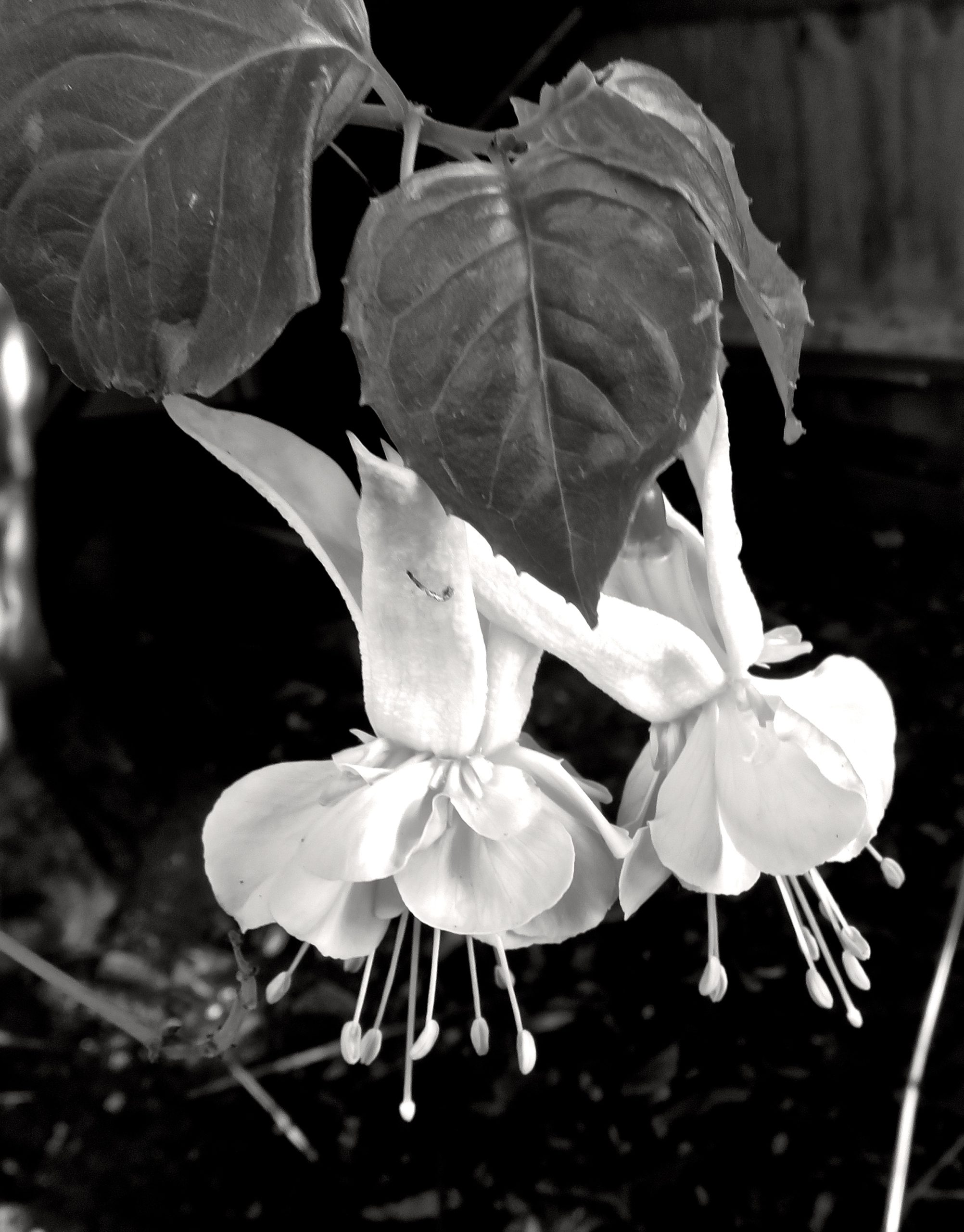 Quasar, are still out in the garden. Normally a delicate pink and lilac on a white ground, this picture was my selection for the third day of my Black and White Flower photograph submissions.
Edward Sherred, landscaper, called this morning with his wife. Every couple of years he had pruned the tops of the variegated hollies in the front garden. Our predecessors had the benefit of free tree surgery and his wife used the branches to make Christmas wreaths. Having enjoyed a similar arrangement at Lindum House I was happy for us to continue the process. He did a good job.


 It was a dank day for my Hordle Cliff top walk this morning. Stinging nettles and sticky willies were sprouting again in the hedgerows. Blackberries had been conned into producing more blossom, and a brave little dandelion had forced its way up through a driveway’s gravel.

Birds were silently snuggled up in their nests, and The Needles were shrouded in mist. I met no other creature in an hour’s walk.
‘The Castle of Otranto’ is hailed as the first gothic novel, and Matthew Lewis’s ‘The Monk’ as the ultimate one. This work, which I finished reading today, has all the ingredients. Set in Madrid at the time of the Inquisition, we have a dubious monastery and a doomed convent; we have wild weather and benighted forests; we have superstition and sorcery; we have blind belief and blasphemy; we have saintly heroes and sinful religious; we have cunning and deception; we have a sadistic prioress and a seduced and seducing prior; we have terror and torture; we have ghosts, ghastly dungeons, and damp sepulchral crypts strewn with unburied bodies; and we have rape and murder most foul.
Hammer (‘The House of Horror’) Films would have relished it, but it was a French-Spanish production directed by Dominic Moll that presented the adaptation released in 2011.
It hard to believe that Lewis was barely twenty when he completed this fast-moving and insightful novel that has intrigued readers ever since 1796. My Folio Society edition benefits from an introduction by Devendra P. Varma and is embellished by the wood  engravings of George Tute, who must have thought it was Christmas when asked to illustrate a book packed with such dramatic incident. He is certainly up to the task.
This evening we dined on Jackie’s delightful chicken jalfrezi (recipe) and savoury rice (recipe). I finished the chianti.
The First Gothic Novel
Jackie, as usual, drove me to and from New Milton for my trip to London to visit Norman for lunch, and Carol afterwards. I took my usual routes from Waterloo to their respective homes.
A woman also being delivered to the home station this morning, left her driver with a farewell that had me chuckling. ‘What?’ she asked, addressing him through the still open passenger window……… Then ‘sod off’, followed by a cheery ‘see you later’. I hadn’t caught what had provoked the imprecation.
A short while later she and I had a good laugh about it on the crowded platform.
It was a gloomy day in London, which is probably why I focussed on some of the more seamy aspects of the capital’s suburbs. Littered around a bench in the recreation  ground at the far end of Preston Waye (sic) were beer cans, fag ends, and other debris from a party, the attenders of which had eschewed the bin provided. The bicycle rack

 across the street from Preston Road tube station had not saved one owner from losing his wheels, and judging by the rusting condition of what was left of his transport he had decided to leave it where it was. Alongside this a pair of soiled underpants or panties lay on the floor of a telephone box. I didn’t investigate them closely enough to determine the gender of their erstwhile wearer.
Signal failures between Eastleigh and Basingstoke extended my outward journey by forty minutes and caused chaos at the end of the day when two train-loads left the terminus on one service, resulting in large numbers of passengers standing or sitting on the floors of the aisles. Squeezing past the standers and stepping over prone people on the way to the loo was rather embarrassing, especially as it was impossible not to touch them, and absolutely necessary to be careful where you did.
Horace Walpole’s ‘The Castle of Otranto’ dubbed by Andrew Graham-Dixon and others the first Gothic novel is a short book. I read it on the train. Published in the 1760s, the first edition rapidly sold out and has been in print ever since.
Harking back to the Middle Ages, as Gothic does, the book had all the necessary ingredients for evoking a romantic image of that period. There is a feudal tyrant, knights on a mission, damsels in distress, forbidding weather conditions, and a gloomy castle complete with dungeons, empty corridors, and a hidden passageway. The well-constructed plot, in five chapters, follows the form of Greek Tragedy, and the author borrows from Shakespeare devices such as his clown characters.
Walpole’s story was perfectly timed to engage the enthusiasm of his times for such tales, and spawned many others, such as Matthew Lewis’s ‘The Monk’, with which I continued whiling away my extended train journey.
 My Folio Society edition of ‘The Castle of Otranto’ is illustrated by Charles Keeping, one of my all-time favourites. He has a distinctive style and remains faithful to the text, nicely capturing the required mood. Here we have Isabella, a young woman fleeing the tyrant Manfred. A gleam of light in the gloomy castle depths renders her visible and displays the frightening path with rippling pools she has to tread.
The War Of Canudos
Yesterday evening, after dinner, Jackie attempted to turn off the extractor fan. She pulled the cord. Something snapped inside. To reach it I had to climb up on a chair. Fortunately the glass spice jar I knocked off the top of a tower of shelves didn’t break. I fiddled around and found a screw under a cap. I unscrewed it and removed the casing, to discover a small piece of plastic had sheered and come adrift. This meant I had to release the mechanism manually. At least I stopped the fan, but until we buy and fit another, that is how it will need to be turned on.
This morning, Joe, The Lady Plumber’s ‘lad’ came to remove the now redundant piping from our bathroom. Before that we had bought the fireworks for Saturday from Lidl, posted the redundant TV box to BT, and took in two jackets for cleaning.
I then cleared ten brick lengths of bramble and ivy roots from the back drive.
Jackie was out to lunch with her sisters, but sensible enough to have left me a beef and mustard sandwich  garnished with tomatoes. Whilst I enjoyed it I also got pleasure from the cluster of sunlit pale blue morning glories shot with pastel pink that can be seen through the kitchen window.

 This afternoon I finished reading Mario Vargas Llosa’s haunting historical novel: ‘The War of The End of The World’. A Peruvian, the author chose to set his book in Bahia, a North-Eastern state of Brazil, as the nineteenth century was coming to a close. The book was originally published in 1981. My 2012 Folio Society edition uses the 1984 translation by Helen R. Lane. Ben Cain’s illustrations reflect the primitive nature of the story.
A very lengthy tome, it was only the political sections that I had difficulty following, and sometimes found rather boring. We are sensitively shown how the extreme poverty of underprivileged, landless, disabled, and uneducated people of that time and place affected their wretched lives, enough for them to flock to the shelter of a community established by a mystic preacher. Each character is beautifully and touchingly described as the civil War of Canudos progresses to its bitter end. The harshness of the terrain and climate adds to the horrors of thirst, starvation, wounding and destruction, which beset both the settlers and the soldiers sent to drive them out. Transcending all this is the superhuman emotional and physical strength displayed by people ultimately barely alive. The prose, having set the scene at a more leisurely pace, builds naturally, briskly, to a final crescendo. I have to say I was confused by the alternation between present and past in various sections. This was clearly not the fault of the translator, who seems to have done a remarkable job.
Ultimately the state cannot tolerate this enclave hoping to live in peace apart. The title of the book reflects the belief that the world would end at the turn of the next millennium, a myth which perhaps Vargas Llosa is dispelling.
Not knowing much about South American history, this novel had me researching the conflict that took place during 1896 and ’97. I learned that Antônio Vicente Mendes Maciel, an itinerant preacher who had been wandering the less inhabited areas of Brazil for the previous twenty years and had taken the name Antonio Conselheiro (The Counsellor), set up the  community in question in 1893. Bahia was then a desperately poor zone, with a disenfranchised population living on subsistence agriculture. As such it was ripe for his influence, seeking hope from his promise of a better world. After a number of unsuccessful attempts at military suppression, a large Brazilian army force overran the village and killed nearly all the inhabitants.
Daniel’s fish and chip restaurant provided our dinner this evening. My beverage was tea; Jackie’s was coffee.
The Uses Of Enchantment
The gales are back in force. As the wind howled and the rain lashed at our window panes, tearing down the wisteria outside the kitchen door, I felt like a little pig.

One of three, that is. Fortunately in a house made of brick. Had it been of straw we would have woken up exposed to the elements. I refer, of course, to the fairy tale featuring a big bad wolf who huffed and puffed and blew down two of the houses, built of insubstantial materials, with disastrous consequences for the piglets. The wiser, better prepared, porker survived. Other versions have the third brother rescuing his siblings. Either way, it is an entertaining fable, which has given generations of children scary delight.
Not everyone today would agree that this, like many other such tales, is a suitable story for young children. I cannot now remember whether this one featured in Bruno Bettelheim’s 1976 book, ‘The Uses of Enchantment: The Meaning and Importance of Fairy Tales’. ‘Little Red Riding Hood’, also featuring a frightening wolf certainly did. All children have fearful fantasies that they need to come to terms with in a safe atmosphere and environment. Bettelheim’s thesis is that folk tales featuring death, destruction, witches and injury, help children to do so. I have more than once referred to the Brothers Grimm’s ‘Hansel and Gretel’, which some people, as with much of this duo’s work, consider too dark. I am, however, in agreement with Bettelheim.
Heinrich Hoffman, for me, is another matter.

His ‘Struwwelpeter’, of 1845, at one time the most prolifically published children’s book in the world, is aimed at scaring infants into behaving themselves. The cover of my 1909 copy of Routledge’s English translation illustrates what happens to Little Suck-a-Thumb. There is no possibility of redemption in these cautionary tales – just horrific punishment. Contrast this with what must be universally the most popular children’s book of today,

Maurice Sendak’s ‘Where The Wild Things Are’ from 1963. Max, punished for ill-treating the family dog is banished to his room, indulges his fantasies, and is finally forgiven by his mother. It is one thing, although not good, for a child to wave a fork to frighten a dog, quite another for an adult to snip off thumbs.
By mid-afternoon everything had calmed down and I could cease my internal rambling and walk the Hordle Cliff top route in reverse.

Water bubbles balanced on nasturtium leaves sparkled in the sunlight.
When we arrived at Downton at the beginning of April a flood around a manhole cover on a bend a short distance from our back drive was being pumped out.

Today the lake is back. The flood warning sign has lain in the hedgerow all summer.

I fished it out and leant it against a tree. Without this warning the car in the picture would have rushed through the water the driver would not have seen on the blind bend, and given me a cold shower. Other pools reflected the skies at regular intervals.

The skeleton of an umbrella no longer fit for purpose lay abandoned in a bus shelter that has also seen better days.

Even the dogs on the cliff path showed no interest in descending to the shingle below.
This evening’s dinner consisted of rack of pork ribs marinaded in chilli sauce, served with pilau rice and green beans, followed by ginger pudding and custard. Unless you are of a certain age you will not remember the runner beans that, by the time they reached the greengrocer’s, had tough skins with strong cords running down the sides. If you do remember, you may have helped your mother top and tail them, deftly stripping off the stringy bits. Now, the young vegetables reach the supermarkets in tender condition and you just toss them into the boiling water or the steamer. With our meal Jackie finished the Pedro Jimenez, and I began the Rawnsley Estate shiraz grenach mourvedre 2012. Incidentally, it was competition from the Australians that forced the French to name the grapes on their wine labels.
The Bhagavad Gita
8.9.14
I found my main gardening task today really tough. Having thought I had taken up all the concrete slabs from the former kitchen garden, I discovered another path of them. They were bounded by bricks.  All these have now enhanced the paving pile, leaving me wringing wet. The latest heavy blocks are those that look darkest in the photograph.
After this, I dragged myself to the Shorefield post box and back, then settled down in a chair to read. Interrupted only by a robotic telephone call trying to sell us a new boiler, I finished that Indian classic ‘The Baghavad Gita’. Described by Jackie’s former work colleague as a ‘book on the Soul, Karma, and Reincarnation’ this dramatic piece takes the form of a dialogue between Krishna and the warrior Arjuna, with Sanjaya taking the role of the classical Chorus. Originally written in ancient Sanskrit it is an interlude in the much longer epic, Mahabharata.
Now, I had a choice. I could attempt Jackie’s tome, containing the original text and copious commentary by His Divine Grace A.C. Bhaktivedanta Swami Prabhupada, or I could confine myself to my Folio Society edition with a brief introduction by Amit Chaudhuri. I settled for the latter.
Relying on the doctrine of reincarnation, the god attempts to convince the warrior that it is his duty to kill friends and relatives facing him on the battlefield because their spirits will not die and they will have rebirths. The book is, of course, about much more than this, being a guide to the achievement of inner peace. Much of it does make sense to me, but the killing theory seems to be rather too easy a justification. It beats me how that can bring about inner peace.

The scholarly edition is illustrated by sumptuous realist paintings and photographs, whilst the other is liberally strewn with more imaginative suggestions from the hand of Anna Bhushan. The double spread I have chosen from the first book relates to the doubt of Arjuna and to the reincarnation philosophy. Zooming will make the text clearer.
 Whilst I was thus recuperating, Jackie continued her autumn pruning and clearing. Later on, I helped by transporting unwanted foliage to the compost heap and the combustible piles.
Jackie’s delicious chicken curry and savoury rice amply sufficed for our dinner, with which I drank Louis de Camponac cabernet sauvignon 2012. Jackie had already consumed her Hoegaarden when we relaxed in our garden as the sun went down.
Later, I began reading ‘The War of the end of the World’ by Mario Vargas Llosa.
The Day Of The Triffids

 Yesterday evening, the head gardener put me right on red hot pokers. As she read my post for that day she pointed out that the plants I had erroneously given this term are actually Lords and Ladies, which are the berries of an insignificant variety of arum lily. We have both emerging in the garden. I think I can now tell the difference.
We both spent much of the day gardening. It is a truism that whatever we plan to do on our never ending project is subject to delay through diversion. Thus, when intending to plant out seedlings of sunflowers from seeds my sister in law, Frances, had, along with a magnificent hoe, sent us for a housewarming present, she found herself embarking upon what she termed heavy landscaping. 
 In building up the soil in front of the pruned prunus, she had discovered that the brick path we had excavated some while back was wider than we had thought.
 The bordering row of bricks had been covered with stone. She moved the tablets back and set them in an upright position; filled the earth triangles with gravel; and planted and watered the sunflowers.
 My task was continuing to do battle with the invasive plants along the path by the neighbouring empty house, in preparation for extending the IKEA wardrobe fence.
 As I did so, carefully avoiding brambles desirous of poking me in the eye, I was grateful that these and the lonicera, privet, and ivy, were neither, like triffids, ambulant, nor, as far as I know, capable of communicating with each other in order to assist in tracking down their prey. I had no wish to emulate Bill Masen, blinded by triffid-juice. Our neighbours’ invading plants certainly stretched out their tendrils and forced them through windows in the ramshackle fence which is our only rampart.


Now I have reached the corner occupied by the compost heap, I only have to turn right down the back drive and tackle the even less defined boundary between that and the back of the untended jungle. I am not sure I have the stomach for that this year.
According to Wikipedia, ”The Day of the Triffids’ is a 1951 post-apocalyptic novel about a plague of blindness which befalls the entire world, allowing the rise of an aggressive species of plant. It was written by the English science fiction author John Wyndham Parkes Lucas Beynon Harris, under the pen name John Wyndham. Although Wyndham had already published other novels using other pen-name combinations drawn from his real name, this was the first novel that was published as John Wyndham. It established him as an important writer, and remains his best known novel. The story has been made into the 1962 feature film of the same name, three radio drama series in 1957, 1968 and 2008, and two TV series in 1981 and 2009. In 2003 the novel was listed on the BBC’s survey The Big Read. The protagonist is Bill Masen, a biologist who has made his living working with triffids – tall, venomous carnivorous plants capable of locomotion and communication”.
Early this evening Barrie called in to return my copy of Kilvert’s Diaries, and the three of us had a pleasant chat for a while. Afterwards Jackie and I dined at The Plough Inn, Tiptoe. With my pint of Doom Bar and Jackie’s Becks we enjoyed, as usual, the best pub food we have found since arriving in The New Forest. I managed to finish the mixed grill as Jackie did her half rack of pork ribs. No mean feats. Creme brulee was Jackie’s choice of dessert, mine being lemon meringue pie and ice cream.
The Power Of Speech
This morning, Jackie drove me to New Milton where I caught the London train. It is the first week of the Wimbledon tennis tournament. Naturally the train was to have an additional stop at Wimbledon. Naturally it was a little late. Naturally it contained only four coaches. Naturally one of those was designated First Class. Naturally the other carriages were crowded.
As an introduction to to Cicero’s ‘In Catilanum’ I-IV, D.H.Berry’s article on ‘The Catiline Conspiracy’ which I read today offers a clear account of this event and Cicero’s action in opposing it. We are also told that Cicero’s speeches ‘Against Catiline’, which I went on to read, were published three years after the happenings that took place during the great orator’s consulship. This is significant because, although presented by the author as what he had said at the time, they may be construed as a later defence of his position.
Cicero was responsible for implementing the senate’s decision to execute the five captured conspirators without trial. This was not legal. The consul’s action, although praised at the time – he was honoured as the saviour of Rome – was ultimately to lead to his death in dishonour.
The four speeches deal, in order, with his exhorting Catiline to leave Rome; with warning the senate that the rebel was gathering his armies against the state; with the capture of those criminals left by their leader to act in the capital when the time came;and with the execution debate.
There were many such events in Roman history. What makes this one unique is that it occurred during the time of a man with the ability to sniff it out, to combat it so eloquently, and to write it up so cleverly to preserve the story for posterity.
From Waterloo I travelled by my now customary underground route to Preston Road, and a short walk to Norman’s. In the recreation ground through which I pass, I noticed two patient carers helping a severely disabled young woman prepare her headgear, presumably as a protection against the strong sun. They passed me on their way to the enclosure where I had seen Yaw practising his footballing skills on 19th March. I greeted them. The carers returned the greeting. The young woman took that as an invitation to sit on the bench I was occupying. With good humour she was persuaded otherwise.
The carers then began a game of catch with their charge inside the fenced off area. They were encouraging when she managed the task of grasping the basket ball, and all three seemed genuinely to be enjoying themselves. I realised that the younger person seemed without the power of speech.
I did not think it appropriate to produce my camera.
The Roman orator employed his considerable skills more than two thousand years ago. He used them to climb to a position of great power. Ultimately they caused his violent death. His name and influence have been valued throughout the world, and down the centuries.
Today’s nameless young lady will have a very different life. May it, and its ending be happier than that of the man whose name will be forever remembered.
For lunch my friend provided an excellent beef casserole with mashed potato and vegetables followed by juicy summer pudding with which we shared a superb bottle of Chateauneuf du Pape 2012. I then took the tube from Preston Road to Westminster via Finchley Road and walked on to Carol’s. From there I took my usual transport back to New Milton where Jackie was waiting to drive me home.
Latin Gave Me Up
Although not having got round its baffle, the crow is back trampling the petunias on the chimney pot. The squirrel, on the other hand, earned a meal this morning. It made a successful launch from the eucalyptus, crash landed on top of the corvine baffle, slipped underneath it, and scoffed away. Given that the rodent has now rivalled Eddie the Eagle, Jackie moved the feeder further from the tree. The next lift-off point will doubtless be the new arch. Google can supply further information both on our aforementioned Olympic skier and yesterday’s Greg Rutherford reference.
We returned, briefly, to Castle Malwood Lodge this morning to retrieve two garden recliners we had left behind; and for a chat with Mo. Jackie then drove us to Ringwood where I deposited two pairs of shoes for repair; back home for lunch; then on to New Milton for me to catch the London train to visit Carol.
The corner around our old flat is well stocked with self-seeded blooms from Jackie’s temporary garden; and

the little meadow alongside New Milton station has an abundance of wild flowers.

Today I finished reading Cicero’s ‘Pro Roscio Amerino’ (For Roscius of Ameria). This is an eloquent and subtle defence of a man facing a trumped-up charge of parricide, and is significant for its being the young advocate’s first speech in a criminal court, and for his courage in taking on powerful political elements. No doubt aided by D.H.Berry’s able translation, the writing flows, and is very readable and entertaining.
It is to be inferred from my last sentence that I did not read this in the original, which would have been far beyond me. I am no Latin scholar, as was proven by my first three years at Wimbledon College. My Grammar school was then notable for its emphasis on the classics. Keen to obtain as many OxBridge university places as possible, Latin and Greek were the school’s most valued subjects, for in those 1950s days, a Latin qualification was a requirement for entry into our two leading centres of learning.
I was never subjected to Greek, and my Latin was so abysmal that, long before the O level stage, I was transferred to Geography, not then considered of prime importance.
Being top of the class in French, it was always a mystery to me that I could not grasp Latin. At school, I thought maybe it was because it seemed to be all about wars that didn’t particularly interest me. Not very many years ago, I twigged the reason for the imbalance. It was partially about word order, but more significantly about ignorance of grammatical terms. Without understanding these, I could manage the modern language, not that dissimilar in construction to our own. Meeting concepts like ‘subjunctive’ which were not considered needing explanation for passers of the eleven plus exam, I didn’t just swim, I sank.
Latin gave me up. And Geography teaching was hit and miss, so I failed that too.
So. In English. I went on to read ‘In Verrem 1’ (Against Verres). This was a necessarily short piece used as a device to circumvent the delaying tactics of the defence of a patently guilty man. It was so successful that Verres withdrew and further prepared speeches were not required.
Each of the Orations in my Folio Society edition is preceded by a helpful introduction by the translator. I began Berry’s piece on ‘The Catilinarian Conspiracy’.

From Waterloo I walked across Westminster Bridge to Carol’s in Rochester Row. I have seen this route even more crowded than today, but it was still a struggle to reach and walk across the bridge and past the Houses of Parliament and Westminster Abbey.

At the junction of Great Smith Street and Victoria Street a woman struggled with a chain of keys that would have done credit to Dickens’s Jacob Marley from ‘A Christmas Carol’, to free her bicycle from its fixture on a set of railings. Having succeeded, she dropped the cluster on the pavement and loaded her steed. Given her apparel and the content of her baskets, I wondered how she would manage to ride off. She didn’t. She donned her furry hat over the straw one, pushed the bike across the road, and continued down the street.
I took the 507 bus from Carol’s back to Waterloo and boarded the train to New Milton where my chauffeuse was waiting to drive me home; show me her planting and tidying of the garden; and feed me on fresh vegetables with beef casserole, the method of cooking of which is given in yesterday’s post. She drank Hoegaarden, and I abstained.
Hours In A Library
During the night I began to realise that, although ‘Monkey’ by Wu Ch’eng En was snuggled up in the novels section of the library, there was no Gibbon among the shelves that I thought had been accurately filled yesterday. That meant that there had to be another History container somewhere among the 24 left to empty. This morning’s search demonstrated no such luck.
There were two.
Consequently another couple of hours was spent moving books along and adjusting the heights of shelves. After lunch it was the turn of Biography. In searching for the first of those, I came across a third History box. It was well into the afternoon before I could tackle the stories of people’s lives.  These were all on their shelves soon after our evening meal which consisted of liver, bacon and sausage stew with roast potatoes, carrots and beans, followed by a chocolate eclair. All delicious. I drank via di Cavallo chianti 2012 then got back to finish the last of the biographies.
 Over the past day or two I have spent so much time on the task of housing a lifetime’s book collection that I have often thought of Sir Leslie Stephen. Virginia Woolf took the name by which we know her from her husband Leonard. She was born a Stephen, her father being the eminent Victorian man of letters.
 The reason he has come to mind is that the Folio Society edition of a selection of his writings is called ‘Hours in a Library’. I have spent many of these lately, but, I think, not quite in the way he did, which was in reading and writing. It seems a bit antisocial to hide away with a book, whereas sitting in company with one doesn’t to me.
Stephen was the first editor of the Dictionary of National Biography, the first volume of which was published in 1885 by Smith, Elder & Co. This is a record of the lives of notable UK people that continues in regular supplements today. From 1917 it has been produced by the Oxford University Press. The original edition ran to 63 volumes, which are now reproduced on the same sheets by OUP, albeit on thinner paper with one third of the number of tomes.
I do have the complete set which we are going to need more bookshelves and organisational ingenuity for me to keep. So it will be off to IKEA tomorrow.
Some OUP publications supplement my 23 of the original nineteenth century issue. How I came by these is a story worth telling. Sam and Louisa, when they were both quite young, had been given the task of hiding these books, individually wrapped, around the house and garden. I had the job of following their clues, as in an Easter Egg hunt, each one leading to another. I wondered when the supply would run out and how many there would be. They were a birthday present from Jessica who had found them in a second hand bookshop in Lincolnshire. I have never discovered any more, although, much later, I did find odd copies of the modern edition, with which to complete the collection, in a shop on Marylebone Road.