While Nick Hayter continued with his transformation of our kitchen, I printed him a set of pictures of his progress “on the job”, including this one demonstrating his mask-less cutting-in skill produced this morning.
Downton Service Station had already provided our Modus with a new clutch and handbrake by 10 a.m., so we happily collected it.
Five chapters further on in ‘Little Dorrit’ provided me with five more of Charles Keeping’s illustrations to scan.
‘Leaning on Mr Merdle’s arm, Mr Dorrit descended the staircase’.
‘He approached his destination through the by-streets and water-side ways’.
‘Now, sir,’ said Mr Dorrit, turning round upon him and seizing him by the collar’.
‘All the guests were now in consternation’, just one displaying distress. Another double page spread.
Keeping has portrayed stubborn intransigence to perfection in ‘Each proudly cherishing her own anger’.
This afternoon Nick completed his redecoration project.
This evening we dined on Jackie’s succulent sausages in red wine; creamy mashed potatoes; crunchy carrots; and tender cabbage with which she drank Hoegaarden and I drank more of the Cabernet Sauvignon.
Today Nick Hayter continued turning our kitchen into a magazine-worthy product such as it can never have been since the house was built.
In the meantime I scanned another batch of colour slides from
Highgate West cemetery, mostly from September 2008.
The bluebells in this image including the gravestone of Henry and Eric Holgate, suggest and earlier month in the year.
The Egyptian Avenue reflects the Victorian fascination with that culture.
One of the mausoleums in another avenue contains the remains of Marguerite Radclyffe-Hall who still receives floral tributes after her death in 1943. brittanica.com writes of her:
‘Radclyffe Hall, byname of Marguerite Radclyffe-hall, (born Aug. 12, 1880, Bournemouth, Hampshire, Eng.—died Oct. 7, 1943, London), English writer whose novelThe Well of Loneliness (1928) created a scandal and was banned for a time in Britain for its treatment of lesbianism.
Hall was educated at King’s College, London, and then attended school in Germany. She began her literary career by writing verses, which were later collected into five volumes of poetry. The Blind Ploughman, one of her best-known poems, was set to music by Conigsby Clarke. By 1924 she had written her first two novels, The Forge and The Unlit Lamp. The latter book was her first to treat lesbian love. Adam’s Breed (1926), a sensitive novel about the life of a restaurant keeper, won the coveted Prix Fémina and the 1927 James Tait Black Memorial Prize for fiction.
Hall’s fame turned to notoriety with the publication of The Well ofLoneliness,in which she explored in detail the attachment between a young girl and an older woman. The intense and earnest love story was condemned by the British, and a London magistrate, Sir Chartres Biron, ruled that although the book was dignified and restrained, it presented an appeal to “decent people” to not only recognize lesbianism but also understand that the person so afflicted was not at fault. He judged the book an “obscene libel” and ordered all copies of it destroyed. Later, a decree handed down in a U.S. court disagreed with Biron, finding that discussion of homosexuality was not in itself obscene. The British ban on The Well of Loneliness was eventually overturned on appeal after Hall’s death.’
The plinth in the first of these two pictures bear a grieving bas-relief; others sculpted statues.
John Turpin and I were part of a group taking a booked and paid for tour which was the only way possible to visit Highgate West. I was admonished by what I considered to be an over-zealous guide as a stood on a further stretch of undergrowth to focus on the grave of Carl Rosa, his second wife, and a daughter. Like a good boy I did as I was told.
‘Carl August Nicholas Rosa (22 March 1842 – 30 April 1889) was a German-born musical impresario best remembered for founding an English opera company known as the Carl Rosa Opera Company. He started his company in 1869 together with his wife, Euphrosyne Parepa-Rosa, and popularised opera in Britain and America, performing standard repertory in English, as well as operas by English composers.
Rosa was born Karl August Nikolaus Rose in Hamburg, Germany, the son of Ludwig Rose, a Hamburg businessman, and Sophie Becker.[1]His father subsequently took him to Edinburgh. A child prodigy, Rosa toured in Scotland from age 12 to age 16, eventually earning glowing notices.[2][3] Beginning in 1859, he studied at the Conservatorium at Leipzig (where he met and became lifelong friends with Arthur Sullivan)[3]and, in 1862, in Paris.
In 1863, Rosa was appointed Konzertmeister at Hamburg, where he had occasional opportunities to conduct.[1] Three years later he visited England, appearing as a soloist at the Crystal Palace. He had considerable success as a conductor both in England and the United States. He travelled to America in 1866 as a member of a concert troupe promoted by the Baltimore impresario Hezekiah Linthicum Bateman that also included the Scottish operatic soprano Euphrosyne Parepa. During this tour, on 26 February 1867 in New York City, he married Parepa, who became known as Madame Parepa-Rosa.[4]
In 1869, in collaboration with the Chicago impresario C. D. Hess, the couple formed the Parepa Rosa English Opera Company in New York and toured in America for three seasons, with Parepa as the star and Rosa as the conductor. It brought grand opera to places in America that had never seen any, performing Italian operas in English, which made them more accessible to American audiences. In 1872, the Rosas returned to England and also visited Europe and Egypt.[4] Rosa changed the spelling of his name after he moved to England, where people took “Rose” as a monosyllable.[1]
In 1873 Rosa and his wife started the Carl Rosa Opera Company (the change in name reflecting her pregnancy) with a performance of William Vincent Wallace‘s Maritana in Manchester on 1 September,[5] and then toured England and Ireland. Rosa’s policy was to present operas in English, and that remained the company’s practice.[6] That year, Rosa invited the dramatist W. S. Gilbert to write a libretto for Rosa to present as part of a planned 1874 season at the Drury Lane Theatre. Gilbert expanded one of the comic Bab Ballads that he had written for Fun magazine[7]into a one-act libretto titled Trial by Jury.[8] Parepa died in January 1874; Rosa dropped the project and cancelled his planned 1874 season.[8][n 1]Rosa later endowed a Parepa-Rosa scholarship at the Royal Academy of Music in London. He married a second time in 1881. With his second wife, Josephine (d. 1927), he had four children.[1]Carl Rosa startled by the bogey of Italian Opera in an 1886 cartoon by Alfred Bryan
The company’s first London season opened at the Princess’s Theatre in September 1875, playing The Marriage of Figaro, with Charles Santley as Figaro and Rose Hersee as Susanna. In 1876, Rosa staged a second London season, which featured the first performance in English of The Flying Dutchman with Santley in the title role.[5] For the next fifteen years, under Rosa’s guidance, the company prospered and earned good notices, with provincial tours and London seasons, frequently in conjunction with Augustus Harris at the Drury Lane Theatre.[1] Such was the success of the company that at one point three Carl Rosa touring troupes were set up.[5] Rosa hired Alberto Randegger as the musical director of the company from 1879 to 1885. In 1880, George Grove wrote: “The careful way in which the pieces are put on the stage, the number of rehearsals, the eminence of the performers and the excellence of the performers have begun to bear their legitimate fruit, and the Carl Rosa Opera Company bids fair to become a permanent English institution.”[10] In 1892, Rosa’s Grand Opera Company gave a command performance of La fille du régiment at Balmoral Castle.[5]
Rosa introduced many works of important opera repertoire to England for the first time, performing some 150 different operas over the years. Besides Santley and Hersee, Minnie Hauk, Joseph Maas, Barton McGuckin and Giulia Warwick were some of the famous singers associated with the company during its early years.[11] Rosa also encouraged and supported new works by English composers. Frederic Hymen Cowen‘s Pauline (1876), Arthur Goring Thomas‘s Esmeralda (1883), Alexander Mackenzie‘s Colomba (1883) and The Troubabour, and Charles Villiers Stanford‘s The Canterbury Pilgrims (1884) were commissioned by the company. Earlier English operas by Wallace, Balfe and Julius Benedict were also included in the company’s repertoire.[4] An obituarist noted, “He had long looked forward to the time when Sir Arthur Sullivan would have undertaken a grand opera, and to the last had hoped to have been able to produce such a work.”[2] Shortly before his death, Rosa launched a light opera company that debuted with Robert Planquette‘s Paul Jones.[1]Tomb of Rosa, his second wife Josephine and daughter Violet, Highgate Cemetery, London’ (Wikipedia)
For this evening’s dinner Jackie produced a thick and fluffy cheese and onion omelette and oven chips with which she drank Hoegaarden and I drank Coonawarra Cabernet Sauvignon 2019.
This morning, while Nick continued brightening up the kitchen, Jackie helped the ailing Modus to Downton Service Station. Unsurprisingly the diagnosis, which was delivered later, was the need for a new clutch. It is hoped that we will receive it back by the weekend.
This afternoon, having reached the 3/4 point of Charles Dickens’s ‘Little Dorrit’, I scanned seven more of Charles Keeping’s remarkable illustrations.
‘It was a deserted place and looked upon a deserted scene’ which was the side of the River Thames at night. The ladder scaling the wall to the left of the illustration was placed for easy access to the river bed. It was at such a location when the tide was low that I had to fish my late wife Jessica out of the mud.
Mr Keeping remains faithful to earlier portrayals of these two characters in ‘He rolled Mr Flintwinch about with a hand on each of his shoulders.’
‘I am now going to devote an hour to writing to you again’ depicts the unmistakeable letter-writer from the opposite side in a different location from the first such image.
With ‘It was a dinner to provoke an appetite’ the artist captures what I think is one of the rare boring passages of the prose.
‘Mrs Plornish, now established in a snug little shop at the crack end of the Yard’, contains typical details of the illustrator’s work, such as worn steps, feral pigeons, and a horse in the stable. These are Keeping’s own embellishments.
‘Mr Sparkler came and sat down on the other side of her’, for a happy announcement. The artist makes the varying feelings about this very clear;
equally in ‘Nobody noticed the Bridegroom’, whose insignificance is well depicted.
This evening we dined on Jackie’s succulent sausages in red wine; sage and onion stuffing; creamy mashed potatoes; piquant cauliflower cheese; crunchy carrots; and tender cabbage, with tasty gravy. The Culinary Queen drank Hoegaarden and I finished the Recital.
This morning Nick Hayter performed more painstaking preparation work on our kitchen. Apart from exemplary decorating he exhibits enviable flexibility.
An Antipodean friend, in order the more safely to transport some important paperwork to another part of the UK, e-mailed the documents to me to print out and post in snail mail. This mission was carried out this afternoon. Jackie drove me to Everton Post Office where I posted the package.
The overflowing ditch at the corner of Woodcock Lane sports an excellent puddle with reflections and the possibility for passing motorists to splash potential stalactites to drip in sub zero temperatures.
Striated skies streaked over Walhampton.
This evening we dined on Jackie’s spicy chicken jalfrezi and pilau rice with vegetable samosas. I drank more of the Recital.
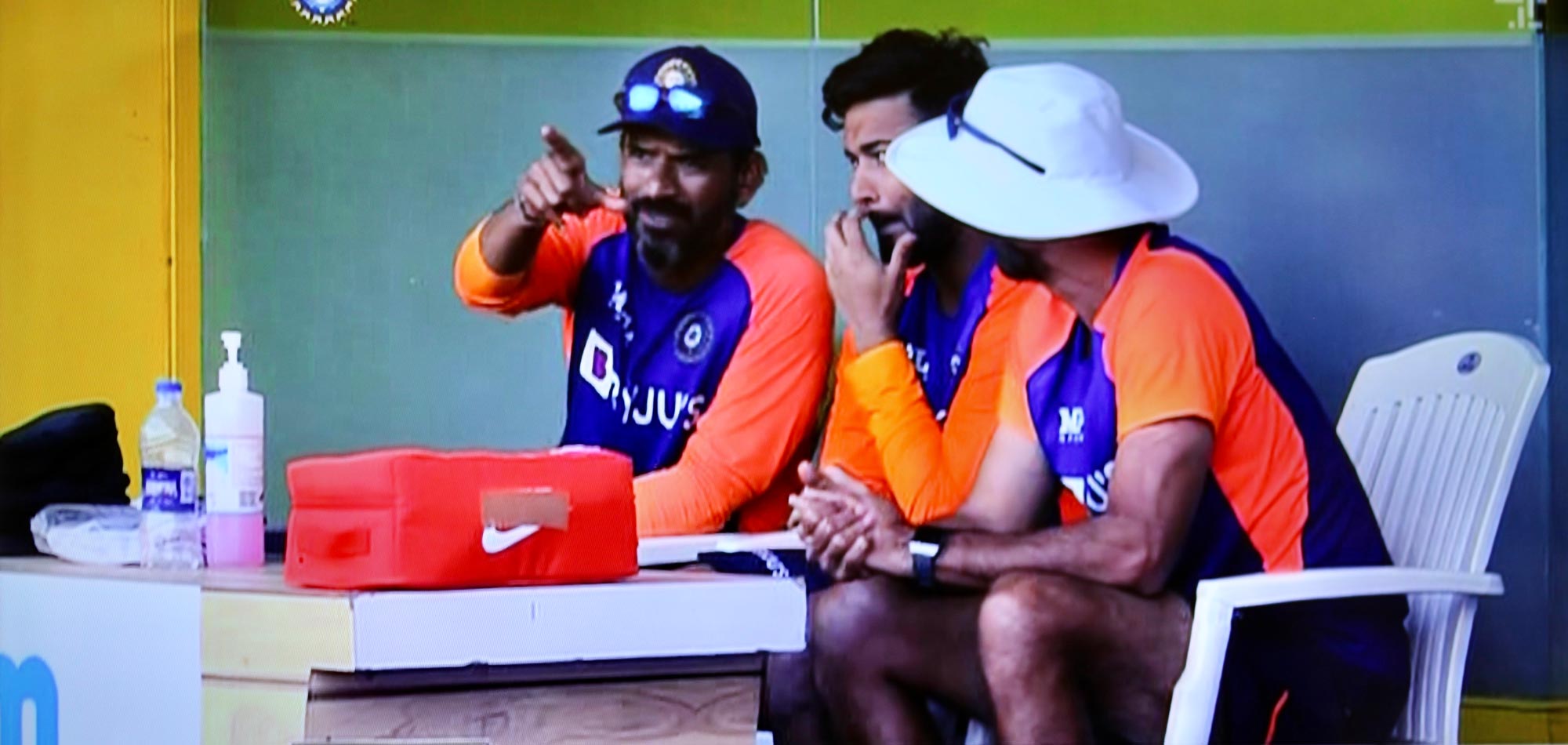
while Nick Hayter continued decorating our kitchen after Barry had repaired the leaking roof, I watched the fourth day’s play of the Test match between India and England at Chennai broadcast on Channel 4.
This afternoon we drove to Grove Pharmacy at Christchurch Hospital for Jackie’s first Covid-19 vaccination. Her procedure was even quicker and smoother than mine.
We took a short diversion through the forest on our way home. With the temperature having plummeted to 0 degrees centigrade we experienced very fine snow throughout our trip.
Just outside Burley the moorland pools were iced over and bearing locked in branches.
The one shaggy haired, muddy legged foraging pony we encountered seemed oblivious of the falling fine floury precipitation.
Deer on Burley Manor lawn hugged the fenced boundaries, maybe seeking shelter from the hedges beyond.
Our next stops were at Otter and Everton Garden Centres where we bought a solar lamp and a shepherd’s crook on which to hang it for Elizabeth whose birthday it is today. We delivered them and stuck them in her lawn.
We have noticed a new phenomenon, one example of which Jackie photographed alongside Jordan’s Lane. It seems that cars are throwing up spray from the pools on the tarmac which have frozen in the process of dripping.
This evening we dined on oven fish and chips, baked beans, pickled onions, and gherkins, with which Jackie drank Hoegaarden and I drank Languedoc Montpeyroux Recital 2018.
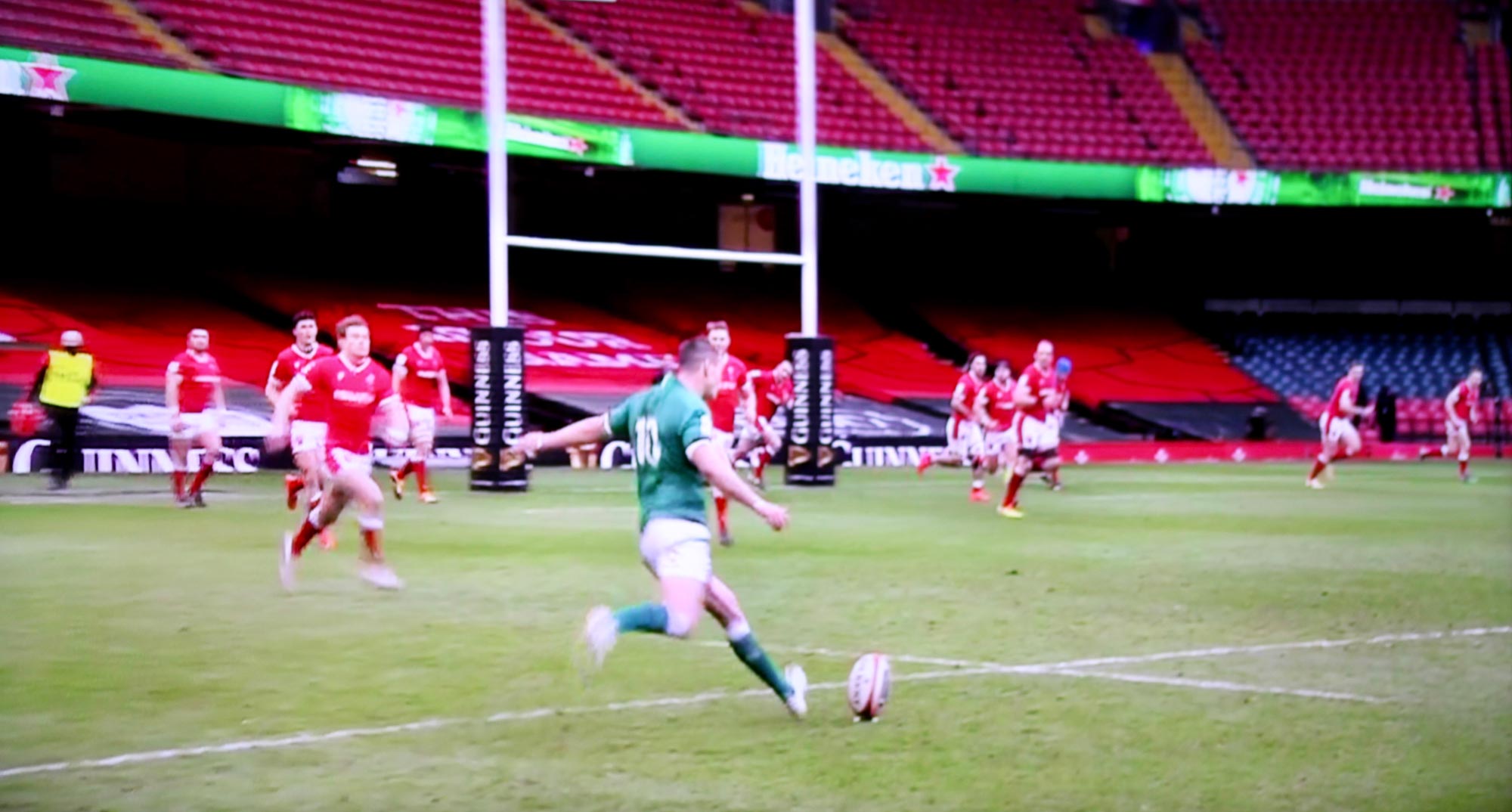
Here is the post I didn’t have time for yesterday, featuring the Six Nations rugby match between Wales and Ireland.
The primary aim of a game of rugby is to score as many tries as possible by
grounding the ball on the opposite side of the opponents’ goal line.
The try notches up 5 points. Afterwards the best place kicker has the opportunity to convert this to 7 by kicking the ball over the bar and between the goal posts.
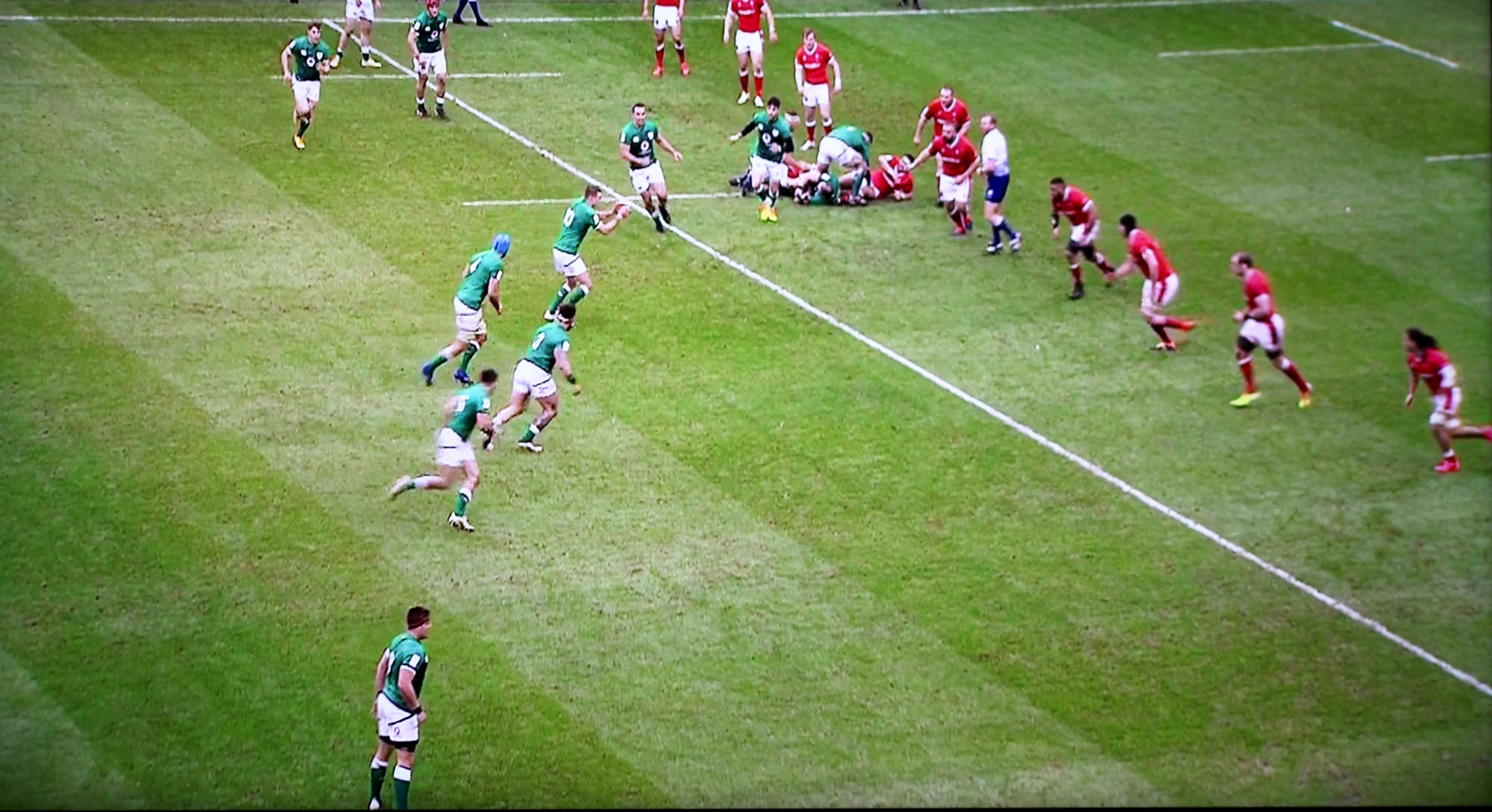
The referee, in the white shirt is there to ensure fair play, to interpret the rules, and to make decisions about points scoring.
We now, with the benefit of technology, have the Television Match Official who, having access to replays, has the task, at his request, of aiding the on field referee.
The grounding must be controlled and the feet inside the touchline. The score above was legitimate.
The ball carrier may be tackled by an opposition player. There are strict rules about the execution of this.
One of the consequences of an infringement is the set scrum. This is where two packs of forwards, each weighing in total 850/950 kilos, shove against each other to gain mastery and possession of the ball which is tossed into the middle by the scrum half, seen in green in the first picture, and red in the second. This can eat up 5 minutes of playing time.
Loose scrums. rucks, and, mauls result in less choreographed tussles.
These pieces, with or without the intervention of the referee, are followed by a lining up of the three quarter backs, one of whom will pass the ball along while the opposition attempt to dispossess them. It was this passing process that in 1965 prompted my late brother Chris, accompanying Jackie on her first time of watching me play, to utter the memorable one line explanation; “You have to get the ball over that line by throwing it backwards.” Although players may kick the ball ahead, a forward pass is not allowed.
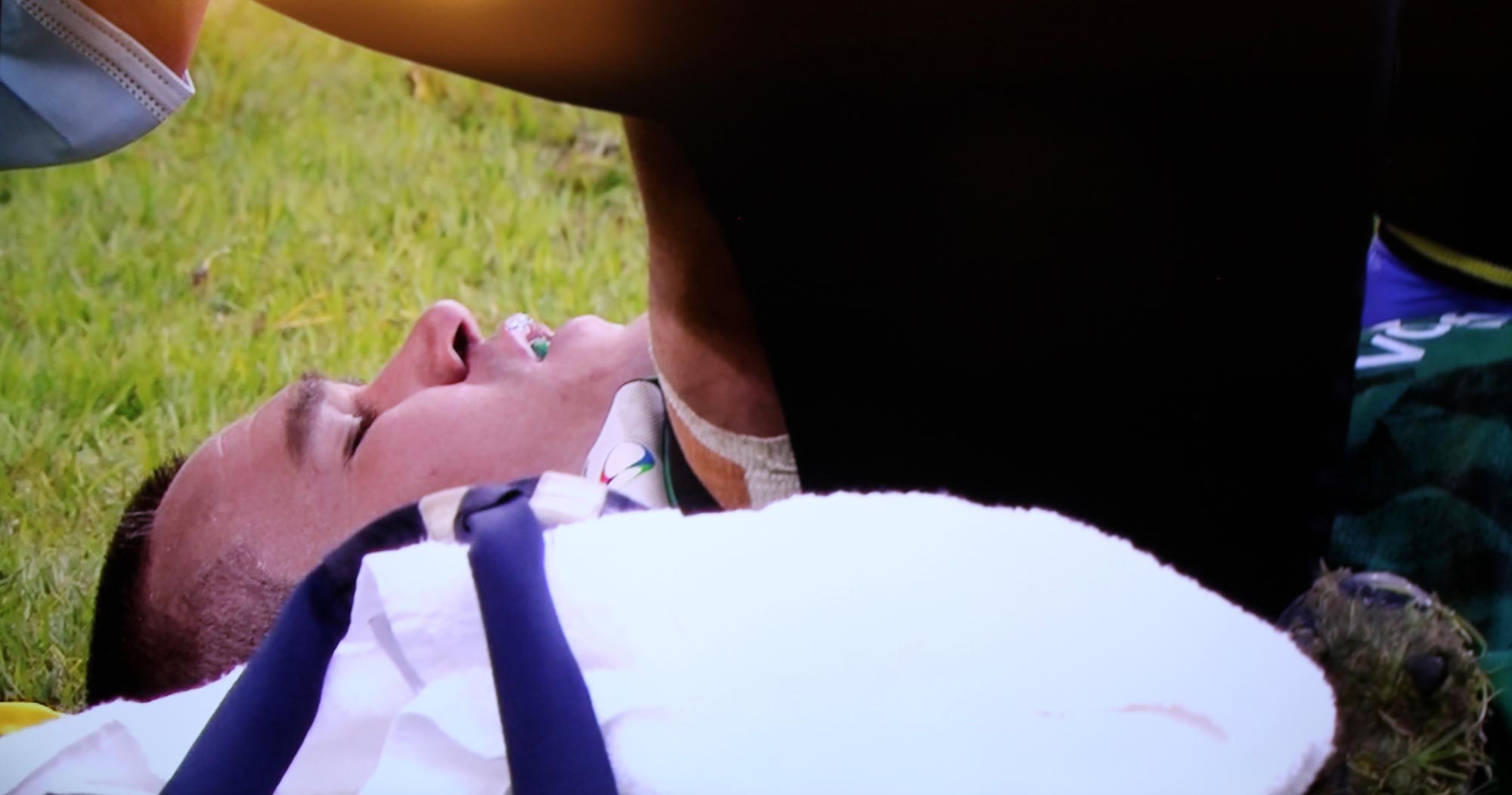
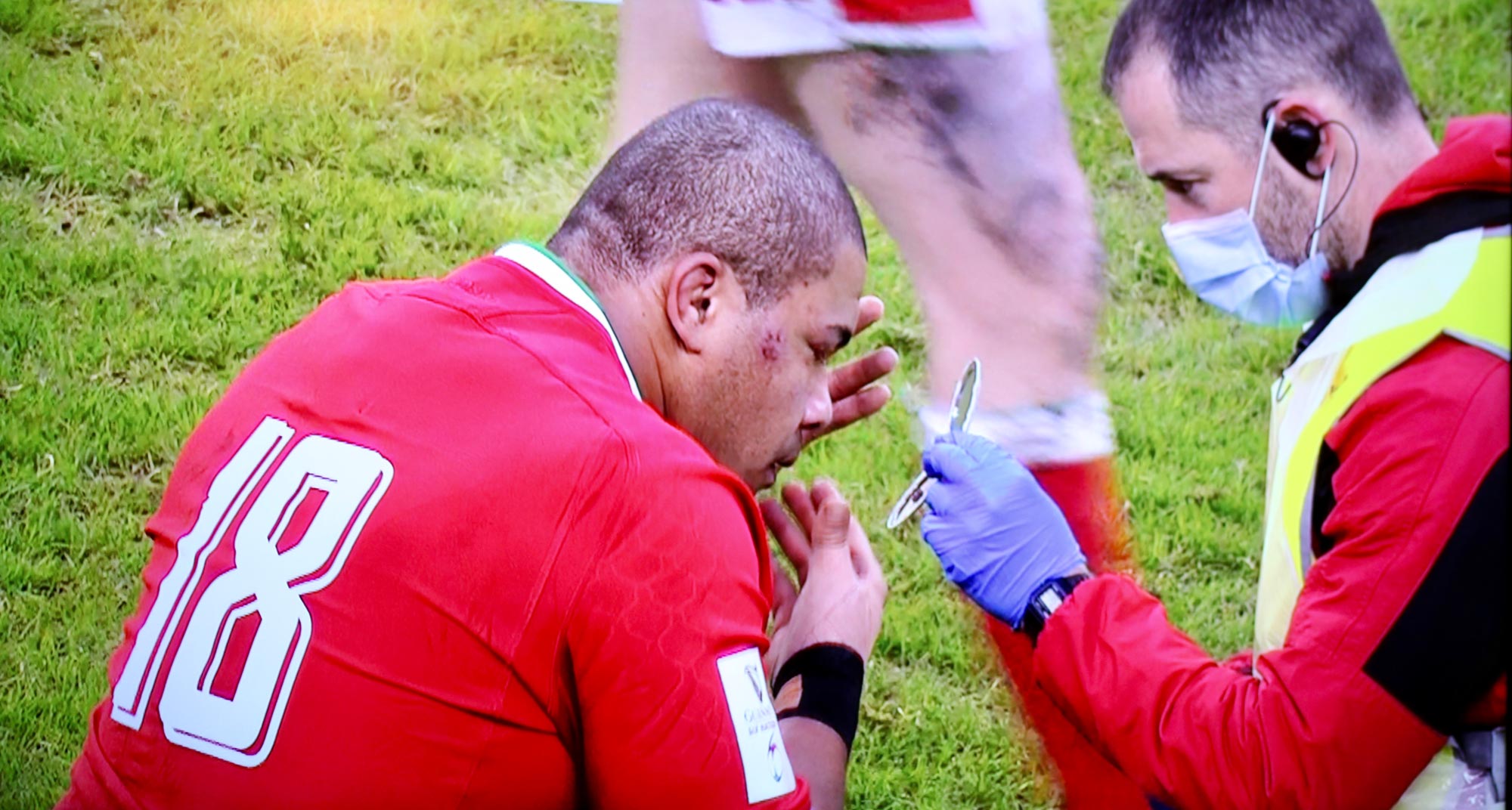
Medical assistance is essentially on hand. This player struggled on fo a while before having to leave the field.
This one, captain Jonathon Sexton, had no choice. Despite his reluctance he had to go off for a compulsory Head Injury Assessment.
Earlier, he was the first of the faces I pictured in this gallery. His opposing captain, facing him, sporting a black eye, has plaster on his ear.
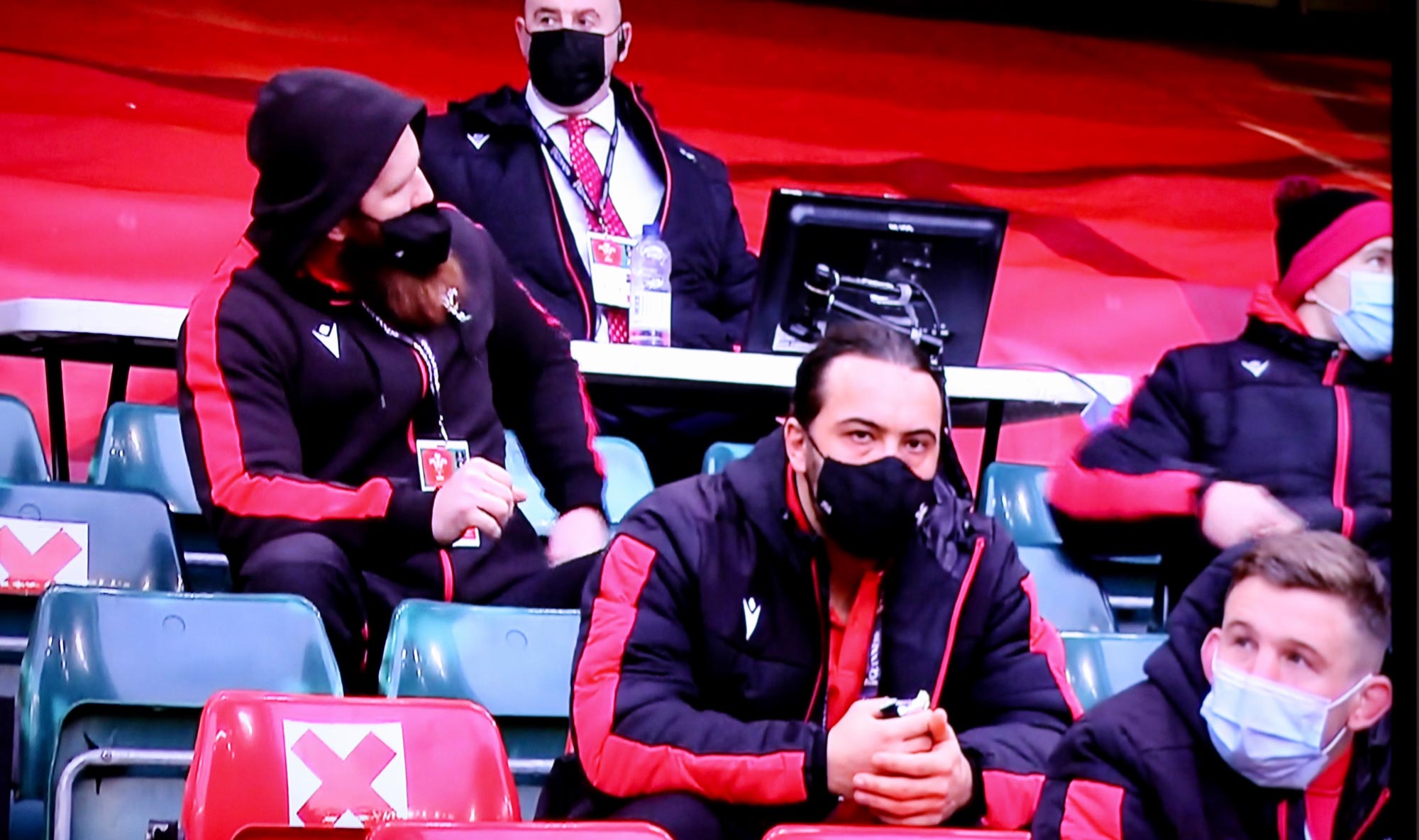
The masked supporters could not show theirs.
This scene reminded me of the season in which I lost three contact lenses in a fortnight. I then gave them up on the grounds that there is a limit to the number of times one can have 30 men in rugby kit crawling around in the mud in search of them.
I spent the morning watching the Channel 4 coverage of third day of the current Test Match between India and England in Chenai; and the afternoon watching BBC’s broadcast of the Six Nations rugby match between Wales and Ireland in Cardiff. The Indian weather was hot and humid; the Welsh much cooler. Covid has prevented any spectators except for match officials. In Chenai no-one wore masks; in Cardiff they did.
My photographs were all taken from the TV screen. I cropped all images for two reasons, namely to produce the pictures I wanted and to remove broadcast spoiler score information.
There are now many different forms of international cricket requiring different time spans and consequent paces of the game. Traditional Test Cricket ebbs and flows with changes of fortune over five days.
Bowlers bowl to batsmen; one batter receives the ball, the other stands at the bowler’s end ready to run to the other end, crossing with his partner to score one or more runs. The bowler aims to hit the stumps behind the batsman. The umpire in the white coat and hat is there to make decisions about dismissals.
Wicket keepers are equipped with special protective gloves, pads for their legs, and helmets for their faces. Slip fielders beside him have no such protection.
The essence of spin bowling is that the aim is to make the ball change trajectory after hitting the pitch. Throughout the Indian sub-continent the conditions are conducive to this method. Here Jack Leach has bowled ball seen about to land in the first picture; sends up a reddish dust cloud and takes a path behind the batsman’s front leg in the next; eventually ending up in the wicket keeper’s gloves. Had this hit the bat on the way through the man would have been out.
Batting technique is very important.
There are other ways than being bowled (when the stumps are hit by the ball) of being out or losing your wicket. If the ball is caught by a fielder without first hitting the ground the batsman is out, caught.
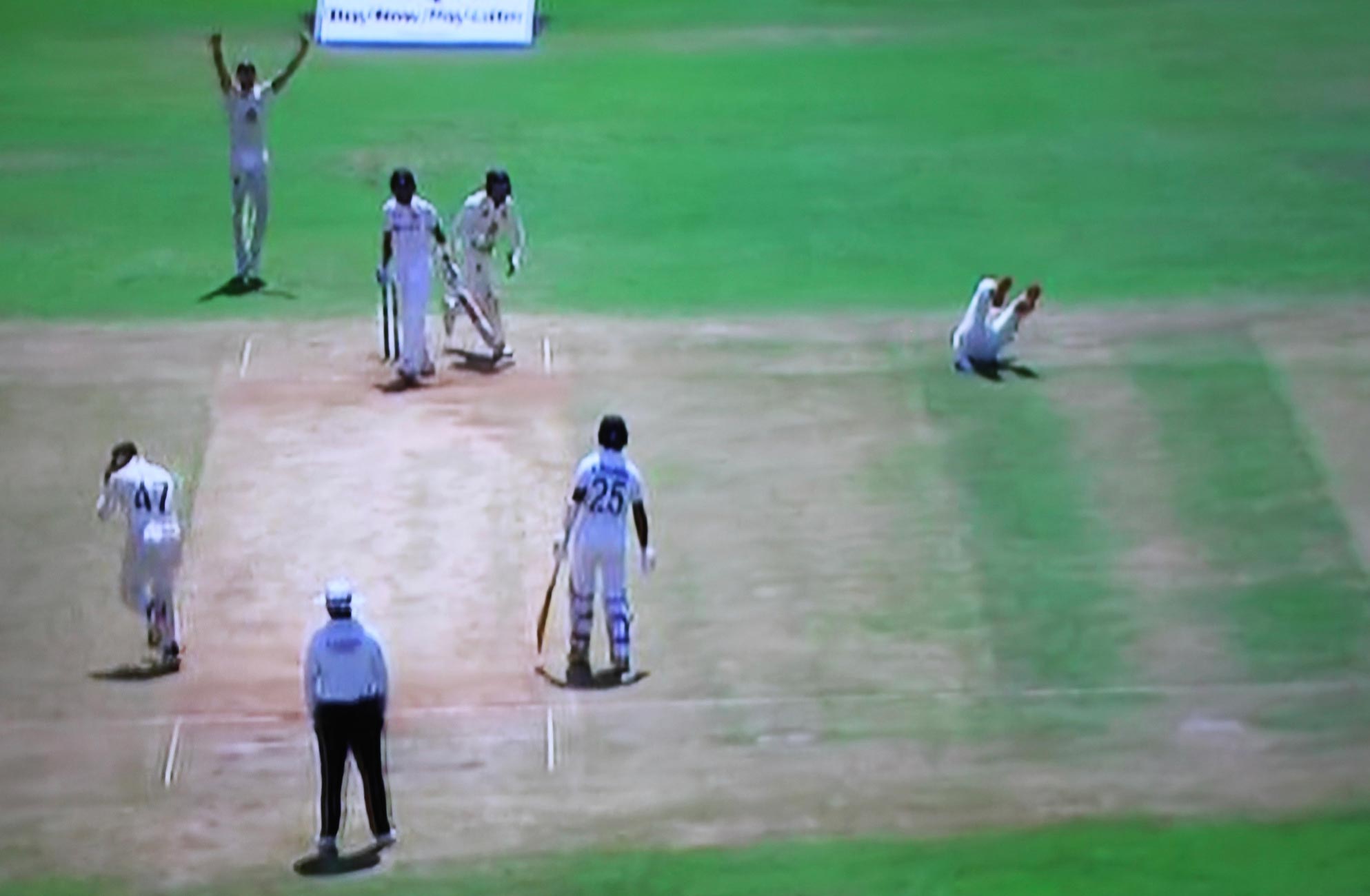
This is a quite phenomenally athletic dismissal close to the wicket.
Had this one been held out in the deep field it would have been equally spectacular.
When appealing to the umpire to grant a dismissal, arms are uplifted with a cry of ‘Owzat’, or, as is the modern way shrieks and gesticulations.
We now have a third umpire equipped with the technology to check the on- field umpire’s decision.
Either the fielding captain or the batsman may ask for a review.
This offers the opportunity for waiting in anguish, for adjusting helmets, discussing tactics, or tightening boot studs.
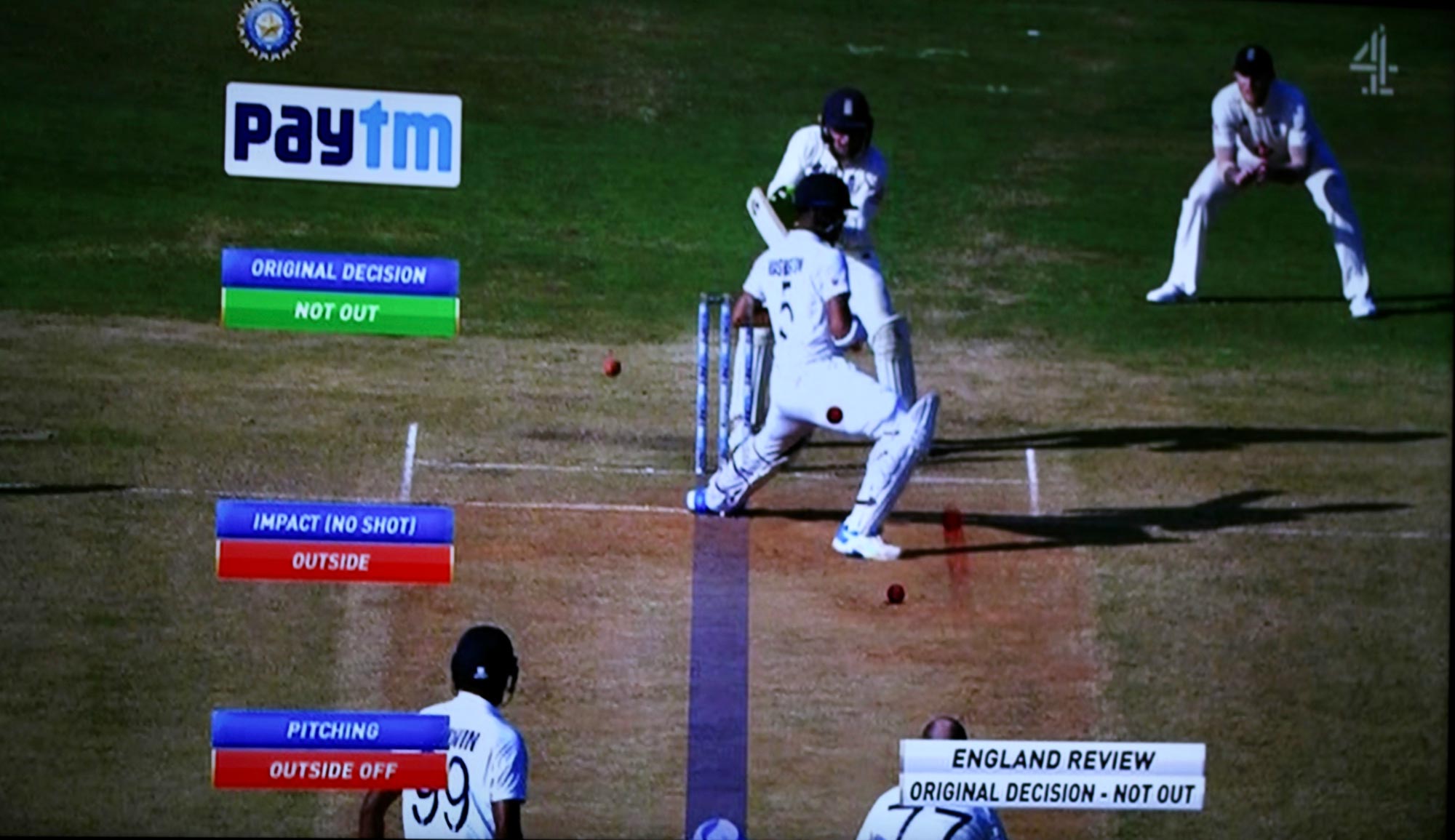
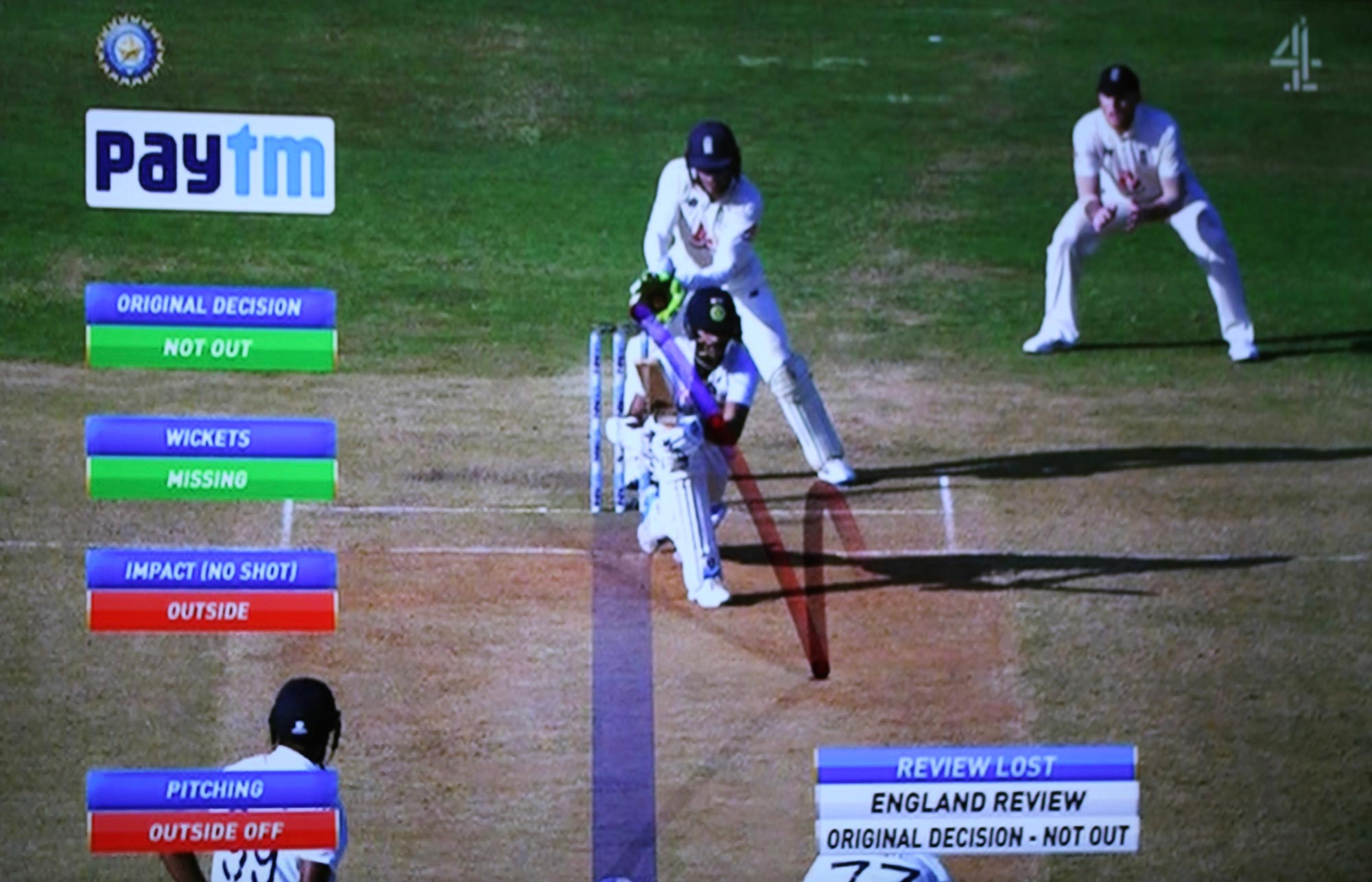
Here are views which aid the third umpire’s deliberations. The second picture tracks the anticipated path of the ball in order to estimate whether it would have hit the stumps.
Batsmens’ team mates watch keenly from the otherwise empty stands.
As the evening gradually draws to a close, long shadows have a game of their own.
I have become so carried away with trying to explain some of the aspects of our summer game that I have no time to do the same for the rugby. This will follow tomorrow.
This evening we dined on thick bacon chunks, flavoursome pork chipolatas, piquant cauliflower cheese, chestnut mushrooms, creamy mashed potatoes, crunchy carrots and tender cabbage. The Culinary Queen finished the Sauvignon Blanc and I finished the Macon.
This morning I watched most of the second day’s play of the current cricket Test Match between England and Indian Channel 4. During the afternoon and early evening it was the turn of ITV’s coverage of the Six Nations rugby internationals between Italy and France; and between England and Scotland.
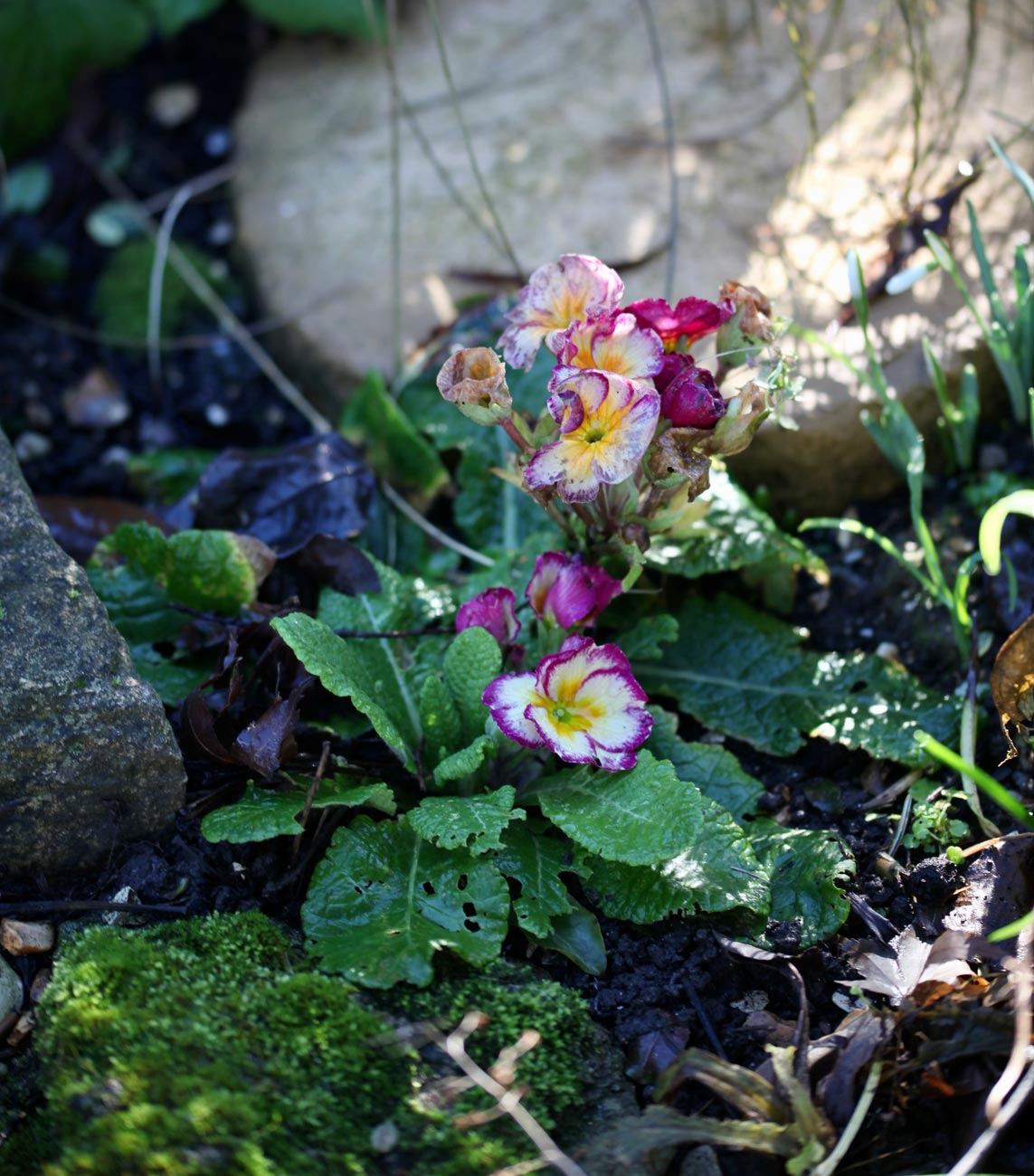
I am so grateful to my blogging friend Tootlepedal for tactfully pointing out an error in yesterday’s original title by letting me know that he could not find any primroses that it seemed the decent thing to do would be to nip out into the garden between sporting binges and
find some to redress the lack. They are a bit manky, but at least they are survivors.
After the rugby I scanned three more of Charles Keeping’s illustrations to ‘Little Dorrit’
‘Gowan seized the dog with both hands by the collar’.
The different natures of the two sisters were clearly pictured by the artist in ‘Fanny was so very much amused by the misgivings, that she took up her favourite fan’.
‘The Dowager Mrs Gowan drove up, in the Hampton Court equipage’.
This evening we dined on succulent baked bacon; piquant cauliflower cheese; creamy mashed potatoes; crunchy carrots, and tender cabbage, with which Jackie drank more of the Sauvignon Blanc and I drank more of the Macon.
Before Jackie discovered that, for the first time in 15 years, we can now view Test Matches live on free to air terrestrial television I listened to the first day of the England v India match on BBC sport. I watched the last couple of overs on Channel 4.
This morning I took advantage of a break between showers to wander round the garden with my camera.
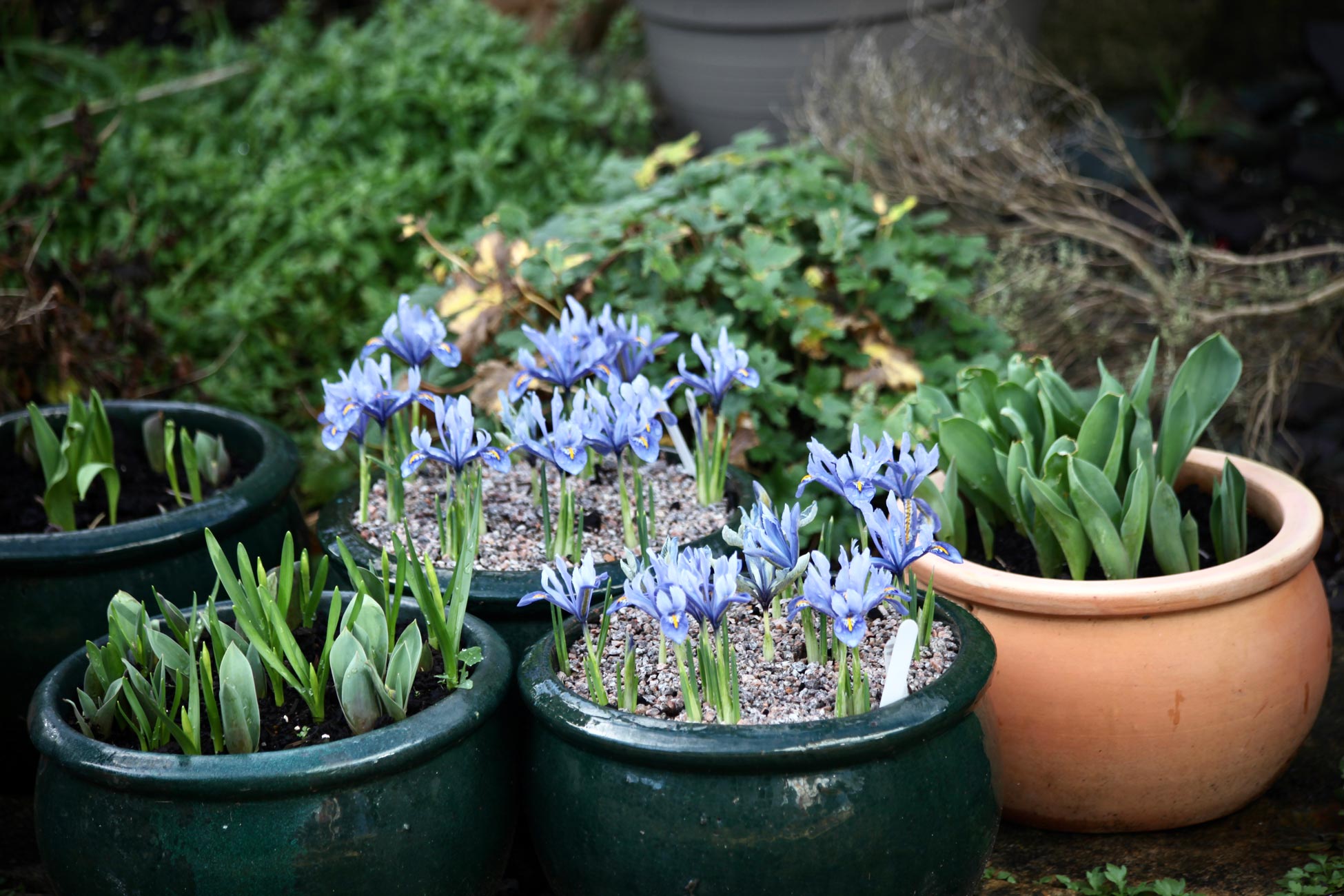
The irises reticulata are all now in bloom, with tulips beside them pushing up.
Other irises and numerous hellebores still collect raindrops.
Camellias are quite prolific.
Honesty seed pods now have a skeletal presence and the metal plant Louisa gave us for Christmas will live on for a while.
Some winter flowering clematis cirrhosa Freckles have survived their recent heavy pruning.
Wherever we go we encounter a plethora of snowdrops.
This afternoon we paid a brief visit to Barry and Karen to deliver his prints.
Afterwards we took a brief drive along the lanes, like Coombe Lane largely waterlogged.
Sunlight streamed across the landscapes, lit the lichen coated hedges, and silhouetted the bones of an oak tree.
A small shaggy haired pony eyed me as I photographed its more delicate be-rugged cousin.
Jackie photographed a pair of rooks – or were they crows? – conducting a corvine conversation.
Several donkeys were installed on Wooden House Lane.
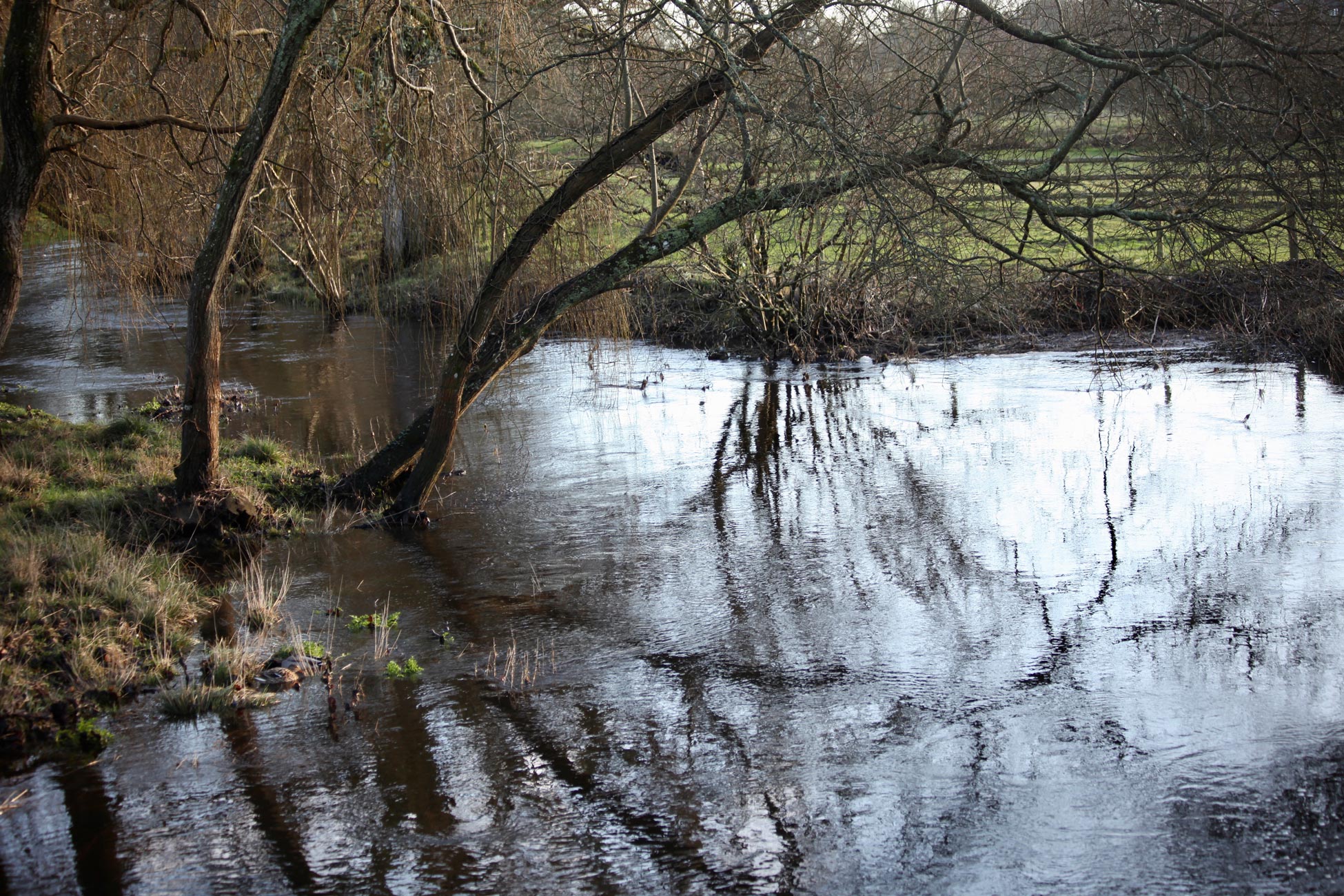
The stream running under Church Lane reflected the trees above.
This evening we dined on the varied flavours of Jackie’s piquant cauliflower cheese; creamy mashed potatoes; smoked haddock; with carrots and petits pois for splashes of bright colour. We both drank Marlborough Sauvignon Blanc 2020.
On another wet afternoon we drove to Lymington for printer inks and to Milford on Sea pharmacy and Co-op, diverting to Keyhaven on our way home.
Saltgrass Lane was well waterlogged, even though the tide was not yet high enough for its closure.
Walkers, dogs, and vehicles were silhouetted on the spit against dramatic skies.
Sedate swans, occasionally dipping their benthic burrowing beaks, sailed along the water’s surface.
Skeins of geese honked overhead;
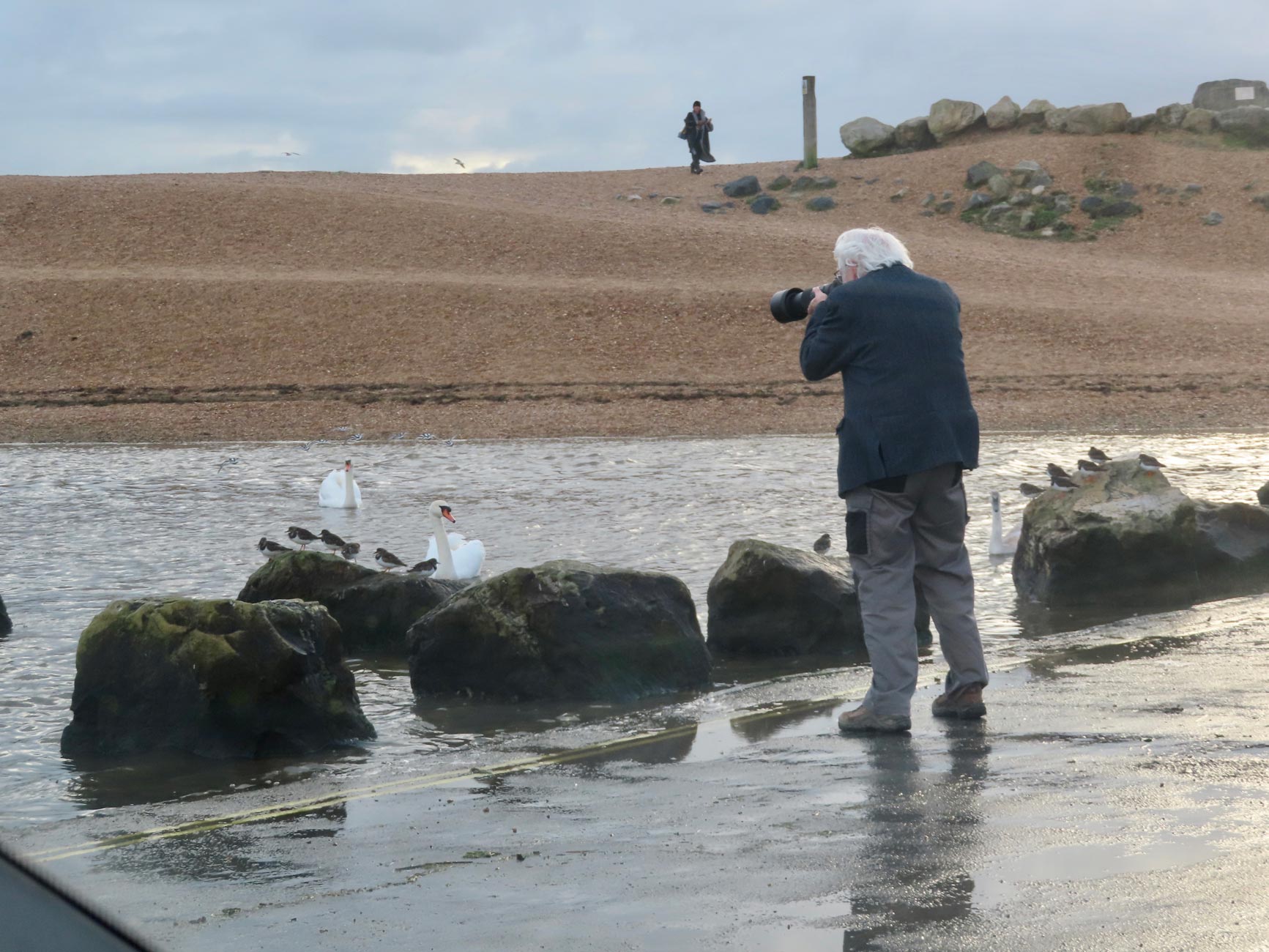
turnstones rested on rocks while
Jackie photographed me photographing them, as the rising tide lapped around them
Nearby she also spotted a thrush (identified by quercuscommunity’s comment below as more likely a rock pipit), curlews, geese, and an oystercatcher.
A hardy human pair spent some considerable time immersed up to their necks in the water, arousing the interest of a pair of swans when they changed into their dry clothes. The last picture is Jackie’s.
This evening we dined on tasty Welsh rarebit, Jackie’s choice chicken and vegetable stewp, and fresh crusty bread, with which Jackie drank Hoegaarden and I drank more of the Macon.