Silhouettes At Sunset

We set out for a drive in the forest an hour before sunset.

There were a number of people out riding, such as this young lady on Barrows Lane. They were usually in no particular hurry. Neither were we.

As I emerged from the Modus high on Holmsley Passage, a dog in a Land Rover fixed me with its baleful beady eye.

A number of dog walkers, like this woman with her pair, were also taking the air.

A couple of motor cyclists followed a fast moving car, the driver of which did his best to splash me as he sped past. Fortunately I had anticipated the shower and (with poetic licence) nipped over the bank in the foreground.

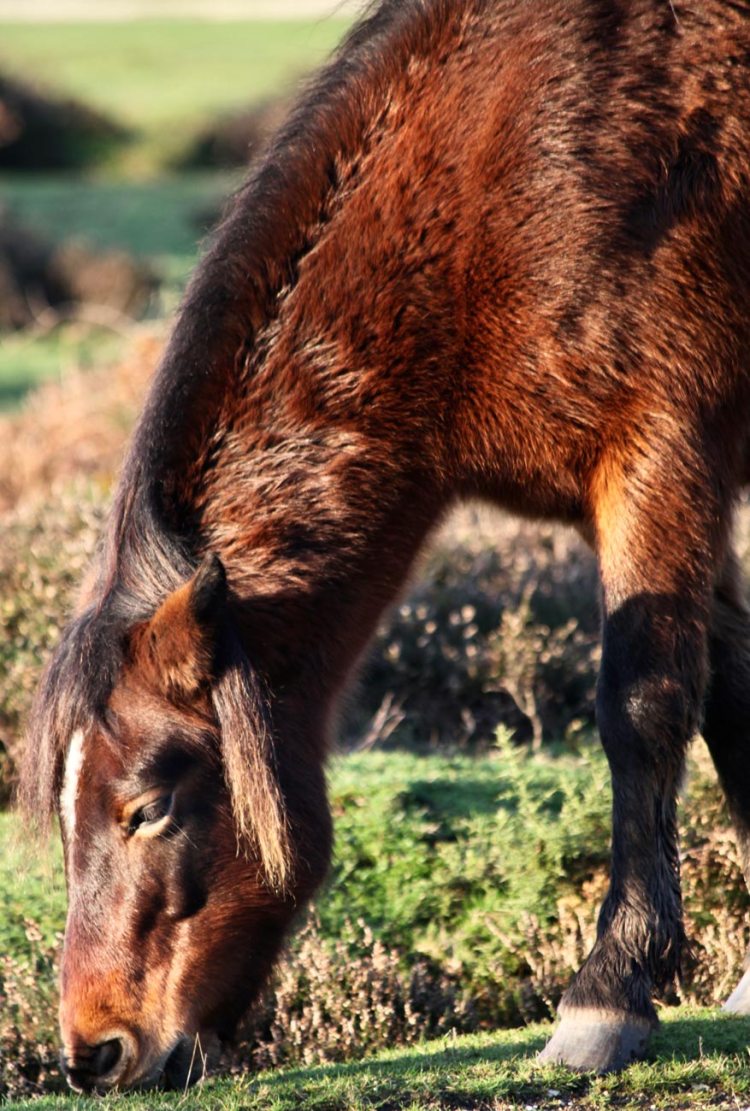
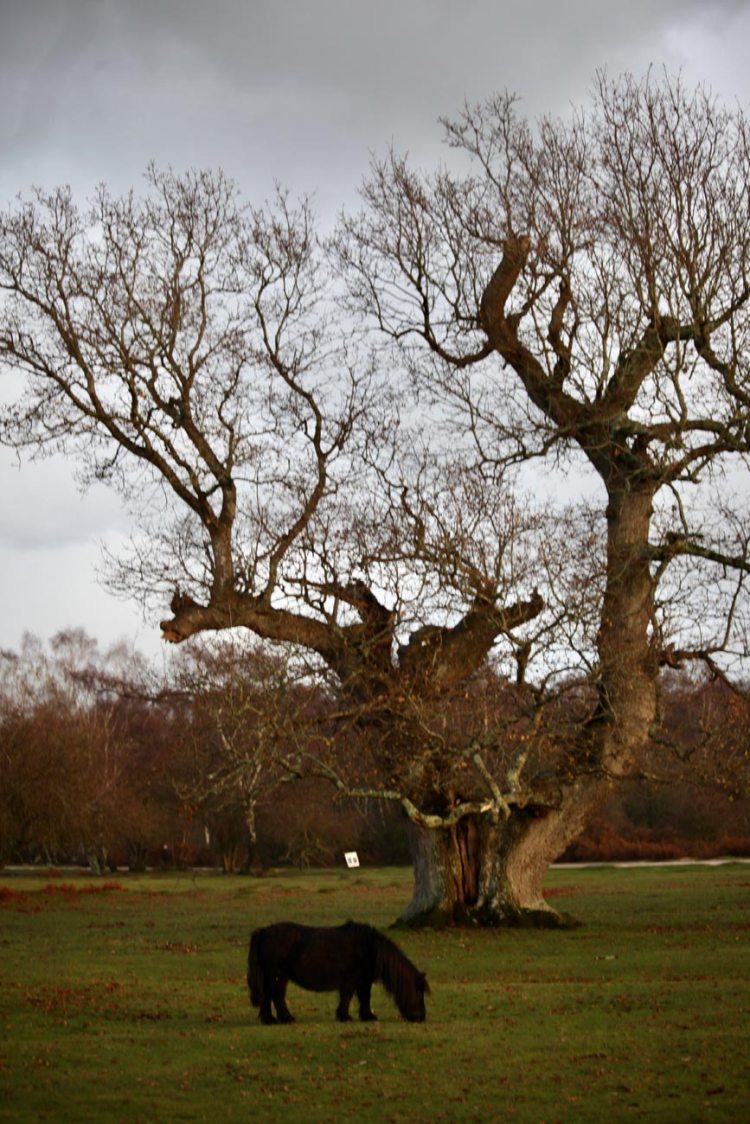
The late sun burnished both landscape and ponies. The second black and white subject stretched its neck whilst emitting an extended whinnying.

Alongside Bisterne Close a group of ponies seemed intent on stripping the holly branches until, with one accord, they trooped off into the woodland and out of sight.

We just had time to catch

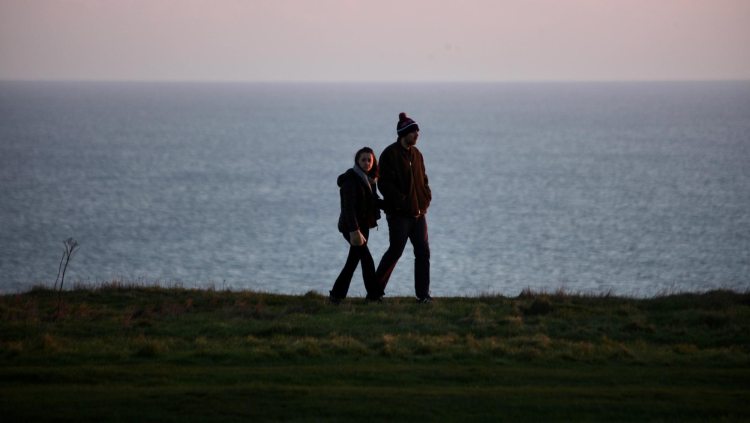
sunset at Barton on Sea where groups of well distanced visitors provided me with a choice of silhouettes. A young family played cricket on the green. The ball was struck in my direction, my reflexes kicked in, and I bent at the knees in an attempt to scoop it up. I couldn’t get down far enough and had to plead dodgy pins. My pride hurt the most.

This evening we dined on Jackie’s savoury omelette-topped rice served with a quartet of prawn preparations, namely salt and pepper, hot and spicy, tempura, and skewered in a skein of shredded potato. The Culinary Queen and I both drank Greco di Tufo 2019, a most mellow Italian white from Lidl.

Changing By The Second

Wild wind howled and piercing precipitation rattled the roof throughout the night and well into the morning.

Jackie photographed and I e-mailed this image of crooked hand from our 200 year old long case clock to Martin Fairhurst of Dials in Lymington who will repair it. Even with the bend the clock keeps perfect time and chimes seven minutes late according to the point of the digit, as if there were no crook in it.

After lunch I made a start on a month’s ironing. When the sun sneaked out I unplugged the iron and we sped after it. Since it had made the effort we would have been rude not to.

The field alongside South Sway Lane, once home to pony Gimlet and her foal,

was now occupied by a nomadic Mallard family.

A drain was overflowing, suggesting that the lane itself will be flooded soon. Last year it became impassable.

The rain had definitely not conceded the skies. Rainbows followed us around

The fast-flowing, rippling and bubbling Balmer Lawn stretch of Highland Water had overflowed its banks. Within seconds of my striding out to photograph it the clouds rolled in, rain hammered down, and my woollen jacket soon took on the scent of damp sheep.

On the signal of the click of my camera a reflective crow was instantly on the wing.

Just around the corner the sun emerged once more, cast long shadows, and burnished trees against a dark slate sky.

Lulled into a false sense of security I walked across a muddy field to photograph ponies sheltering among the trees. They knew that I would soon be walking through torrential bead curtains.

Houses and trees were silhouetted against the clouds’ bonfire smoke. The skies were changing by the second.

I heard gleeful laughter emanating from a parked people carrier whose occupants were impressed by the ponies. As I raised my camera in polite request

the mother of the boys cheerfully wound her window down and, with a smile, said “put your tongue back in”. This was, of course, the signal to stick it out further. Although rain still rolled down the vehicle it had stopped falling from the skies.

As I drafted this post the heavy rain clattered throughout against my window.

This evening we dined on oven fish and chips, green peas, cornichons, and pickled onions with which Jackie drank Hoegaarden and I finished the Coonawarra.

Cheered Up By Sunset

Today began unpromisingly dull and wet. I scanned the last few colour slides from

Abney Park Cemetery in May 2008. The second image and

the two which follow have been converted to black and white. The first of these shows a typically decorated capital. The second is the Pesman family grave. According to jacobstree.co.uk Frederic Adolphus senior, originally an artificial flower maker, lived for 81 years. His wives, Agnes Susan née Peak, daughter of a builder; Mary Ann, née Bulford; and some of his children were not so fortunate. The last name on the stone, obscured by ivy is probably the son of Frederick and Agnes who, along with two sisters, did not survive early infancy. Two of their daughters did survive, one to be 90.

Before lunch we drove to Ferndene Farm Shop and bought a Christmas tree, the needles of which

attempted to spear me on the way home.

The weather gradually improved this afternoon when we drove into the forest.

Barrows Lane is becoming soggy. Jackie parked on the verge while I photographed the landscape including two field horses in bright red and blue rugs.

By sunset over Hatchet Pond the skies had really cheered up.

When I came to draft this post I was hard put to distinguish between Jackie’s and my shots. The second gallery images are, I believe, those of the able Assistant Photographer, who,

driving home, metamorphosed into my Chauffeuse, and parked at East Boldre while I photographed

the remnants of the sunset reflected in a Winterbourne pool

and providing a backcloth for skeletal trees.

For dinner this evening Jackie provided lamb jalfrezi, mushroom rice topped with slices of boiled egg, and vegetable samosas. The Culinary Queen drank Hoegaarden and I drank more of the Coonawarra.

Stygian Skies

Heavy rain fell from decidedly Stygian skies throughout the morning during which I finished reading the fourth chapter, entitled ‘ ‘Give me combat!’ France: 1894-9′, of Barbara W. Tuchman’s The Proud Tower.

I had previously been vaguely aware of the Dreyfus Affair with dominated the decade, but never really understood it until reading Tuchman’s analysis of the schism that split France. Dreyfus was a French army captain who happened to be Jewish and was unjustly accused of selling secrets to Germany. There is now no doubt that Captain Dreyfus was framed by the French military authorities who used forged documents to condemn him to years of imprisonment. It became a national conflict between the Dreyfusards, convinced of his innocence, and those who believed the military should be supported at all costs. Violent anti-Semitism developed and was pitted against those, largely artists and intellectuals, who fought for justice.

I will refrain from offering more details save to say that the ultimate pardon did not come with a finding of innocence. Ms Tuchman describes the physical and emotional violence of the warring parties, which also involved a failed assassination. France, too, had the seething undercurrent which seemed endemic to the rest of Europe.

My mid afternoon today the rain had ceased and a brief appearance of sun had cast a little light over the land.

While I readied myself for a trip into the forest Jackie nipped out into the garden and photographed

raindrops on weeping birch and clematis cirrhosa Freckles.

The chameleon skies were the canvas on which my camera painted

varying tones of indigo and smoky ochres with pink tinges.

This evening we dined on Jackie’s mixed meats and vegetable stoup followed by pepperoni pizza and fresh salad, with which she drank Hoegaarden and I drank The Second Fleet Cabernet, Merlot, and Petit Verdot Coonawarra 2019.

Not Much Call For It In 2020

On another gloomy and cold morning we ventured out into the forest trusting that the nearer we arrived at midday the brighter the light may become. If anything there was more darkness at noon.

We stopped at Setley Ridge Garden Centre which Jackie, masked up, entered and bought some Christmas presents while I focussed on the displays outside, in the doorways, and through the window.

Afterwards Jackie tucked the Modus onto a verge in Church Lane while I

photographed the fast moving bubbling, rippling, stream with its arboreal reflections.

The old quarry lake at Pilley was once more full enough to provide a still canvas for artistic reflections.

No-one had plucked mistletoe from a fallen tree. I guess there is not much call for it in 2020.

A trio of donkeys spilled over the road at Jordans Lane.

Jackie photographed a driver’s eye view.

Our starter for this evening’s dinner was Jackie’s chicken, bacon, and vegetable stoup. The main course was her succulent shepherd’s pie topped with crisp croquette potatoes; served with firm Brussels sprouts, carrots, cauliflower and broccoli; and meaty gravy. Dessert was apple and gooseberry crumble and custard. The Culinary Queen drank Hoegaarden and I drank more of the Merlot.

Clear Water

Pink sky streaks sent me out in the bright, chill, morning with my camera,

and perhaps led me to the hues of gladiolus, Dr Ruppel, Mamma Mia, Lady Emma Hamilton, this particular climbing rose, pelargonium, and carpet rose.

High up in the copper beech I think it was a blackbird serenading.

We took an early drive into the forest, and, enabling me to wander around the banks of Ibsley Water, Jackie parked her modus near the ford.

Angled sunlight cast long reflections on the rippling surface and penetrated the clear water to the shingle bed.

The gnarled oaks beneath Rockford Sand Pit have almost shed their foliate canopies.

While Jackie sat in the car an inquisitive jackdaw eavesdropped on her

animated conversation with a friendly robin. Our red-breasted friends do seem to be lingering in the woodlands.

Elizabeth visited us this evening and stayed for dinner which consisted of Jackie’s wholesome shepherd’s pie; crunchy carrots; firm Brussels sprouts, broccoli, and cauliflower, with meaty gravy, followed by apple and gooseberry crumble and custard. The Culinary Queen drank Hoegaarden and my sister and I drank Adam Mason South African Merlot 2019.

A Prominent Mainer

This Photograph of Thomas B. Reed is from Sauk Valley Media.

The third chapter in Barbara W. Tuchman’s ‘The Proud Tower’ is entitled ‘End of a Dream – The United States: 1890-1902’. I finished reading it this afternoon. It can be no coincidence that she closed her period with the year in which the gentleman whose portrait appears above died on 2nd December.

A Republican from Maine, the Speaker of the House, this giant of a man in all respects according to Tuchman, dominated the political scene during this decade until the public mood brought about his retirement to his legal practice.

This was a period during which the struggle between the adherents of the basic constitutional principles and the bellicose expansionists resulted in the United States going to war against Spain in Cuba and the Philippines.

Reed had begun by successfully taking on Democrat filibustering techniques and changing the working of the house. He continued his isolated position battling against the popular imperialist tide until he realised he would be no more successful than had been England’s King Cnut.

‘Canute was 40 when he died in 1035. He was also known as Cnut the Great, King of England, Denmark, Norway and parts of Sweden. By the time of the Norman Conquest in 1066 his story was quickly becoming lost to time but his relationship with the tide lingers on.

We can thank the historian Henry of Huntingdon who recorded the story of the tide in the 12th Century. The general consensus is that Canute sat his throne on the beach and commanded the tide not to rise so that his royal presence would remain dry…… 

Apparently Canute was trying to prove a point about Kings and God: ‘Let all men know how empty and worthless is the power of kings, for there is none worthy of the name, but He whom heaven, earth, and sea obey by eternal laws.’ (https://www.firstclasssailing.com/blog/the-king-canute-dispute/)

The great man from Maine would have agreed with him.

It is perhaps significant that some United States soldiers in the Philippines perpetrated similar mass reprisals against villages any member of which was believed to have killed one of their men.

Later this afternoon we visited Elizabeth and enjoyed a lively conversation, interrupted by a call from Patrick.

Earlier I had received a similar call from the same gentleman. “This is Patrick”, he said, “I am calling about your Government grant for the lagging you have recently had installed in your loft”. Quick as a flash, because I am attuned to these things, because I hadn’t phoned anyone about it, and because we hadn’t had any lagging done, I replied: “Bugger off, Patrick and try and scam someone else”. He hung up. Had I had more time I might have strung him along a bit, but I wanted to finish my chapter.

Elizabeth’s Patrick may or may not have been the same as mine. “I think you’ve got the wrong number”, she said. He hung up.

This evening Jackie and I enjoyed a second sitting of the excellent Hordle Chinese Take Away fare with which she drank Hoegaarden and I drank more of the Coonawarra.

All My Ducks In A Row

On a bright, fresh, and crisp morning we took a drive into the forest. Slanting sunshine set the thawing frost glistening and lengthened shadows.

We tried a visit to Tanner’s Lane. This meant driving between rows of parked vehicles with no turning space. I walked while Jackie turned back.

We had imagined this little hidden beach would be safe enough. No such luck.

This was the only group keeping some distance from others on the sand and shingle.

There were other dogs, one in the water with three hardy humans.

I was not inclined to linger.

We continued to Sowley Lane where I was next decanted.

Some oak leaves dallied on gnarled limbs; others, grounded, glistened with dew drops; holly prickles had broken one’s fall.

Two men in a boat discussed their best fishing spot.

We stopped for a look at Buckler’s Hard,

where a robin drew our attention to the parking restrictions.

As we passed Beaulieu Mill Pond I spotted a pair of long necked log peacocks on the far bank.

Jackie parked and I walked back past the border of reeds to photograph them.

On the way there I managed to get all my ducks in a row.

Down a bank along Lymington Road a solitary donkey enjoyed a breakfast of spiky thistles.

Ponies preferred grass

or languorous cogitation of the thawing frost in the hazy sunshine.

In her Modus Jackie aroused the attention of an inquisitive field horse which she photographed along with

golden silver birches and glistening white terrain.

This evening we dined on Mr Chan’s Hordle Chinese Take Away’s fine fare with which Jackie drank Hoegaarden and I drank more of the Coonawarra which involved opening another bottle.

On The Brink Of December

On a bright and sunny morning I wandered round the garden in my shirtsleeves.

Individual titles of these views can be found when accessing the gallery with a click on any image. The last two pictures show a Japanese maple before and after it had been pruned by Aaron and his A.P. Maintenance team who also

tidied up some of the beds.

Even a sleepy bee on a cobea scandens didn’t seem to realise that we are on the brink of December.

‘So enchanting was the vision of a stateless society, without government, without law, without ownership of property, in which, corrupt institutions having been swept away, man would be free to be good as God intended him, that six heads of state were assassinated for its sake in the twenty years before 1914. They were President Carnot of France in 1894, President Canovas of Spain in 1897, Empress Elizabeth of Austria in 1898, King Humbert of Italy in 1900, President McKinley of the United States in 1901, and another Premier of Spain, Canalejas, in 1912. Not one could qualify as a tyrant. Their deaths were the gestures of desperate or deluded men to call attention to the Anarchist idea.’ So begins the second chapter of my Folio Society edition of Barbara W. Tuchman’s ‘The Proud Tower’, namely The Idea and the Deed – The Anarchists: 1890-1914′.

This chapter deals with the Anarchism that swept Europe during this period leading to WWI – the theory of the intellectuals and the actions of those prepared to carry out ‘The Deed’ with which it was hoped the populace would be terrified into changing the orders of society. As always in such events, more ordinary people were killed than those for whom bombs or bullets were intended. Interestingly, it seems that Germany, who used the terror tactics espoused by their military theorists to suppress the Belgian people in August 1914, was the major European country least affected by the Anarchists.

Tuchman’s descriptions of the avowed terrorism bears alarming similarity to that technique practiced today. Unfortunately modern bombs are far more destructive than those that were available more than a century ago. Perpetrators are prepared now, as they were then, to sacrifice their own lives for their espoused cause.

The fluid writing in this work is far more literary than that permitted by the requirements of ‘The Guns of August’.

This evening we dined on Jackie’s succulent shepherd’s pie; a leak and pork sausage; roast potatoes; moist ratatouille; and firm cauliflower, carrots and Brussels sprouts with which she drank Hoegaarden and I drank more of the Coonawarra.

The Talented Tattooed Tiler

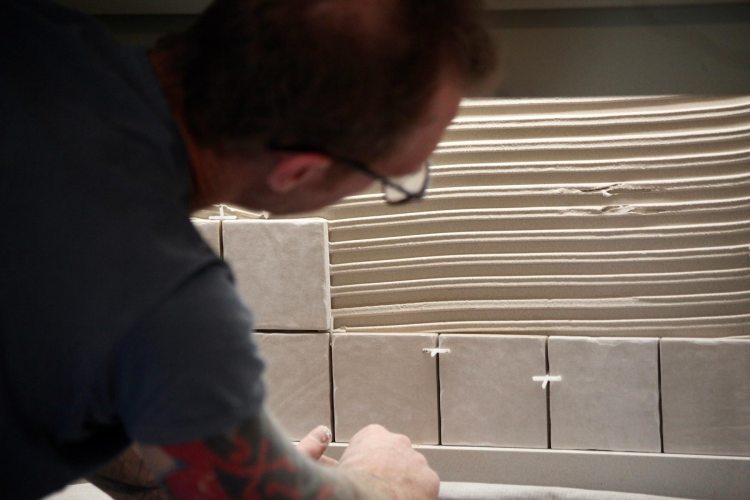
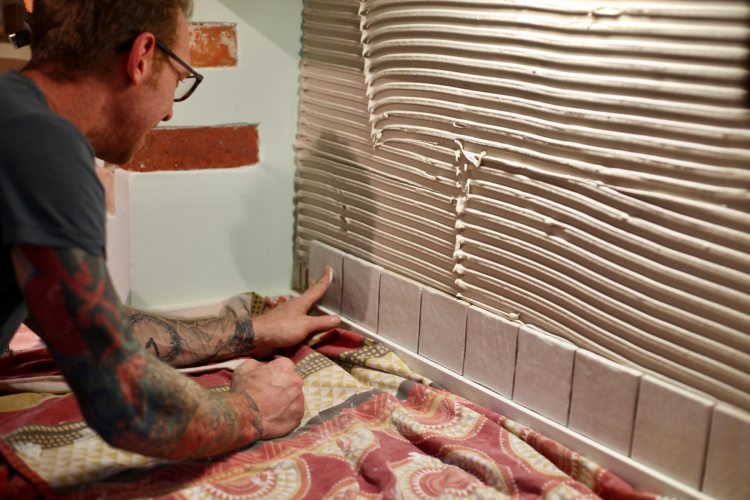
This morning and into the afternoon Darren Gregory (Facebook Page DG ceramics) tiled our kitchen.

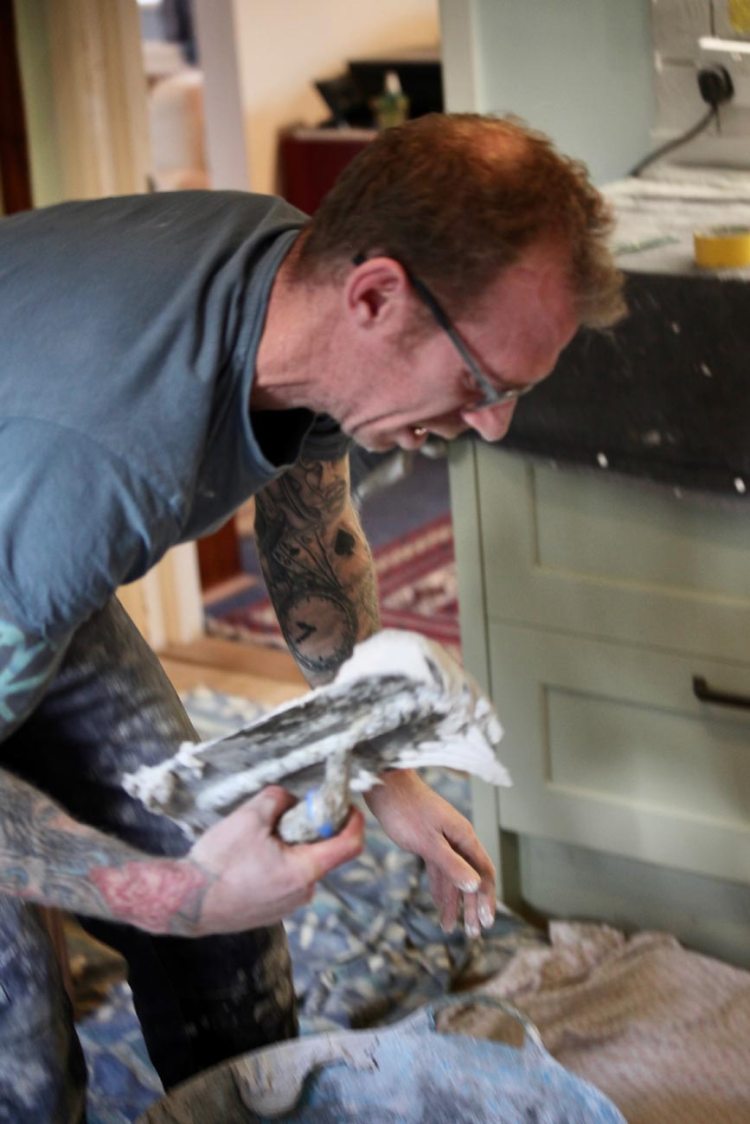
Darren is cheerful, friendly, fast, and efficient.

After cleaning the surfaces to be covered, Darren applied a ridged primer on which he carefully fixed the individual tiles. While waiting for the panel behind the hobs to dry, the craftsman repeated the process beneath the hanging shelves and the granite work surface. The primer is kept in a small tub, liberally applied with a flat trowel thingy, a bit like the blackboard duster that the schoolmasters of my youth might lob around the classroom; once the tiles are in place the adhesive is tidied up with a forefinger, smoothed over, and sponged clean.

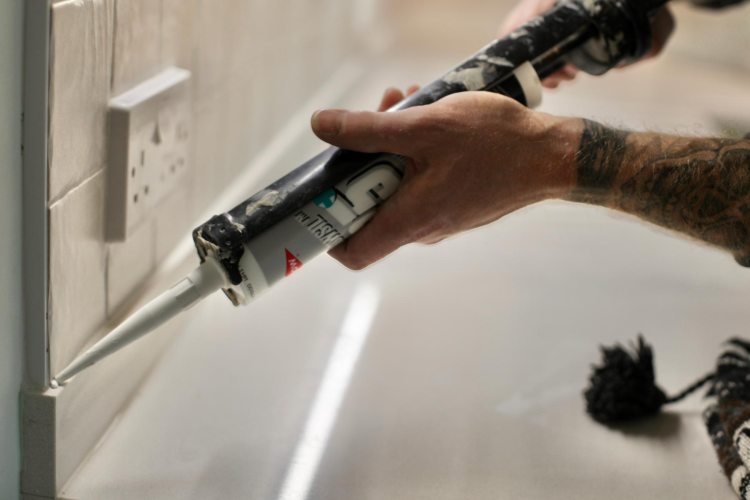
The tiles that have to be cut are carefully measured, sawn, and clipped to fit. Surrounding the light switches was perfectly done. “Stay there” said Darren, as he applied a length of sticky tape to hold one in place while he carried out the operation.

I was a little premature in photographing what I thought was the completed work. The silicon gun had yet to squirt the final trim.

This evening we dined on roast chicken thighs, potatoes, parsnips, pork and leek sausages, sage and onion stuffing; crisp Yorkshire pudding; moist ratatouille; firm carrots and Brussels sprouts, all with meaty gravy, with which Jackie drank Hoegaarden and I drank The Second Fleet Coonawara smooth blend of Cabernet, Merlot, and Petit Verdot 2019