When Brian of https://equinoxio21.wordpress.com/2021/01/12/carnival-of-carnivals/ posted his Brazilian feature a couple of days ago his photographs sent me on a search for a set of my own colour slides from August 2007. I spent rather too much time on what seemed a fruitless exercise until, overnight, I remembered some forgotten boxes.
This was the year of Jessica’s death and my return to London to try to set up home alone once more. My usual meticulous filing system broke down. Consequently I kept slides unidentified in the processor’s little boxes. When Jackie and I were reunited in 2009 she helped me identify the contents, although I have never incorporated them into my archival system. Jackie had remembered this process and thought it was possible that she had labelled one box Notting Hill Carnival.
Indeed she had.
Today I scanned them.
For a couple of years I lived in Sutherland Place, very close to this corner where one of the sound units was situated. In 2007 I was one of only two residents who stayed at home for the Bank Holiday weekend. The other woman wore earplugs and, as the music shook our houses, advised me to do the same. The sound from the speakers was actually painful.
I do hope this young lady occupying one of the floats still has her hearing.
The wonderful light on this August day, and the sparsity of some of the clothing belies the fact that the temperature was very cold. When I left my spot on the railings beside St Stephen’s Mews to go home to use the lavatory and add another layer of clothing
I was able to reclaim it on my return. Two years later that would not have been possible. I couldn’t get near any of the floats, and when I left my flat I had to prove that I lived in the road in order to pass the barrier to reach home. 2007 may well have been the last manageable year of such a popular event drawing visitors from all over the country.
This evening we dined on Jackie’s wholesome savoury rice; a rack of ribs in barbecue sauce; and crisp tempura prawns with which she drank for of the Cabernet Sauvignon and I drank more of the Shiraz.
The day was still grimly dark by the time we left to deliver Elizabeth a tub of Jackie’s chicken and vegetable stewp. (Interested readers will note that I have changed my spelling from stoup, because stewp is what google recognises and who am I to argue?)
Whenever the vehicle in front of us seems especially slow for no apparent reason, it is quite probable that a cyclist will be pedalling along ahead.
So it was today on School Lane. Even when the towed trailer on the road reached a wide enough section of the narrow winding route to be able to pass safely, the rider pulled more into the centre.
A pleasant young lady riding her pony crossed Pilley Street to open the gate for equine access, closed it again while waving to a van driver, then, with a friendly greeting, entered Burnt House Lane ahead of us.
We found Elizabeth happily working in her garden, enjoyed a short conversation, and set off to track the now almost visible sun towards the setting hour.
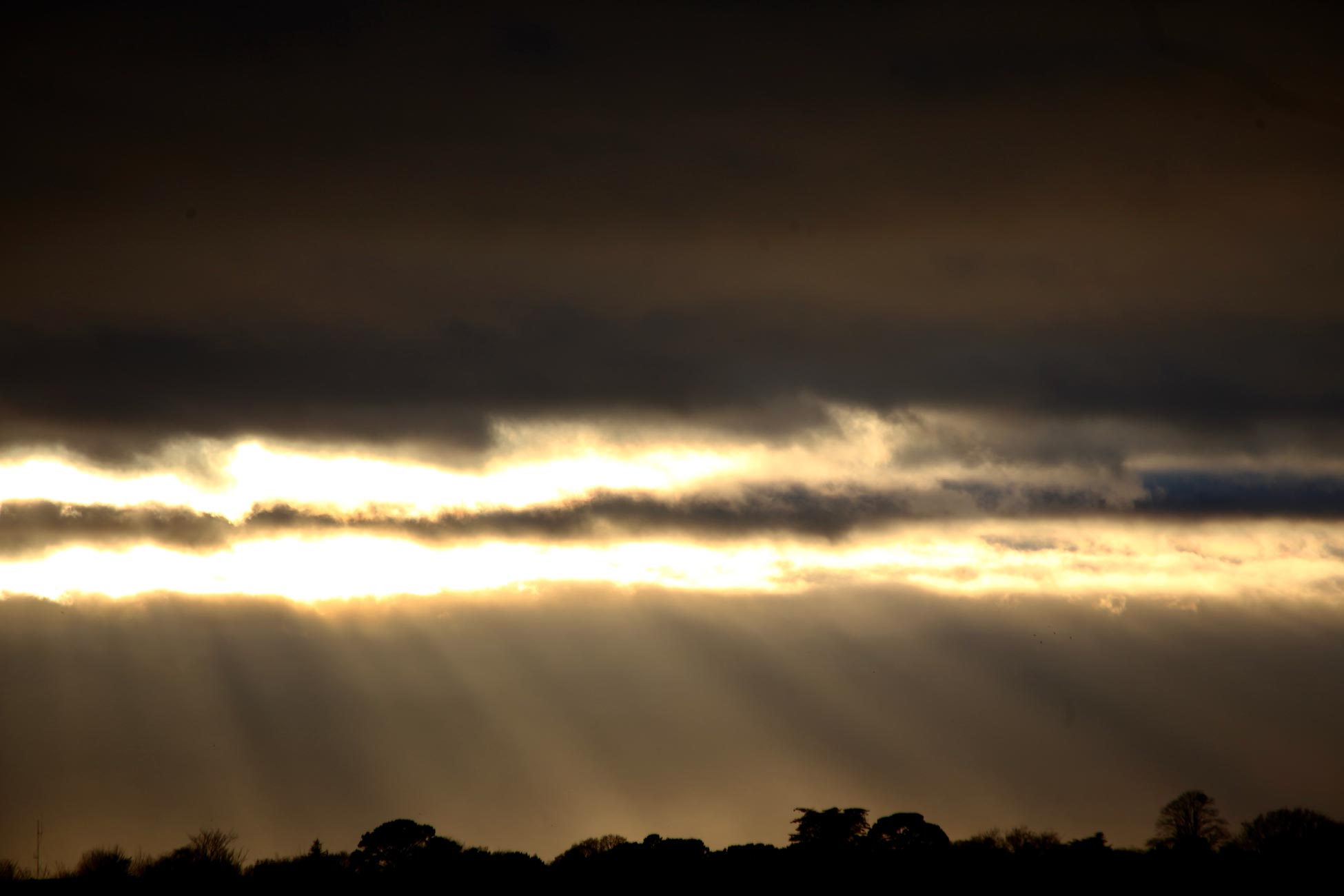
Glimmers were seen from Burnt House Lane;
a little lower from Warborne Lane;
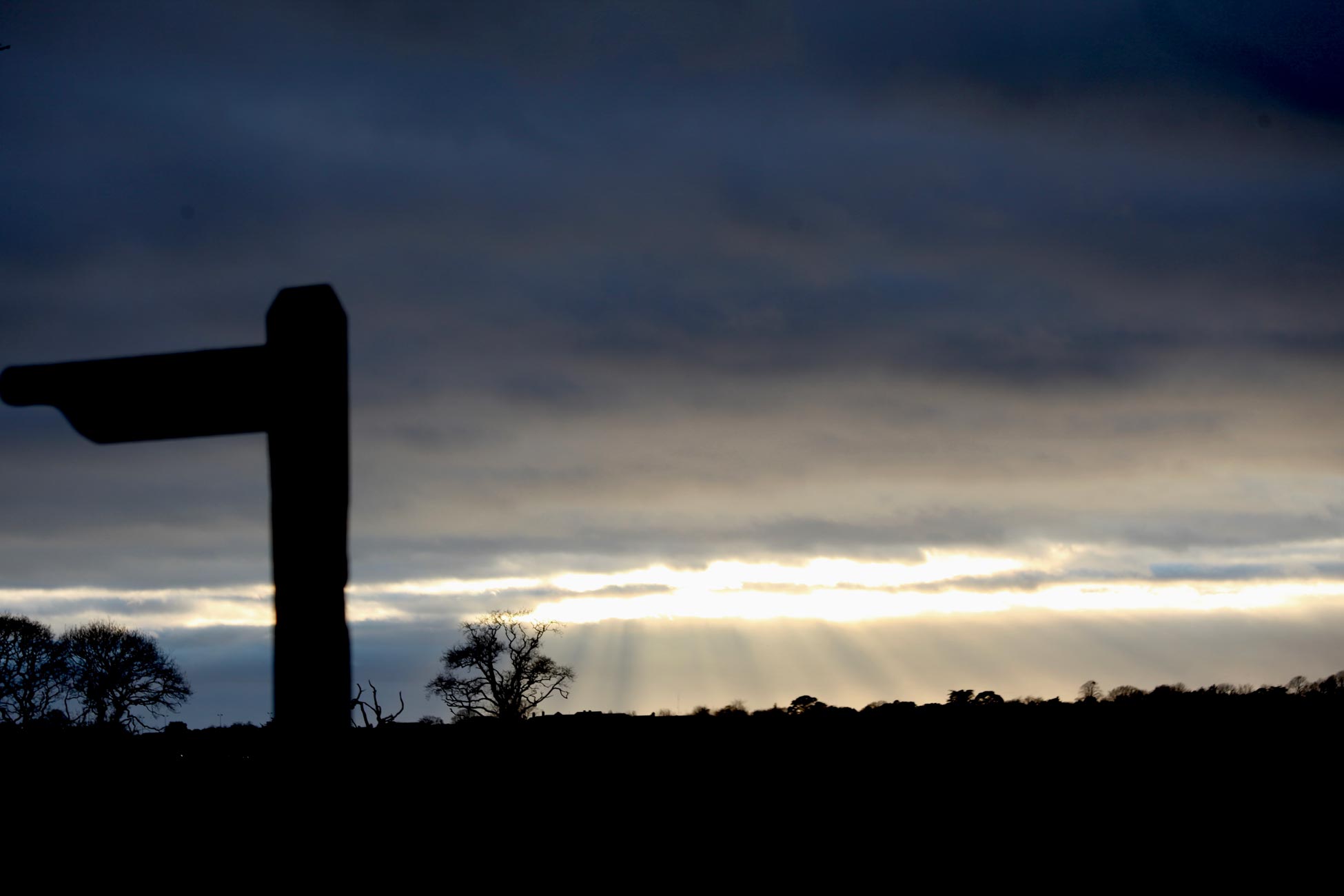
Walhampton was blessed with Jesus Beams;
sunset wasn’t far off beyond the silent coastal preservation machinery;
and all but retreated behind the clouds at Barton on Sea.
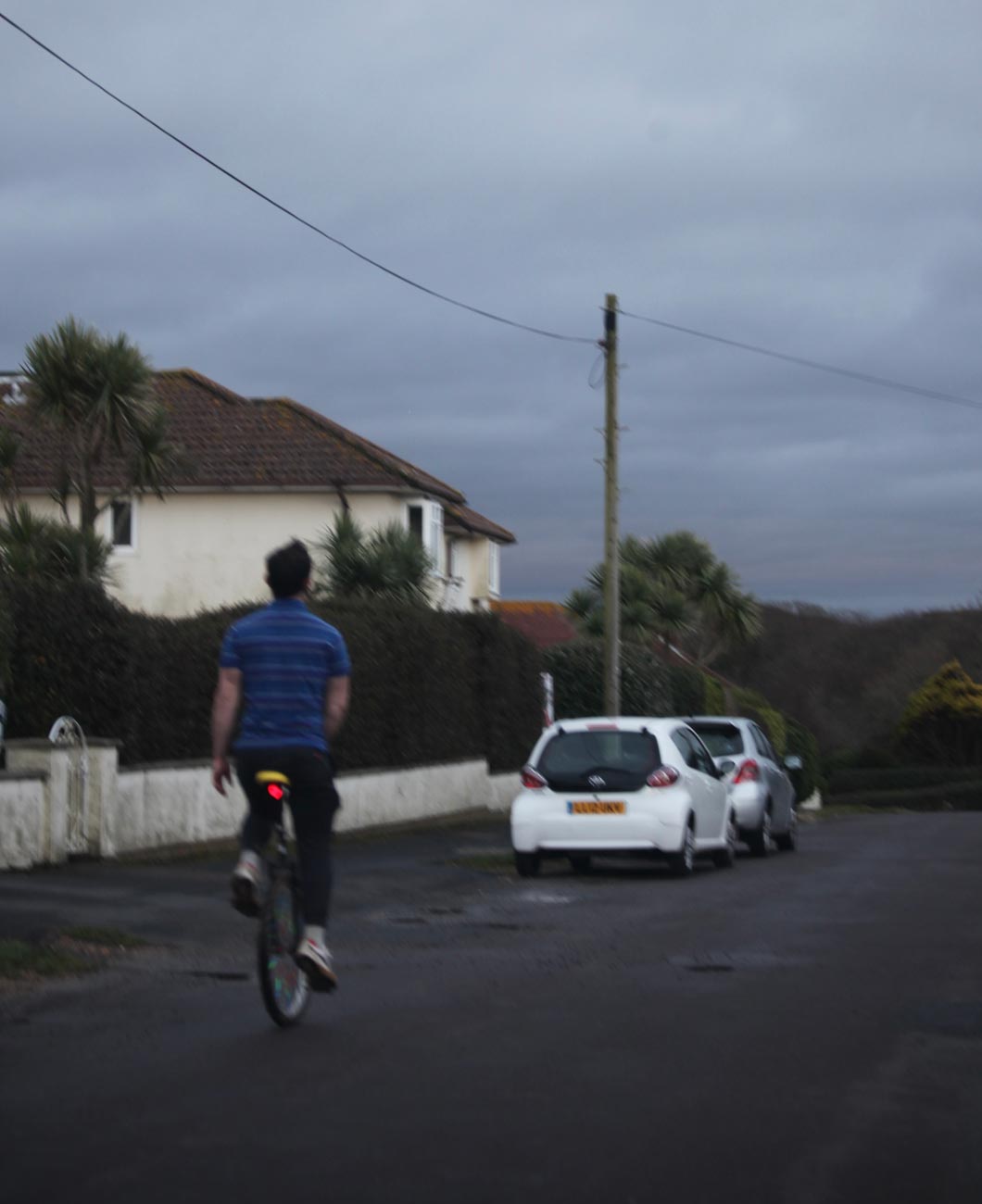
We had begun our trip following a bicyclist along School Road – on Grove Road, Barton, we tailed a unicyclist who kept well out of our way.
This evening we dined on oven fish and chips and baked beans with which we both drank Marlborough Cabernet Sauvignon 2019.
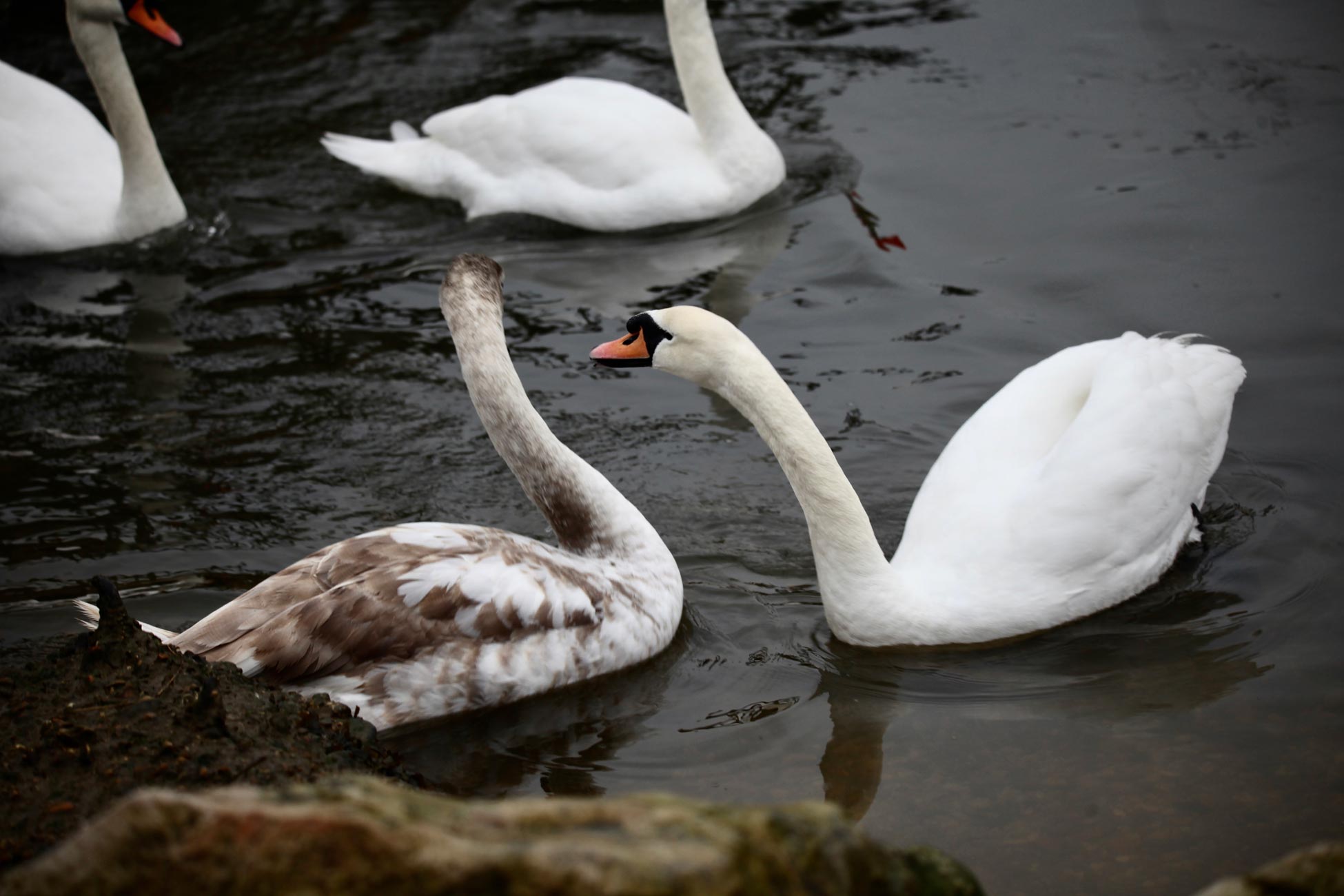
Today’s observations suggest that it is to enable them to reach the river bed.
Here I am photographing the swans.
This evening we dined on Jackie’s scrumptious sausages in red wine; creamy mashed potatoes; crunchy carrots and cauliflower, with firm Brussels sprouts. The Culinary Queen drank Hoegaarden and I drank more of the Shiraz.
On a dank, overcast, yet warmer, morning, Jackie drove us to Ferndene Farm shop where her shopping ran so smoothly that it was only a four-page read in the car for me.
We took a slight diversion on our way home, passing Sammy Miller Motorcycle Musem further along Bashley Cross Road, where
work went on attending to donkeys in a field and pigeons perched on a rooftop.
Historic transport, like this plane on display needed no feeding during lockdown. The motorcycle weather vane was in a constant wheel spin generated by the stiff breeze.
Like any other ungulates in our fields there are always some of these alpacas seen on the Sway road inquisitively spotting me spotting them.
Shortly after lunch deceptive clouds scudded across rapidly changing skies over Downton allowing cerulean patches and brief sunlight. This was all too fleeting. Soon we were back in the gloom.
This evening we dined on Jackie’s succulent sausages in red wine; creamy mashed potatoes; crunchy carrots and cauliflower; and firm Brussels sprouts with which she drank Peroni and I drank The Second Fleet Limestone Coast Shiraz 2019.
the cold and gloom of Downton Lane as I walked its length and back this dull, dreary afternoon.
One resident had made a cheerful crab pot and stump arrangement rather like ours; tree fungus decorated another arboreal relic.
Had I had more sense I would have turned back at the stream, but I didn’t, and just about made it home.
This evening we dined on Jackie’s nicely maturing chicken and vegetable stoup with crusty bread fresh from the freezer, with which I finished the Fleurie and the Culinary Queen abstained.
Yesterday I finished reading the fifth and final of Charles Dickens’s Christmas Books. This morning I scanned Charles Keeping’s faithful, first-class, illustrations.
Christopher Hibbert, in his informative introduction to my Folio Society edition, offers the insight that this work reflects painful experiences of the writer’s own life. Seeking freedom from his phantoms ‘The Haunted Man’ of the novella appeals for forgetfulness. The story reveals that forgiveness is really what is required. Once more this tale has been overshadowed by ‘A Christmas Carol’. It does, however contain much of Dickens’s splendid descriptive writing laced with his wry humour.
Highgate West Cemetery, in September 2008, when I produced the batch of colour slides scanned this afternoon, was nowhere near as oppressively gloomy as the heavy atmosphere that prevailed outside my workroom window.
John Turpin, who wrote the text for ‘The Magnificent Seven’, and I needed to join the above paying group to visit this fine example of London’s Victorian landscaped burial grounds. Although wealthy enough to have afforded these final resting places, I have gleaned no information about the various residents.
Steps lead down to these lower levels which also house the columbarium, from the Latin for pigeon-house, which contains niches for storing funeral urns.
I do not know who warranted this elaborate marker.
These three are memorable for their animals. His mastiff guards the remains of Thomas Sayers.
This is what Wikipedia tells us about him: ‘Tom Sayers (15 or 25 May[1] 1826 – 8 November 1865) was an English bare-knuckle prize fighter. There were no formal weight divisions at the time, and although Sayers was only five feet eight inches tall and never weighed much more than 150 pounds, he frequently fought much bigger men. In a career which lasted from 1849 until 1860, he lost only one of sixteen bouts. He was recognized as heavyweight champion of England between 1857, when he defeated William Perry (the “Tipton Slasher”) and his retirement in 1860.
His lasting fame depended exclusively on his final contest, when he faced American champion John Camel Heenan[2] in a battle which was widely considered to be boxing’s first world championship. It ended in chaos when the spectators invaded the ring, and the referee finally declared a draw.
Regarded as a national hero, Sayers, for whom the considerable sum of £3,000 was raised by public subscription, then retired from the ring. After his death five years later at the age of 39, a huge crowd watched his cortège on its journey to London’s Highgate Cemetery.’ His origins are also related in https://en.wikipedia.org/wiki/Tom_Sayers
John Atcheler, commemorated by a horse on a plinth, was reputedly horse-slaughterer to Queen Victoria. Maybe someone was indulging a wry sense of humour.
Menageries were popular in Regency and early Victorian England. The lion resting above the remains of George Wombwell represents a favourite exhibit of that individual who, according to Wikipedia
‘was born in Wendon Lofts, Essex in 1777. Around 1800 he moved to London and in 1804 became a shoemaker in Soho. However, when a ship from South America brought two boas to London docks, he bought them for £75 and began to exhibit them in taverns. He soon made a good profit.
Wombwell began to buy exotic animals from ships that came from Africa, Australia and South America, and collected a whole menagerie and put them on display in Soho. In 1810 he founded the Wombwell’s Travelling Menagerie and began to tour the fairs of Britain. By 1839 it totalled fifteen wagons, and was accompanied by a brass band.
Wombwell bred and raised many animals himself, including the first lion to be bred in captivity in Britain; he named it William in honour of William Wallace. In 1825 Warwick, Wombwell, in collaboration with Sam Wedgbury and dog dealer Ben White’s assistant Bill George,[1]arranged a Lion-baiting between his docile lion Nero and six bulldogs. Nero refused to fight but when Wombwell released Wiliam, he mauled the dogs and the fight was soon stopped.
Over the years, Wombwell expanded three menageries that traveled around the country. Wombwell was a regular exhibitor at the annual Knott Mill Fair in Manchester, a venue he sometimes shared with Pablo Fanque‘s circus.[2][3] He was invited to the royal court on five occasions to exhibit his animals, three times before Queen Victoria. In 1847 the Queen Victoria noted the bravery of the “British Lion Queen”, the nickname of Ellen Chapmanwho appeared with lions, leopards and tigers. Chapman married Wombwell’s business rival George Sanger in 1850.[4]
On one occasion Prince Albert summoned him to look at his dogs who kept dying and Wombwell quickly noticed that their water was poisoning them. When the prince asked what he could do in return for this favour, Wombwell said, “What can you give a man who has everything?” However, Wombwell requested some oak timber from the recently salvaged Royal George. From this he had a coffin fashioned for himself, which he then proceeded to exhibit for a special fee.
Wombwell frequented Bartholomew Fair in London and even developed a rivalry with another exhibitor, Atkins. Once when he arrived at the fair, his elephant died and Atkins put up a sign “The Only Live Elephant in the Fair”. Wombwell simply put up a scroll with the words “The Only Dead Elephant in the Fair” and explained that seeing a dead elephant was an even a rarer thing than a live one. The public, realising that they could see a living elephant at any time, flocked to see and poke the dead one. Throughout the fair Atkins’ menagerie was largely deserted, much to his disgust.
George Wombwell died in 1850 and was buried in his Royal George coffin in Highgate Cemetery, under a statue of his lion Nero.
The book George Wombwell (1777 – 1850): Volume One recalls the lion and dog fight in Warwick with well researched evidence, but questions whether it ever actually took place. George Wombwell (1777 – 1850): Volume Two covers Wombwell’s life as the most famous showman, from his arrival in London around 1800 to his death in 1850.[5]
In 1851 a tapir broke out of its den at Wombwell’s Menagerie in Rochdale, causing panic among the spectators.[6]
The cedar of Lebanon in the second and third of these pictures is one of the cemetery’s original plantings.
This evening we dined on Jackie’s substantial, wholesome, chicken and vegetable stoup and crusty bread with which she drank Hoegaarden and I drank more of the Fleurie.
On a dull and frosty morning Jackie photographed some aspects of the garden.
A perky dragon was garlanded in frosted ivy; the ‘Autumn’ sculpture vied with winter;
euphorbia, cordyline Australis, and rose leaves bore fringes of frost and lingering water drops;
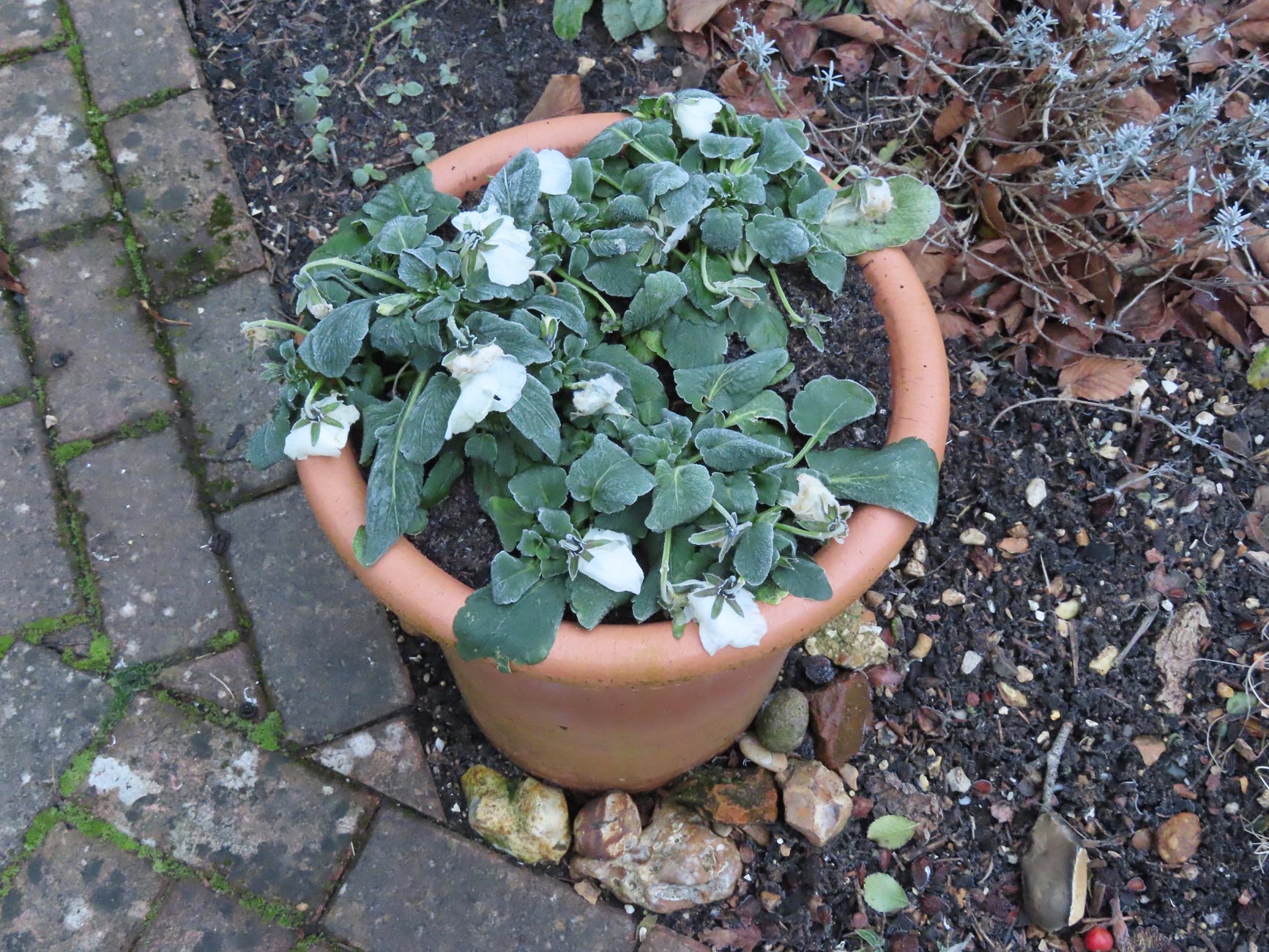
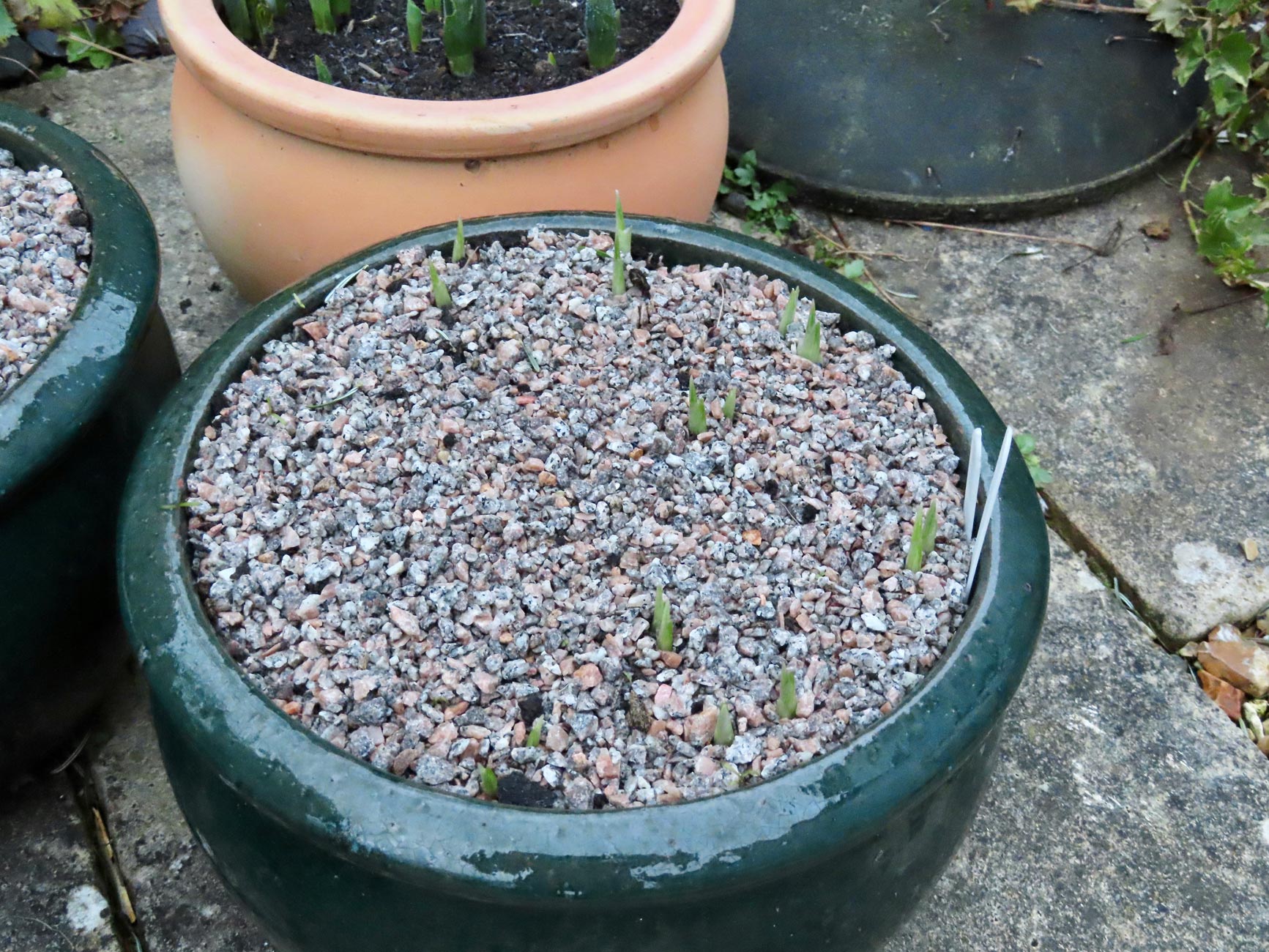
some potted pansies were rather limp, while iris reticulata and tulips broke the soil in defiance.
By the time we drove over to Pilley to present Elizabeth (in our bubble) with a tub of Jackie’s substantial chicken and vegetable stoup, the skies had brightened.
In the woodland alongside Undershore a soft toy had successfully scaled the wall that is the undercarriage of a fallen tree.
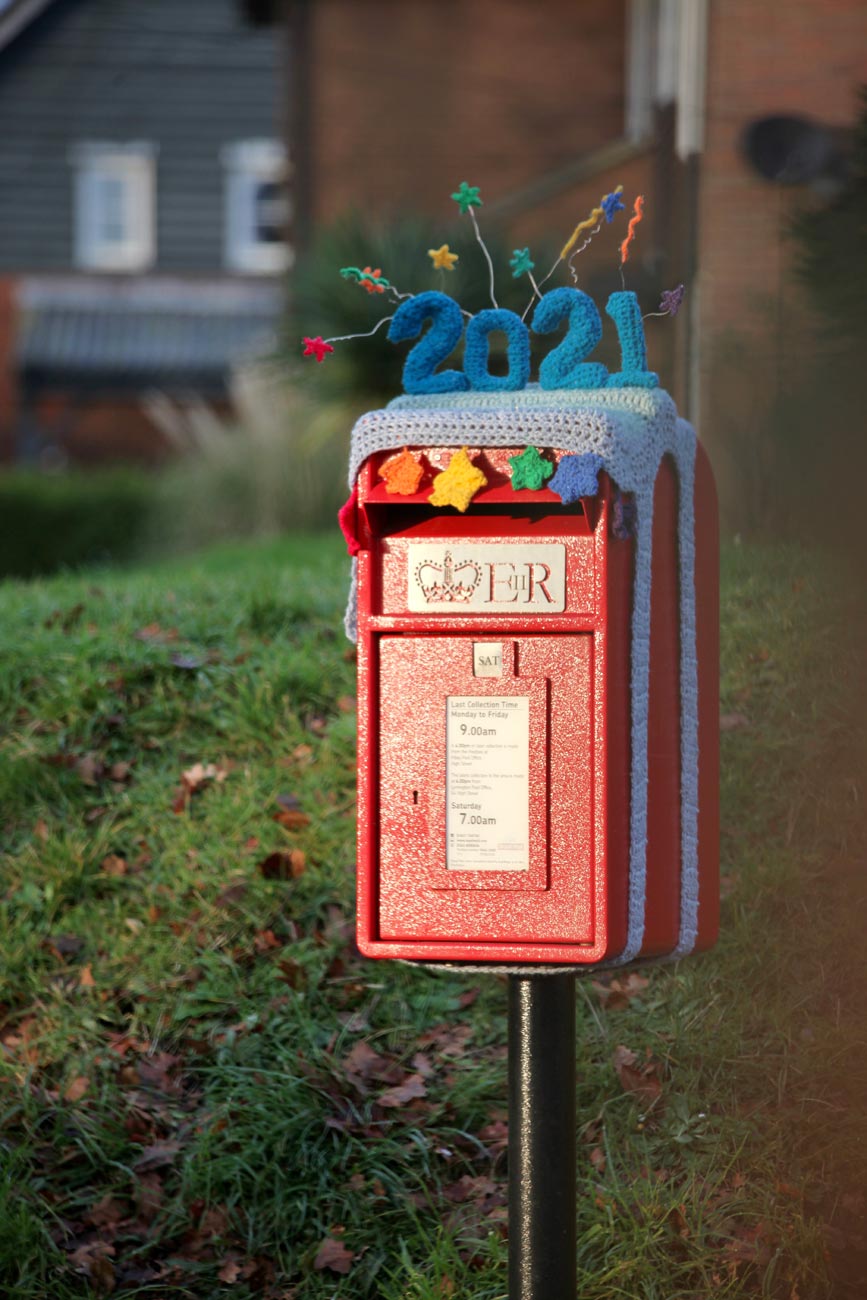
The decorated postbox in Pilley Street now bears the year date 2021;
the icy old quarry lake bears branches and reflections.
At Walhampton I photographed a pheasant on the verge and Jackie focussed on a silhouetted wood pigeon;
on Monument Lane while I caught the lowering sun behind trees Jackie picked out its tipping the monument railings.
Finally the Assistant Photographer caught me
focussed on the dying sunset and twilight haze shrouding the Isle of Wight and The Needles at Milford on Sea.
This evening we dined on succulent fillet steaks; crisp oven chips; moist mushrooms; nicely charred onions; cherry vine tomatoes; and a colourful melange of peas and sweetcorn, with which Jackie drank Hoegaarden and I drank Patrick Chodot Fleurie 2019.
Today we took an early lunch and drove to Tesco for our big shop. As usual I sat in the car, Jackie did the business, and I intended to read my book. After one page my sister, Jacqueline, phoned me and that was the end of the reading.
In fact Tesco wasn’t too difficult, so the Caterer in Chief wouldn’t let me unload the shopping into the car for Covid safety’s sake.
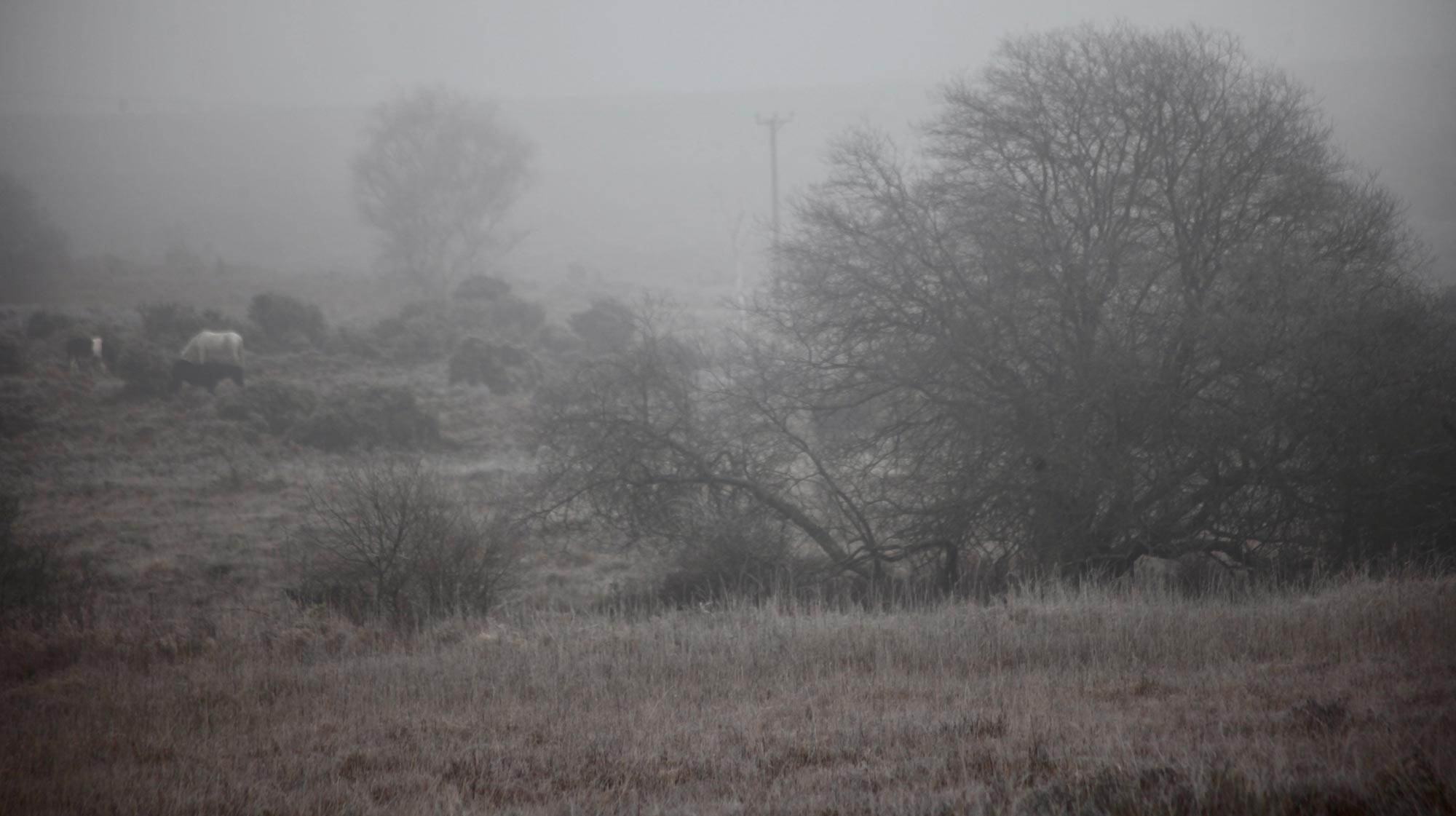
We took a diversion round Holmsley Passage and its misty, frosty, landscape on our way home.
As I wandered, fingers and toes tingling, I discerned just one group of grazing ponies.
Others, on Holmsley Road
and Wootton Common were nearer at hand. One, as soon as I paid it any attention, huddled against its companion seeking security.
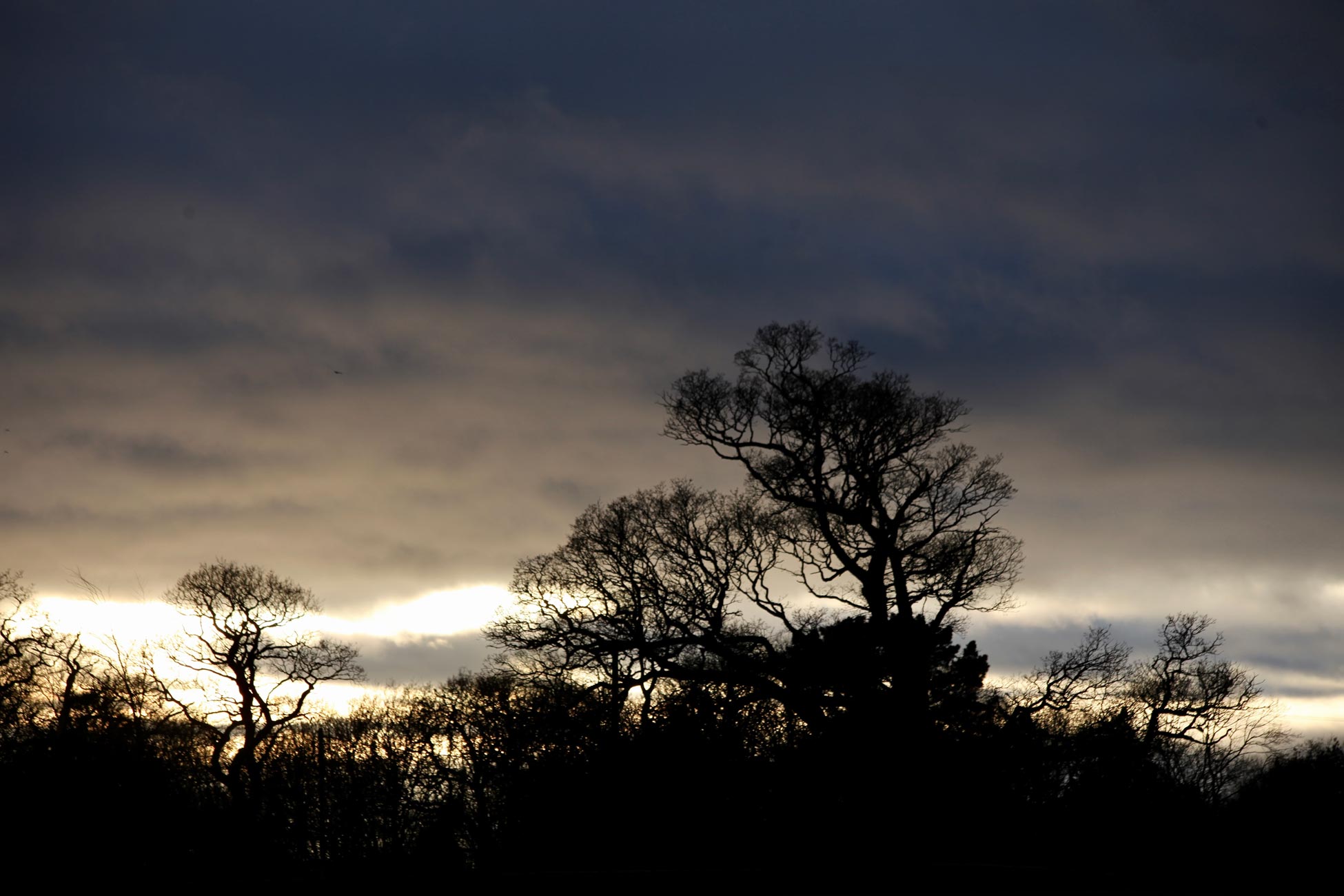
A weak sun, putting in an appearance over Hordle Lane, silhouetted a number of oaks.
Undeterred by the fact that we are still consuming provisions bought in for Covid-cancelled Christmas, Jackie had made her first Easter egg purchases.
This evening we dined on more of Jackie’s perfect spicy pork paprika; boiled potatoes; firm carrots and cauliflower; and tender runner beans, with which she drank Hoegaarden and I finished the Malbec.
On a dank-dull afternoon we drove to Milford on Sea pharmacy for a repeat prescription, with a loop round Keyhaven’s Saltgrass Lane on our return home.
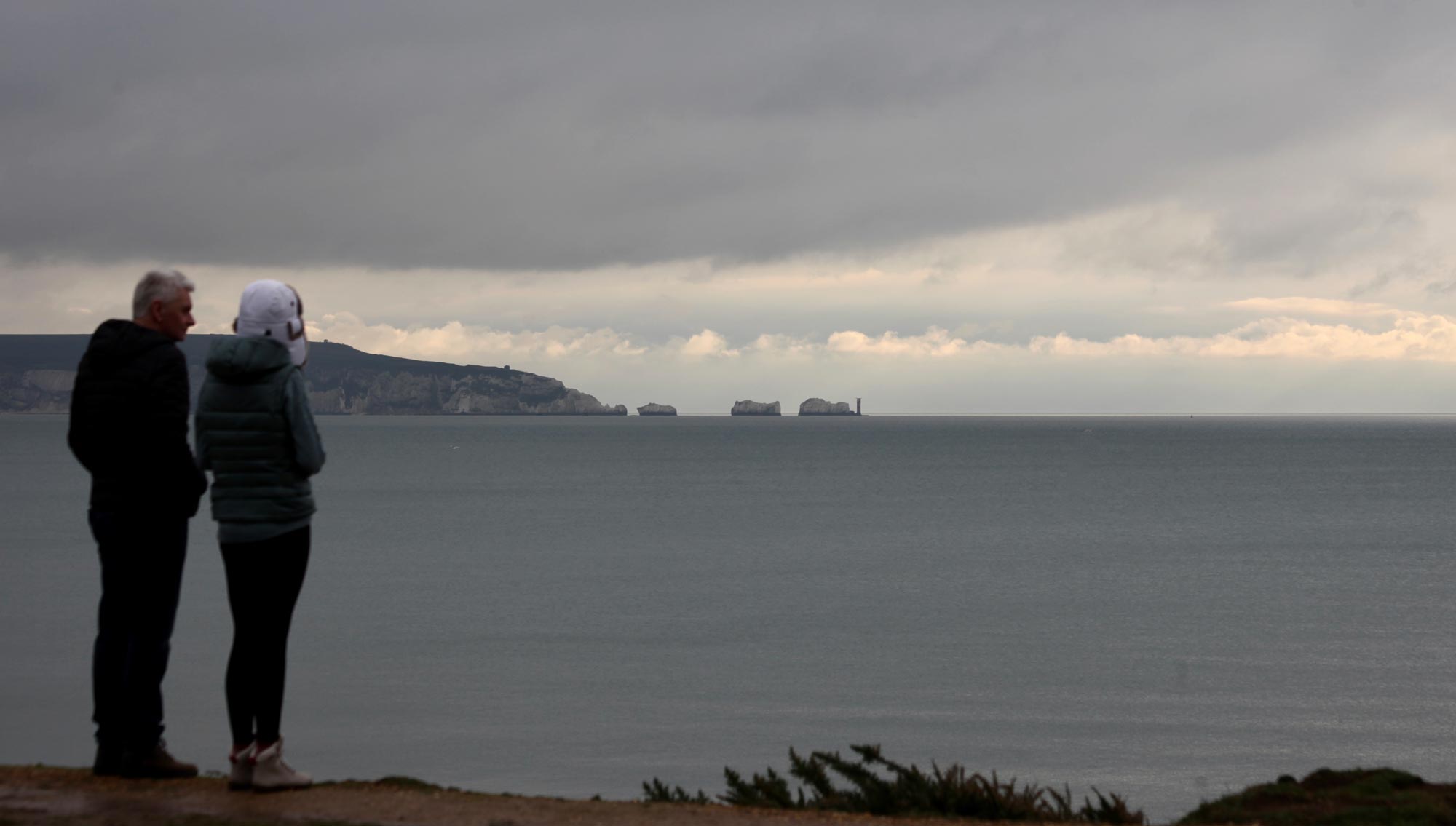
Occasional walkers, like this couple looking across the Solent to the Isle of Wight and The Needles, made their way along the sparsely populated clifftop promenade.
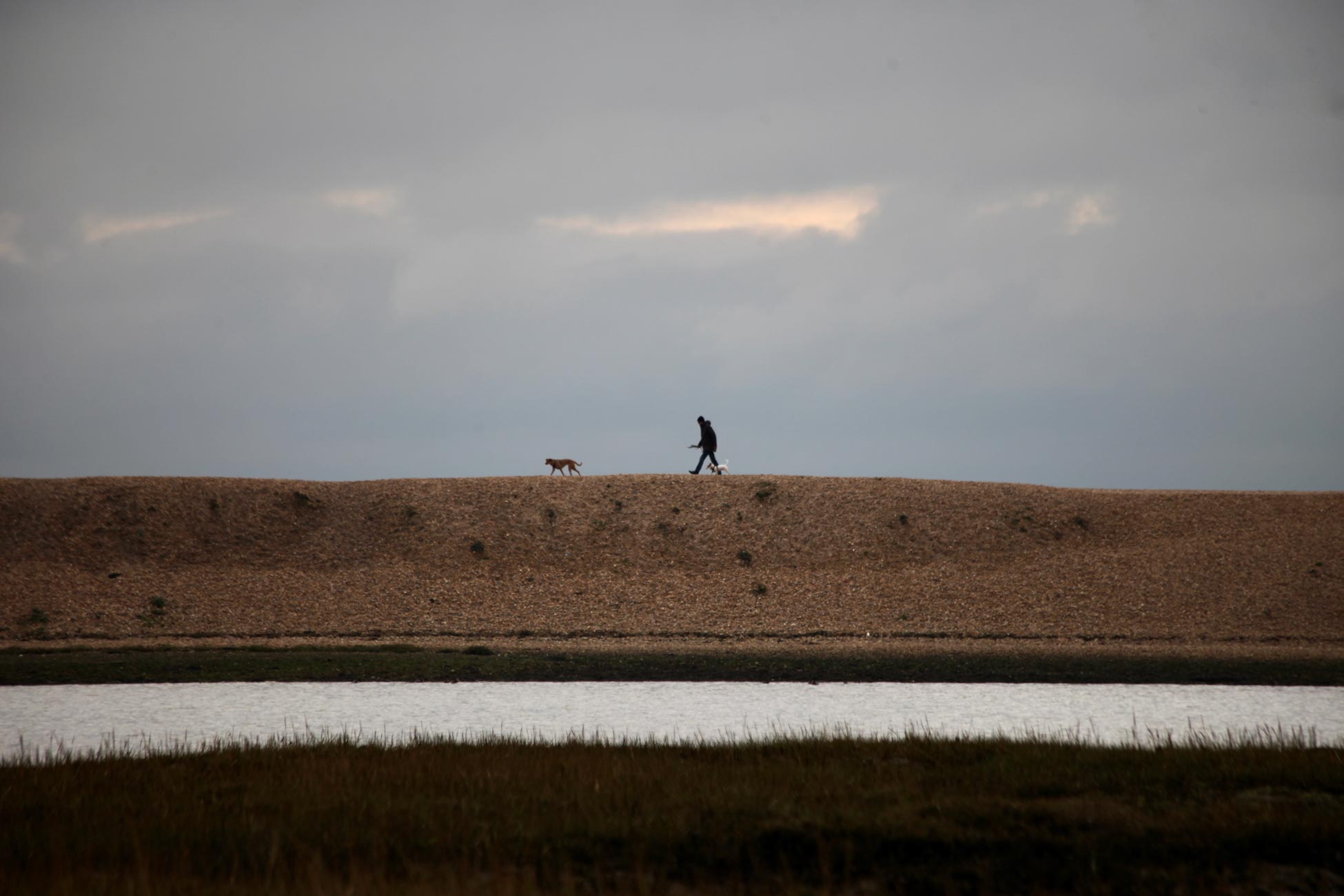
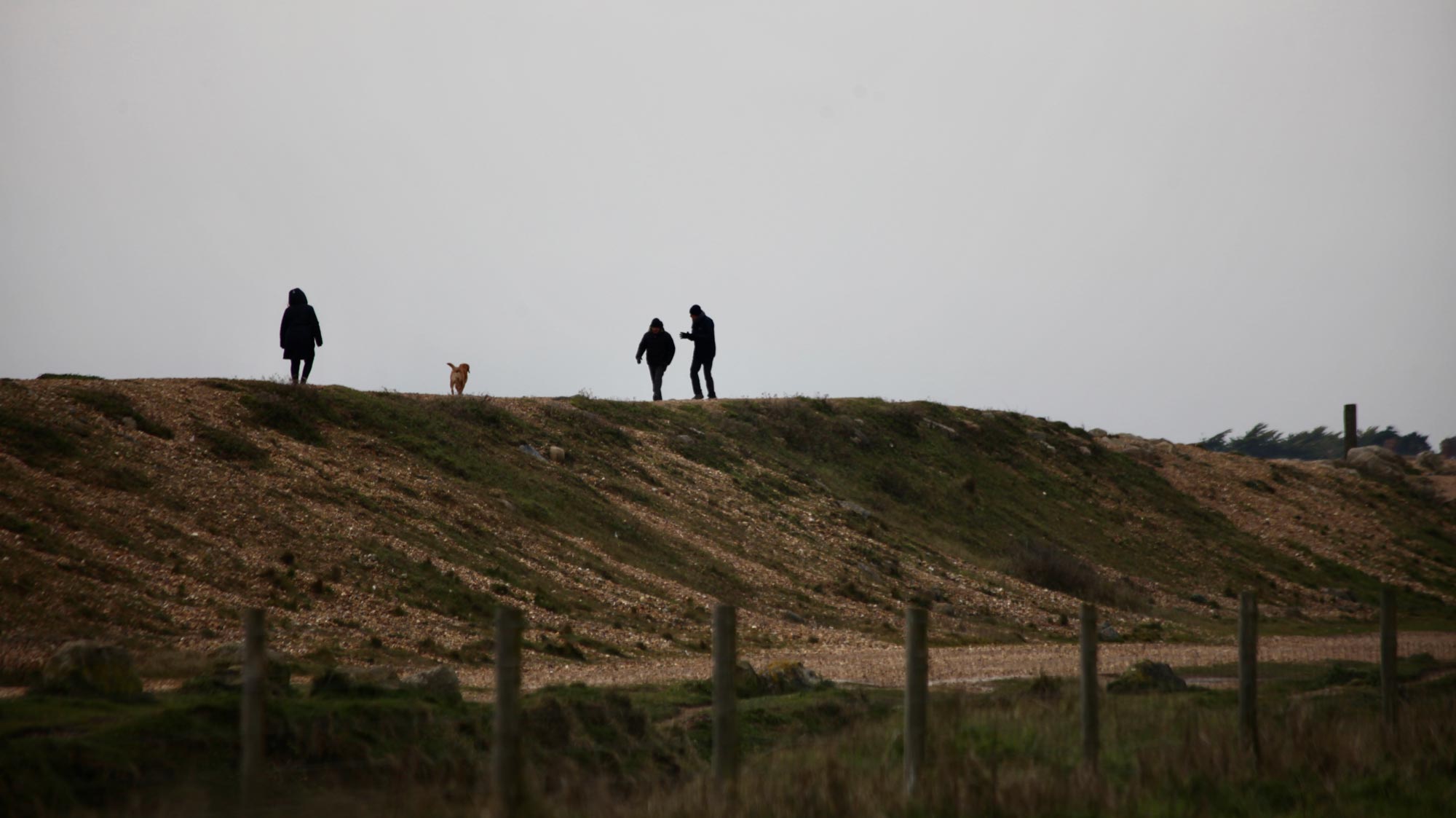
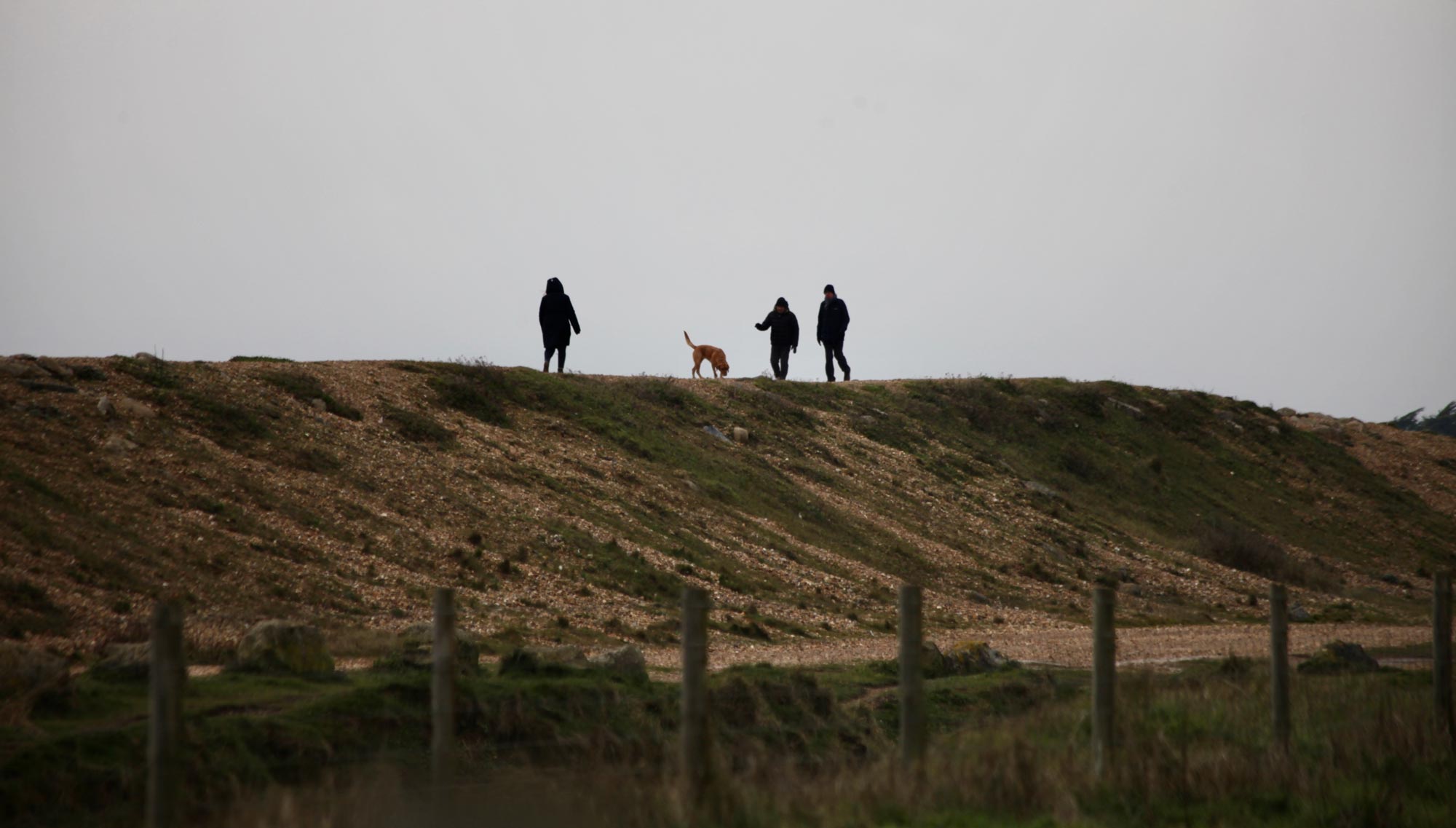
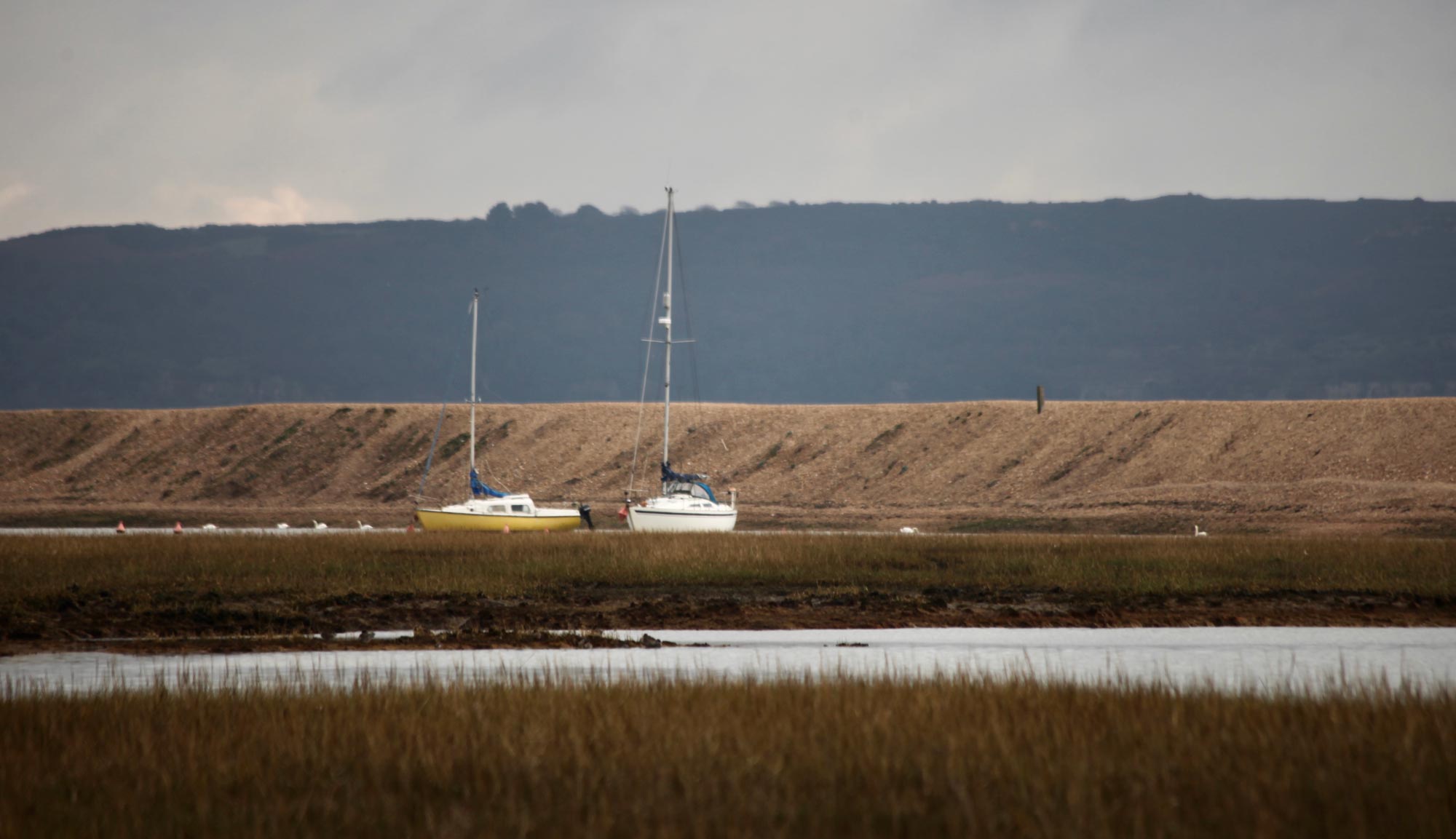
We followed a steady jogger along Saltgrass Lane until we paused to photograph walkers and dogs on the Hurst spit alongside which idle sail boats were moored.
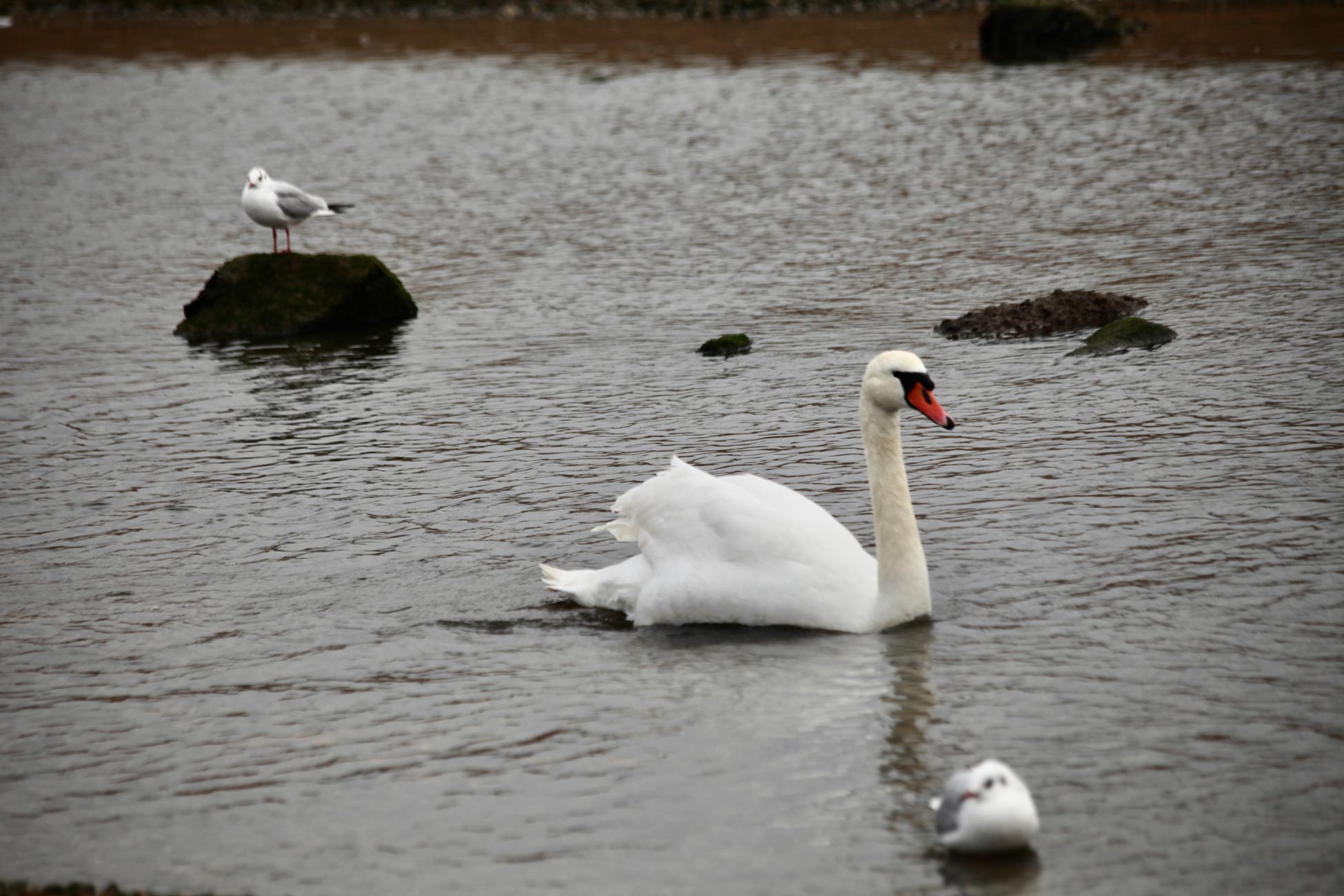
Curlews and turnstones (I am grateful to Quercus for identifying the latter in his comment) fished the shallows;
an elegant swan sailed among resting gulls,
one of which passed the time of day with a trailing cygnet.
This evening we dined on Jackie’s especially spicy pork paprika; boiled potatoes; crunchy carrots; and tender runner beans, followed by aromatic rice pudding laced with a dollop of strawberry jam with which she drank Hoegaarden and I drank more of the Malbec.
This morning I produced an A3 print of his choice for the paraglider from “Sunset Dancing”. Now we are back in National Lockdown handover will probably have to wait a while.
In the meantime Jackie photographed the farmer across Christchurch Road trimming his hedge. He didn’t really cause any disruption to traffic, although it was a little tight at times. The owls on our front fence were undisturbed. Note the thriving carpet rose.
Charles Dickens’s ‘Christmas Books’ is definitely a mixed bag. This afternoon I read ‘The Battle of Life – A love story’, first published in 1846. The narrative begins with a lovely bucolic description and a delightful dance giving us hope for joyful times ahead. There follows a rather boring sequence, more poetic word pictures, and a somewhat far-fetched conclusion, all featuring the author’s entertaining wry humour. Christopher Hibbert, in his introduction to my Folio Society edition, describes this ‘slight but dismal tale’ as a version of relationships and events in the author’s own life at this time. That rings true to me.
Beginning with the dance,
Charles Keeping’s wonderfully moving illustrations are as true as ever to the text.
This evening we dined on Jackie’s well-filled flavoursome beef and onion pie; crisp roast potatoes; crunchy carrots, cauliflower, and firm Brussels sprouts, with tasty, meaty, gravy, with which she drank Hoegaarden and I drank Mendoza Malbec 2019