CLICK ON CLUSTERED IMAGES TO ACCESS LARGER GALLERIES
I began the day by managing to load all the pictures missing from yesterday’s post.
Flushed with success on this morning bright and crisp enough to bring tinges of pink, like those still visible in the garden, I ventured outside with my camera.
Although the curtain of weeping birch leaves is preparing to shed its beads, and the hosts of honesty reveal its seeds,
we still have plenty of colourful blooms, such as these dahlias, Japanese anemones, and fuchsias;
while begonias, honeysuckle, nicotianas, and penstemons persist.
This afternoon we went on driveabout.
On the moors between Brockenhurst and Beaulieu, the lowering sun gilded the topmost bracken fronds.
As we approached Beaulieu, ponies and cattle shared the grazing.
The equines wandered along the road seeking traffic to disrupt;
further on, a trio was more interested in the fodder.
Hatchet Pond itself was still and reflective.
On our return we diverted to Milford on Sea to catch the sunset. Looking east towards the Isle of Wight the sky wore pastel pinks and indigo hues;
contrasting with the fiery flames lighting up the west. As the sun receded into the water its radial beams streamed upwards.
This evening we dined on cheese-centred haddock fish cakes, mashed potato and swede, crunchy cauliflower, carrots, and runner beans, with which we both drank Prestige & Cavet sauvignon blanc 2014.
CLICK ON SMALLER, CLUSTERED, PICTURES TO ACCESS LARGER GALLERIES
On quite a misty morning, we went out for a drive in such a direction as the spirit moved us.
We crossed the Lymington River and turned right along Undershore Road, giving us an atmospheric view of the level crossing we had just passed over.
Just to the left of my vantage point, a duck led her paddle of ducklings onto the water from the muddy bank.
Originally heading for Hatchet Pond we diverted to Tanners Lane, along which was walking a blonde woman with her equally slender and elegant saluki, who were soon to join us on the beach,
where Jackie found the skull of the spirit that had led us there,
and I photographed the sun, the sea, birds overhead, the shingle, the invisible Isle of Wight, a beached boat, and a ferry.
We travelled on in the vicinity of Sowley where the obligatory pony stood hopefully in the middle of the road
and pheasants sped across a field.
Snooks Lane near Portmore led us back to Lymington and home.
I have not dwelt on my daily continuing wrestling with uploading my pictures. Suffice it to say that James Peacock made another visit, bringing his own Apple laptop to try that. The problems were the same, leading us both to the conclusion that the problem lies in the BT internet connection. James is to investigate the possibility of getting this improved.
This is a well researched and beautifully produced A4 size laminated paperback. In tracing the antecedents of these young men who died in WW1, the conflict that was supposed to end all wars, we learn much about the early European settlement of New Zealand. It was only in 1840 that the first British immigrants came to join the Maoris who had come from Polynesia before the 14th. century.
It was only in 1909 that the New Zealand Army was formed, yet it sent more than its fair share to join the 1914-18 conflict, and to die in foreign fields, and in the New Zealand General Hospital No. 1 in Brockenhurst. Almost as many succumbed to illness as to wounds. A proportion of the men were Maoris.
Those of European origin mostly emanated from parts of the UK, notably Scotland. We learn their civilian occupations, and those of their antecedents. As one would expect there was a preponderance of farmers and craftsmen.
The agonies of the men and of their bereaved families are apparent in their factually related stories.
This evening we dined on Jackie’s delicious liver casserole, served with saute potatoes on a bed of peppers, leaks, garlic, and mushrooms. Dessert was cherry crumble and custard. I drank Abbot Ale.
Having spent far too many hours attempting to load today’s photographs onto WordPress, and feeling like the spider of the legend of the Scots king Robert I, I am forced to leave gaps above, which I hope to fill in due course.
explains: “It is said that in the early days of Bruce’s reign he was defeated by the English and driven into exile. He was on the run – a hunted man. He sought refuge in a small dark cave and sat and watched a little spider trying to make a web.
Time and time again the spider would fall and then climb slowly back up to try again.
If at first you don’t succeed – try, try again.
Finally, as the Bruce looked on, the spider managed to stick a strand of silk to the cave wall and began to weave a web. Robert the Bruce was inspired by the spider and went on to defeat the English at the Battle of Bannockburn.
The legend as it is now told was first published by Sir Walter Scott in ‘Tales of a Grandfather’ in 1828, more than 500 years after the Battle of Bannockburn. It is thought that Scott may have adapted a story told about Sir James Douglas.
Caves across Scotland and Ireland are said to be legendary cave of Bruce and the spider: the King’s Cave at Drumadoon on Arran; King Robert the Bruce’s Cave in Kirkpatrick Fleming near Lockerbie; Bruce’s Cave – Uamh-an-Righ, Balquhidder Glen; Bruce’s Cave on Rathlin Island…”
Early the next morning I managed to load the rest of the pictures.
CLICK ON THE SMALLER, CLUSTERED, IMAGES TO ACCESS THE ENLARGED GALLERIES.
This morning Jackie drove us to Burley in search of witches.
The landscape across the moors early in the morning offered misty slate layers in the distance.
On the approach to Burley, the leaves on the trees were turning the rich colours of autumn
The car park in the village was largely occupied by ponies who had generously left a few spaces for the traffic.
One little lad in a buggy wasn’t all that sure about the attention he received.
We soon realised that we had missed the real Halloween event which had been on Saturday, two days ago. Our witch hunt was therefore fruitless. We had to settle for carved pumpkins, including the winning mouse, and ghastly ghouls sporting sheets.
Some sorceresses had abandoned their hats in the form of traffic cones that had found their way into the landscape. In the first of these two photographs the bicycle attached to the railing was probably left by a witch as she switched to here broom. In the second, Jackie converses with a garrulous goose.
Its companion practiced its contortions and they both enjoyed a good preen.
A communal field on the edge of the village contained examples of agricultural machinery and artifacts of a bygone age;
a shepherd’s hut;
and the parked up Burley Wagon Rides conveyance with a nearby pitched tent.
We had been told that a herd of red deer could often be seen on the far side of the field. Like the witches, the deer had flown, but the evidence of their presence was shown by the pruned lower branches of the trees they had pruned.
A bonfire, surprisingly swarming with wasps, was being prepared for the next celebration event, namely fireworks night on the 5th of November, commemorating the failure of the Gunpowder Plot of 1605. Foiled by betrayal, this was a Catholic attempt to blow up the House of Lords and kill King James I. Instead, Guido (Guy) Fawkes was hung, drawn, and quartered. (See LordBeariofBow’s comment below). This involves taking down a hanged victim before death, cutting out living vital organs and quartering the body. It was a common punishment for treachery in those days.
Beyond the field could be seen Burley Manor Hotel. The original manor house dated from the twelfth century. In 1852 the building was demolished to make way for this Victorian replacement which has been an hotel since 1935.
Dew continued to bejewel grass and fallen leaves when we left to return home.
Charles Lane, Bagnum is just one of the sun-streaked roads that rushes towards us as we travel through the forest.
It wasn’t until, watching the 1 p.m. BBC News, I looked beyond Hugh Pym, that I realised the destination of at least one of the Burley witches.
This evening we dined on Jackie’s lovely liver and bacon casserole which was far more tender and tasty than that I had eaten yesterday at Otter Nurseries. It came with new potatoes and perfect Brussels sprouts and runner beans. Lemon and lime merangue pie was to follow. I finished the madiran.
CLICK ON THE CLUSTERED GALLERY IMAGES TO ACCESS THEIR LARGER FORMAT SLIDESHOW.
At 16 degrees, our incredibly mild period continues. It was therefore strange today to begin the winter clearing whilst we continue to enjoy blooms from spring and summer. We did so in rather desultory fashion.
It is difficult to think of winter when you can admire
roses Margaret Merrill, Penny Lane, Mamma Mia, and especially Summer Time;
or fuchsias, geraniums, dahlias, gauras and poppies, one of which harbours a hoverfly; and many more.
With the sun shining, we set off for brunch at The Friars Cliff Cafe. Unfortunately this was in everyone else’s minds. The car park at Steamer Point was crammed full, and shoals of humanity floundered on the beach. There was no doubt the cafe would be full to bursting like me after the Olympics breakfast. We therefore turned back and aimed for Calshot. We hadn’t travelled very far before the sky clouded over. It didn’t look very conducive to photography, so we brunched at Otter Nurseries. Only when I had chosen a liver casserole did Jackie tell me that was what she had planned for this evening. She happily did a rethink.
The walls at Otter contain some rather well-executed paintings for sale. One of these was Boldre Bridge. We wondered why we hadn’t seen the bridge, and realised that would be because we had always driven over it. So we went to look for it. I passed through a five-barred gate and descended a bank to find something approximating the painter’s vantage point.
I was intrigued to notice that the architect had made it possible to feature the Christian fish symbol. The five-spanned bridge, which dates from at least the 18th century is listed under the Planning (Listed Buildings and Conservation Areas) 1990, as amended, for its architectural or historic interest.
A tree had fallen across the river, on which autumn leaves floated over reflections of broken, reeds, and still grey sky.
Just before we drove on, the sun began to light up the foliage on Rodlease Lane.
En route to Sway, I wandered into the forest, taking advantage of the light streaming through the trees, and exchanging greetings with a family of riders.
As I ventured further in, attracted by pinpoints of light in the distance, I was rewarded by this dramatic view across the moorland featuring
a single dwelling in an idyllic setting.
Driving through Hordle on our return, Jackie spotted a cautionary notice for any witches inclined to take to the skies tomorrow night, and a cry for help from an underground prison.
Jackie’s rethink for tonight’s meal involved lemon-flavoured chicken Kiev, French fries, and baked beans, with which she drank Hoegaarden and I drank Reserve des Tuguets madiran 2012.
CLICK ON SMALLER, CLUSTERED, IMAGES TO ACCESS ENLARGED GALLERIES WHICH CAN BE FURTHER ENHANCED.
Today I scanned more of the black and white negatives from the French holiday of 1985.
Whilst we were in the woods featured yesterday, Matthew helped Sam make himself a den.
We then explored the pastoral landscape,
taking time out for Mat and Sam to play catch on top of a shifting pile of grit.
As was their wont, Sam and Louisa found a dog to befriend. Jessica’s arm was ready in case of mishap.
Back at the gite in the evening, Jessica aspired to become a yokel chewing grass whilst basking in the sunlight.
For our dinner this evening, Jackie produced roast lamb breast with roasted vegetables, crisp carrots, cauliflower, and Brussels sprouts. Jackie drank her Hoegaarden and Bavaria mix, while I finished the Chateuneuf du Pape.
CLICKING ON THE SMALLER, CLUSTERED, IMAGES ACCESSES THE LARGER GALLERIES WHICH CAN BE FURTHER ENLARGED.
Many of the negatives from the French holiday of 1985 are in black and white Ilford film. This was my favourite in the dark ages of the early 1980s when I printed my own work in monochrome with chemicals in the blacked out kitchen makeshift darkroom. I scanned another batch today.
A useful prop in the garden of the gite, were the cartwheels.
They worked on their own, or as a backdrop for Sam’s poking about in the water.
The nearby woodlands offered contrasting light,
and lengthening shadows across the roads.
During the process of producing this post, I realised, on gazing out of the window, that a jackdaw had heard on the telegraph that I was working in black and white, and helpfully posed, perching on a pole, cocking its head to make sure that it had heard aright.
Anyone who has followed my technical problems ever since I uploaded Mac’s new operating system will be relieved to learn that this work was done on that machine. This morning, I received an update from Apple which seems to have ironed out a few problems. Don’t get too excited, but do watch this space.
This evening we dined at Lal Qilla in Lymington. We received the usual very warm welcome, excellent food, and friendly, attentive, service. My meal was king prawn Ceylon and Jackie’s chicken Haryali. We shared a naan, special fried rice, and a caulliflower bahji, and both drank Kingfisher.
Today I lunched with Norman in Waterloo’s Lower Marsh. To facilitate this, Jackie drove me to New Milton station in the morning, and home from Brockenhurst this afternoon.
These trains are usually crowded, but this morning’s took the biscuit. Had you actually wanted to purchase a biscuit, or anything else for that matter, this would not have been possible, although there was an at-seat trolley on board. This rapidly became ‘a static buffet’. As we piled on board at New Milton, the young woman in charge of refreshments retreated into what cannot be described as anything other than a cubby hole. It was designed for just this purpose.
Although the announcements invited us to visit her it would have been very difficult to have fought one’s way through the assembled standing humanity. Even had this been achieved the attendant could not have pushed her charge back through the door in order to serve anyone.
The first photograph was taken fifteen minutes or so into the journey. This second about half an hour later. The bottom of the trolley is all that is visible. The young lady in charge was trapped in there all the way to Waterloo.
From the viewpoint of these images it will be apparent that I was seated. How was this possible? For ten minutes it wasn’t. I was standing with those in the pictures outside the tiny toilet cubicle. This small section of the train contained two seats, one labelled disabled. The special seat had a small table in front of it. Standing between seat and table was a little girl using the table to work her puzzle book. I asked the mother whether we could come to some arrangement whereby I could sit down. She happily gave up her own seat. Only when I suggested it did she move across to her daughter’s unused perch. By the end of the journey this mother was feeling very sick on account of the now airless nature of our conveyance.
I had agreed with Norman to check out the eating establishments in Lower Marsh so that we could try somewhere new to eat. I then met him at Cafe Nero in The Cut, and led him back to
our favoured choice.
I had entered Lower Marsh from the Taxi Approach road beside a graffiti adorned tunnel leading back under the station approach. The London Eye is visible in the background.
Other dining possibilities included cafe’s such as this one with an inviting menu board;
or the Olympic with a bar;
a Thai restaurant in the window of which I took a couple of selfies with one shot;
and a Cuban,
the windows of which offered intriguing reflective collages, tented food stalls across the road, and the juxtaposition of an exotic dancer with the Virgin Mary.
La Barca was rather upmarket for Lower Marsh. The ambience was plush, the service attentive, and the food excellent. Norman and I both chose superb broccoli soup and succulent duck in orange sauce, with roast potatoes and crisp vegetables. We shared a bottle of the house montepulciano d’Abruzzo.
Needless to say, I required no further sustenance this evening.
CLICK ON SMALL IMAGES TO ACCESS THE ENLARGED GALLERY.
Throughout the garden we have plants, such as these bidens that enliven the front entrance, that have self-seeded from tubs and hanging baskets.
It was a dewy morning in the forest when we went for a drive.
On the outskirts of Wootton, through a break in the trees, we glimpsed a string of ponies making their way along a bank which turned out to be one side of a dug out car park. Naturally, in the interests of photography, Jackie drove us into it, performing the usual slalom around waterlogged pit-holes.
I ascended the steps and mingled with the ponies, one of whom had a bit of catching up to do.
The gorse bushes wore cobweb and dewdrop strings of pearls;
and moisture lay across the moors. Gulls were forced to share the terrain with crows, dogs and their owners,
whilst riders galloped horses in the distance.
Further on, there was evidence that someone had lost a pretty scarf wrapped around a tree.
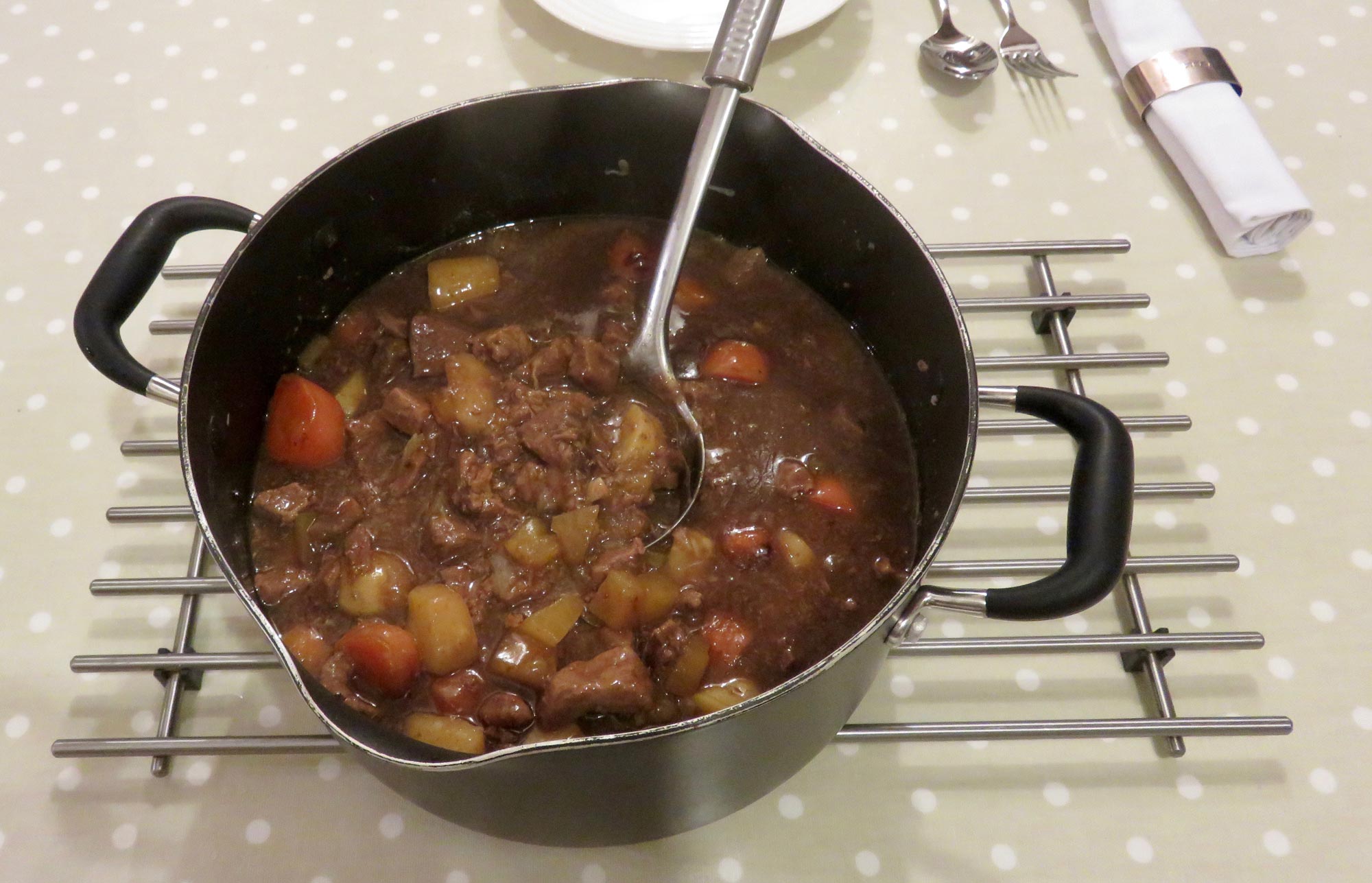
This evening we dined on Jackie’s delicious beef stew and mashed potato, with which she drank Hoegaarden and I drank Gilbert & Gaillard Chateauneuf du Pape 2014. We deserved it because the iMac is still playing up, and I could only post these pictures by e-mailing them in medium size to myself and putting them into WordPress from the Windows laptop. I couldn’t load them directly onto the laptop because I had deleted them from the camera on uploading them to the Mac. Well, it had worked well yesterday.
James Peacock brought back the cured iMac and checked everything was all plugged in and working well. He also worked out the CR2 format problem. This was because the camera was set to film in RAW mode, and CR2 is the format for that. I had not noticed it before because the Mac automatically converts to jpg for WordPress; whereas the Microsoft appears to please itself whether it does or not. Given Microsoft’s current advertising campaign in which a series of alleged Windows users work in the phrase “I couldn’t do that with a Mac” I wondered whether Apple would take this opportunity to retaliate with “Derrick couldn’t do that with his Windows”. I am up for negotiation. Interestingly, a set designer called Beowulf, in the first of these adverts, stated “I couldn’t do that with my Mac”. The “a” quite swiftly replaced “my”.
During the process of unravelling the CR2 issue, I nipped out and photographed the seemingly everlasting sweet peas. These are not, in fact, Lathyrus latifolius, but ordinary annuals which this year are thriving forever. Perhaps it is the sunshine and showers that keep them going.
The mashed potato served with Jackie’s bountiful beef stew this evening was as smooth as the main dish was packed with goodies. With this, the Culinary Queen drank Hoegaarden and I finished the madiran.
This frontispiece contains one of Philip Bannister’s excellent illustrations.
Although the term was not universally adopted until 1925, the Art Deco period had already begun in France by 1915, when Ford’s novel was first published. This, I imagine, is what inspired Bannister’s front cover design.
The author begins with ‘This is the saddest story I have ever heard’, but do not despair, the book is a perfectly constructed work demonstrating profoundly insightful characterisation, well-observed description and good story-telling written in flowing prose.
I will not reveal the story save to say that as a “tale of passion” it is of the suppressed kind, and is related by a close observer of humanity who has not, himself, experienced the “magnetism and passions” of such “splendid and tumultuous creatures” as the ill-fated protagonists of “the Ashburnum tragedy”. Dowell, the narrator, is convinced that in a world stifled by “conventions and traditions”, only the “normal” survive, and no-one, even they, gets what they want in life.
I found myself wishing that Henry James, an earlier American-born writer with an equally psychological bent, who died the year after this book’s publication, could have written rather less densely, and as apparently freely as Ford.
Julian Barnes has provided an interesting introduction to my Folio Society edition.
Here are a couple more of the illustrations.
This evening we dined at The Hare & Hounds in Sway. Jackie’s starter was prawn cocktail,
mine was whitebait in beer batter, served with brown bread and butter and salad.
We both enjoyed fish and chips as a main course,
and neither of us could manage a dessert. Jackie drank Amstel, and I drank Ringwood’s best.